
Alternatives to equity release: which costs less, and which suits you?
Quick answer: what are the alternatives to equity release?
Downsizing, a remortgage or retirement interest-only mortgage, savings or your pension, help from family, unclaimed benefits, council grants and renting out a room. Several cost less than equity release if your income or circumstances allow, and the FCA's rules make an adviser look at them first.
Why ask me about the alternatives?
Because checking them is part of my job, not a sales step. The FCA's rules say that before I recommend a lifetime mortgage I have to consider other ways you could raise the money, your benefits and your tax position, and if one of them suits you better, I'll tell you. I arrange lifetime mortgages across the whole market and retirement interest-only mortgages myself, and my colleagues at Pellucid, the same firm, arrange ordinary mortgages, so the borrowing routes can be compared in one place. I'm a member of the Equity Release Council, and it's me from the first call to completion. Trusted Equity Release is a trading name of Pellucid Ltd, authorised and regulated by the Financial Conduct Authority, FRN 981845.
“Had the pleasure of dealing with Jeremy on behalf of my mum for equity release on her home - if you want someone you can genuinely trust then don't go anywhere else! Jeremy is probably the most honest and genuine advisor that you will come across.”
Is there a better way than equity release?
It's a good idea for some people and the wrong one for a lot more. Aviva says it only suggests a lifetime mortgage for around a quarter of the people it speaks to. Equity release suits you when there's no income to spare for monthly payments, you want to stay in your home, and the cheaper routes below don't fit. It costs more than most of them because the interest compounds unless you pay it, it reduces what you leave, a lump sum can affect means-tested benefits, and repaying the whole plan early can bring a charge. Age UK puts it bluntly: a lifetime mortgage may work out more expensive in the long term than downsizing. The full list of advantages and disadvantages is on my page about the pros and cons of equity release.
Which alternative to equity release costs least?
It depends on your income more than anything. If you can make monthly payments, borrowing you pay as you go nearly always costs less than interest that rolls up. If you don't need to borrow at all, that's cheaper still. Here's how they compare:
| Alternative | What it needs from you | What it costs you | Debt left on the home |
|---|---|---|---|
| Downsizing | A move to a cheaper home | Stamp duty, legal and agent's fees, removals | None |
| Remortgage or further advance | Income to repay capital and interest, a term your age allows | Monthly repayments; the debt is cleared by the end | Falls to nothing |
| Retirement interest-only mortgage | Pension income to pay the interest for life | Monthly interest | The original loan |
| Secured loan (second charge) | Income for monthly repayments | Usually a higher rate than a first mortgage | Falls to nothing |
| Lifetime mortgage, paying the interest | Some spare income, but you can stop | Monthly interest while you pay it | The loan, plus any interest you didn't pay |
| Savings and investments | Money set aside | What it would have earned | None |
| Pension tax-free cash | A pension pot, usually from 55 | Less income later | None |
| Help from family | Family able and willing to help | Nothing, or a family loan | None, unless secured |
| Benefits you're not claiming | Being eligible | Nothing | None |
| Council grants for adaptations | A disability or age-related need | Possibly a contribution, depending on income | None |
| Renting out a room | A spare room and a lodger | Your privacy | None |
| Selling possessions, budgeting, part-time work | Things to sell, or time | Things you'd rather keep | None |
| Lifetime mortgage, nothing paid (equity release) | Age 55 and a home that qualifies | Interest that compounds | The loan plus rolled-up interest |
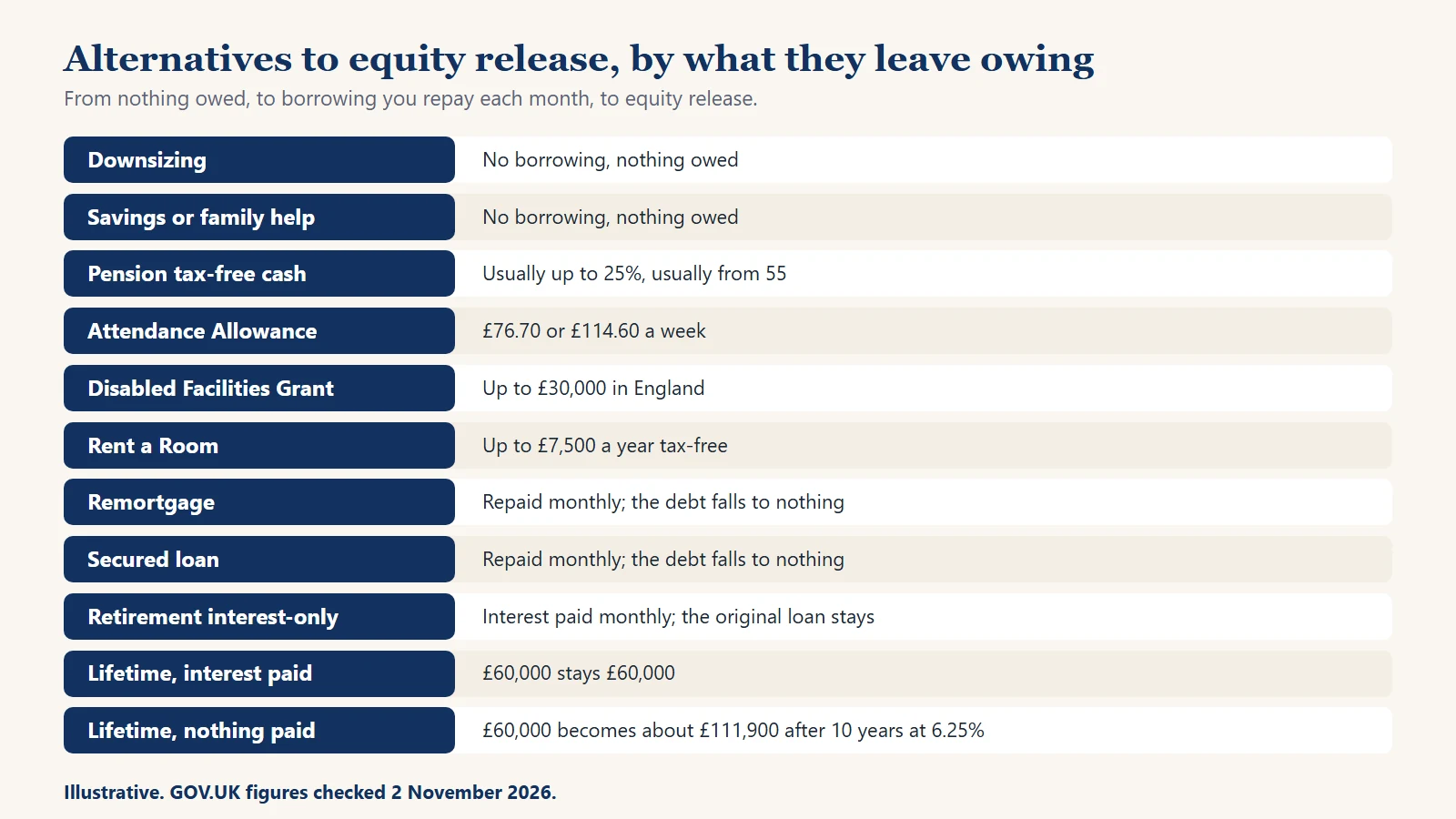
*Costs are what each route asks of you, not quotes. Figures for grants, benefits and Rent a Room are from GOV.UK, checked 2 November 2026.*
How do you choose the right alternative?
Start with three questions: what is the money for, how long does it need to last, and could you pay something each month? Those three rule most options in or out before a lender is involved.
| If this sounds like you | Look first at |
|---|---|
| You can comfortably make monthly payments | A remortgage, further advance or retirement interest-only mortgage |
| You need a one-off sum for adaptations because of a disability or age-related need | A Disabled Facilities Grant |
| You need more income each week and have care needs | Attendance Allowance and Pension Credit |
| You have a spare room and don't mind sharing | Renting out a room |
| The house is bigger than you need and you're open to moving | Downsizing |
| You have savings or a pension pot | Using those first, keeping an emergency reserve |
| Your family would rather help now than inherit later | A gift or a family loan |
| None of these fit and you want to stay put | A lifetime mortgage, ideally paying some interest or taking it in stages |
A lot of people end up combining two: claiming a benefit they'd missed and borrowing a smaller amount, for instance. Borrowing less is always the cheapest version of any loan.
Can you borrow against your home more cheaply than equity release?
Usually, if you can afford monthly payments. These are the borrowing routes, cheapest first in most cases.
A remortgage or further advance
You replace your mortgage with a bigger one, or borrow more from your current lender (a further advance), and repay capital and interest each month. Aviva notes the catch: you'll need to prove you can afford the repayments, and lenders' age limits make it harder for older borrowers. The big banks' limits run from 75 to 80 for when the mortgage must end, and some building societies go further. My page on equity release vs remortgage compares the two in detail, and lender by lender age limits are on my page about mortgages for over 50s.
A retirement interest-only mortgage
You pay only the interest each month, so the debt never grows, and the loan is repaid when the home is sold after death or a move into long-term care. MoneyHelper describes it as a home loan for older borrowers whose needs aren't met by a standard mortgage. The lender tests your pension income, and for a couple, usually whether the survivor could keep paying alone. I arrange them, though only occasionally, because a lot of applicants don't pass that test. How one works is on my page about retirement interest-only mortgages.
A secured loan
A second-charge loan lets you borrow against your home without disturbing your existing mortgage, with an affordability check and monthly repayments. The cost is usually higher than on a first mortgage, and your home is at risk if you don't keep up the payments. Money Saving Advisors notes they're generally used when remortgaging isn't practical, for example when your existing mortgage has an early repayment charge.
A lifetime mortgage where you pay the interest
This is the middle route a lot of comparisons miss. It's still equity release, but if you pay some or all of the interest each month, the debt grows slowly or not at all, and Equity Release Council plans must let you make repayments without a charge, within the lender's limits. Unlike a remortgage, you can stop paying if money gets tight, and nothing is missed. Here's what paying the interest does on £60,000:
| £60,000 at 6.25% | You pay each month | Owed after 10 years | Owed after 20 years |
|---|---|---|---|
| Nothing paid | £0 | about £111,900 | about £208,700 |
| Half the interest paid | £156.25 | about £86,000 | about £134,400 |
| All the interest paid | £312.50 | £60,000 | £60,000 |
*Illustrative only, at 6.25% a year compounded monthly, the rate in my equity release calculator. Your rate is fixed or capped for life and will be in your illustration.*
Does downsizing free up as much as people think?
Less than the gap between the two asking prices, but it's the only big-money route that leaves nothing owed. Selling a £350,000 home and buying a £250,000 one doesn't put £100,000 in your account: Bower lists stamp duty, solicitors' fees, the estate agent and, if you need one, a mortgage broker, and you'll have removals and usually some work on the new place too. The smaller home in the same town is often dearer than people expect, and moving further away takes you from the doctor, the shops and the friends who make later life easier.
Against that, downsizing settles the problem rather than postponing it, and smaller homes usually cost less to run. If you might downsize in a few years anyway, I'd rather you knew that before taking any loan, because repaying a lifetime mortgage early can bring a charge. Some plans can move with you to a smaller home; see can I move house?
Can the money come from somewhere other than your home?
Often, and it's quicker. These routes leave the house alone.
Savings and investments
Using savings first costs you only what they would have earned. The caution is to keep a reserve for repairs and care, because once it's gone the house is the only buffer left.
Your pension
GOV.UK says you can usually take money from your pension pot after you're 55, depending on your scheme's rules, and you can usually take up to 25% of it as a tax-free lump sum. The rest is taxed as income when you take it, and taking too much early leaves less to live on later, so it's worth guidance or advice before you draw on it.
Selling possessions or assets
A second car, jewellery, shares or a second property can raise a lump sum without any borrowing. Selling some assets can bring capital gains tax, so check before you sell anything valuable.
Help from family
Your children are, in effect, the ones paying the interest on any equity release, because it comes out of what they'd inherit, and a lot of them would rather help now. Aviva advises making it clear whether the money is a gift or a loan, and on what terms a loan will be repaid. Gifts can have inheritance tax consequences: GOV.UK says gifts made in the seven years before death may be taxed, though you can give away £3,000 a year free of inheritance tax. Put a family loan in writing, especially if there's more than one child.
What can you claim without borrowing at all?
More than people expect. Some of the shortfall that leads people to equity release can be claimed instead.
Benefits you may not be claiming
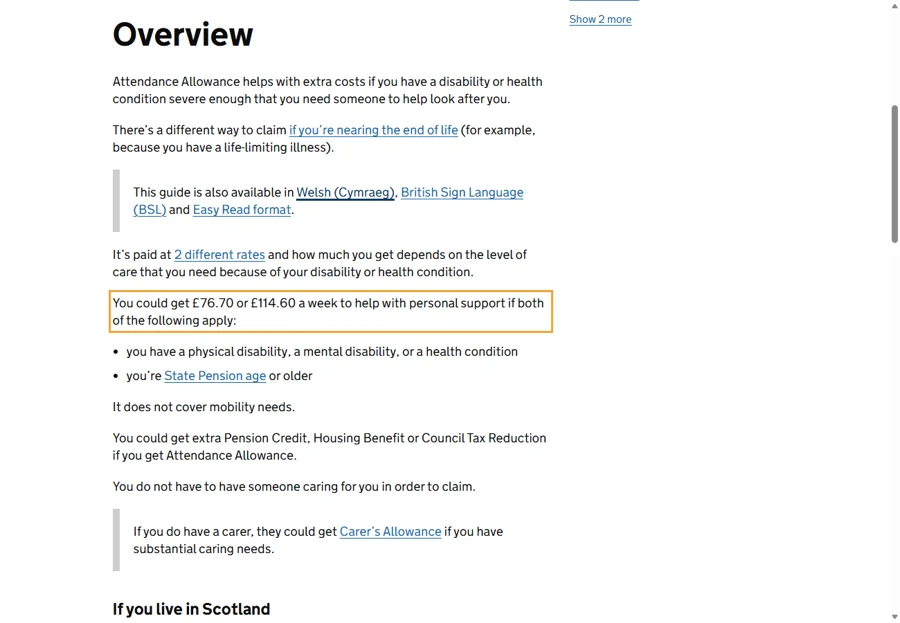
Attendance Allowance is paid to people of State Pension age who need help looking after themselves because of a disability or health condition: GOV.UK lists £76.70 or £114.60 a week, and you don't need to have a carer to claim. Getting it can also mean extra Pension Credit, Housing Benefit or Council Tax Reduction. GOV.UK points to independent, free and anonymous benefits calculators to check what you could be entitled to. It's the first thing I'd have you do.
One warning cuts the other way. Money released from your home counts as savings for means-tested benefits. GOV.UK says savings of £10,000 or less don't affect Pension Credit, but above that every £500 counts as £1 a week of income. Age UK lists Pension Credit and Council Tax Support among the benefits equity release can reduce.
Grants for adaptations and repairs
If the money is for ramps, grab rails, a stairlift, a level-access shower or a downstairs bedroom, a Disabled Facilities Grant from your council may cover it: up to £30,000 in England, and it won't affect any benefits you get. It depends on household income and savings over £6,000, and you shouldn't start the work before the council approves your application. For smaller repairs, Aviva suggests asking your local authority or a Home Improvement Agency.
Renting out a room
Under the Rent a Room Scheme you can earn up to £7,500 a year tax-free from letting furnished accommodation in your home, or £3,750 if you share the income with someone else. At that limit, £60,000 would take eight years to raise, so it suits regular bills better than a lump sum. Think hard about privacy before you advertise the room.
Budgeting and part-time work
Going through what comes in and what goes out costs nothing and sometimes closes the gap, and part-time work brings in income without debt, though earnings can affect means-tested benefits too.
What if the money is for care?
Then the alternatives change. A permanent move into a care home ends a lifetime mortgage, so equity release can only pay for care at home. For a care home, the council's deferred payment agreement pays the fees now and recovers them from your home later, so you don't have to sell in your lifetime. My page on equity release and care home fees goes through the options and the means test.
When is equity release still the right answer?
When it's the only way to raise the money without selling, and you want to stay in your home. If you can't pass an affordability check, a remortgage and a retirement interest-only mortgage are closed to you, and a lifetime mortgage asks nothing of your monthly income. Plans meeting Equity Release Council standards fix or cap the rate for life, let you stay in your home for life, can move with you and carry the no negative equity guarantee. Taking the money in stages through a drawdown lifetime mortgage means interest only runs on what you've drawn. How much you could release is typically 25% to 28% of the home's value at 55, 40% to 43% at 70 and 50% to 57% from 80.
None of that makes it cheap. I'd only recommend it once the routes above have been ruled out, and I'll show you, in writing, why each one was.
Why don't I offer home reversion as an alternative?
Because I don't arrange it. With home reversion you sell all or part of your home to a provider for less than its market value and live there as a tenant. It's legal and regulated, and a few people use it, but it doesn't fit how I want to work. If you'd like to know how it compares, my page on the types of equity release explains it.
How do I compare the alternatives with you?
It starts with a free phone call and costs nothing unless a plan completes.
Step 1: what the money is for
We start with the reason, the amount, and how long it needs to last. A one-off £15,000 for a new bathroom points somewhere very different from £300 a month for life.
Step 2: the free routes first
I check benefits, grants and whether family help is realistic before any borrowing is discussed, and I'll ask you to run a benefits calculator if you haven't.
Step 3: the borrowing routes your income allows
I look at whether a remortgage, further advance or retirement interest-only mortgage would work for a term your age allows. If a remortgage fits, my colleagues at Pellucid arrange it.
Step 4: equity release, only if it's still the answer
If it is, I compare lifetime mortgages across the whole market and recommend one in writing, with the reasons the cheaper routes didn't fit. My fee is fixed rather than a percentage, there's nothing to pay me unless the plan completes, and I'll tell you the figure on the phone.
FAQ
What is the cheapest way to get equity out of your house?
What is the best way to release money from your house?
Can I borrow against my house if I'm retired?
Is downsizing better than equity release?
Will a lump sum from my home affect my benefits?
Can my family lend me the money instead?
Final thoughts from me
What it comes down to:
- If you can make monthly payments, borrowing you pay as you go nearly always costs less than interest that rolls up.
- Downsizing leaves nothing owed, though the costs of moving eat into the gain.
- Attendance Allowance, Pension Credit, a Disabled Facilities Grant and the Rent a Room Scheme cost nothing to use.
- Paying some of the interest on a lifetime mortgage keeps the debt from growing as fast.
- Equity release earns its place when there's no income for payments and you want to stay put.
- FCA rules make an adviser check the cheaper routes before recommending anything.
Book your free initial consultation today.
Pick up the phone and speak to Jeremy directly. If equity release is not the right choice, I will say so.
07768 972861 Or try the quick calculator