
Home › Equity release › Best equity release companies
Reviewed September 2026Best equity release companies
If you're trying to work out the best equity release company, you're in the right place, with one warning from someone who deals with all of them: the honest answer is not a name. I compare these lenders every working week, and which one wins changes with your age, your property and what you want the plan to do.

- Member of the Equity Release Council
- SOLLA Later Life Lending Advice Standard
- Authorised and regulated by the FCA, FRN 981845
Quick answer: who is the best equity release company?
There is no single best, and any list that says otherwise is selling something. The floor is Equity Release Council membership with the no negative equity guarantee. Above that floor, the best company is the one whose rate and features fit your case, which is what advice is for.
Why speak to Trusted Equity Release about choosing a company?
Because I am independent and whole of market: I compare equity release plans across every lender, so these companies compete for my clients' cases, not the other way round. I have specialised in later-life lending since 2009, I am a member of the Equity Release Council, and I hold the SOLLA Later Life Lending Advice Standard. Trusted Equity Release is a trading name of Pellucid Ltd, authorised and regulated by the Financial Conduct Authority, FRN 981845.
Asking me which company fits your case costs you nothing. Email me, request a printed brochure, or get in touch on the number at the top of this page.
Who are the equity release companies?
The lenders I compare include Aviva, Canada Life, Just, Legal & General, LiveMore, LV=, more2life, Pure Retirement, Riverton and Royal London. All of them are Equity Release Council members, which you can check yourself on the Council's register.
Two things about that list. First, it is lenders, the companies whose plan you would actually hold; the adviser who chooses between them is a separate decision, covered below. Second, the household names you might expect are missing for a reason: the high-street banks do not offer equity release at all.
How should you judge an equity release company?
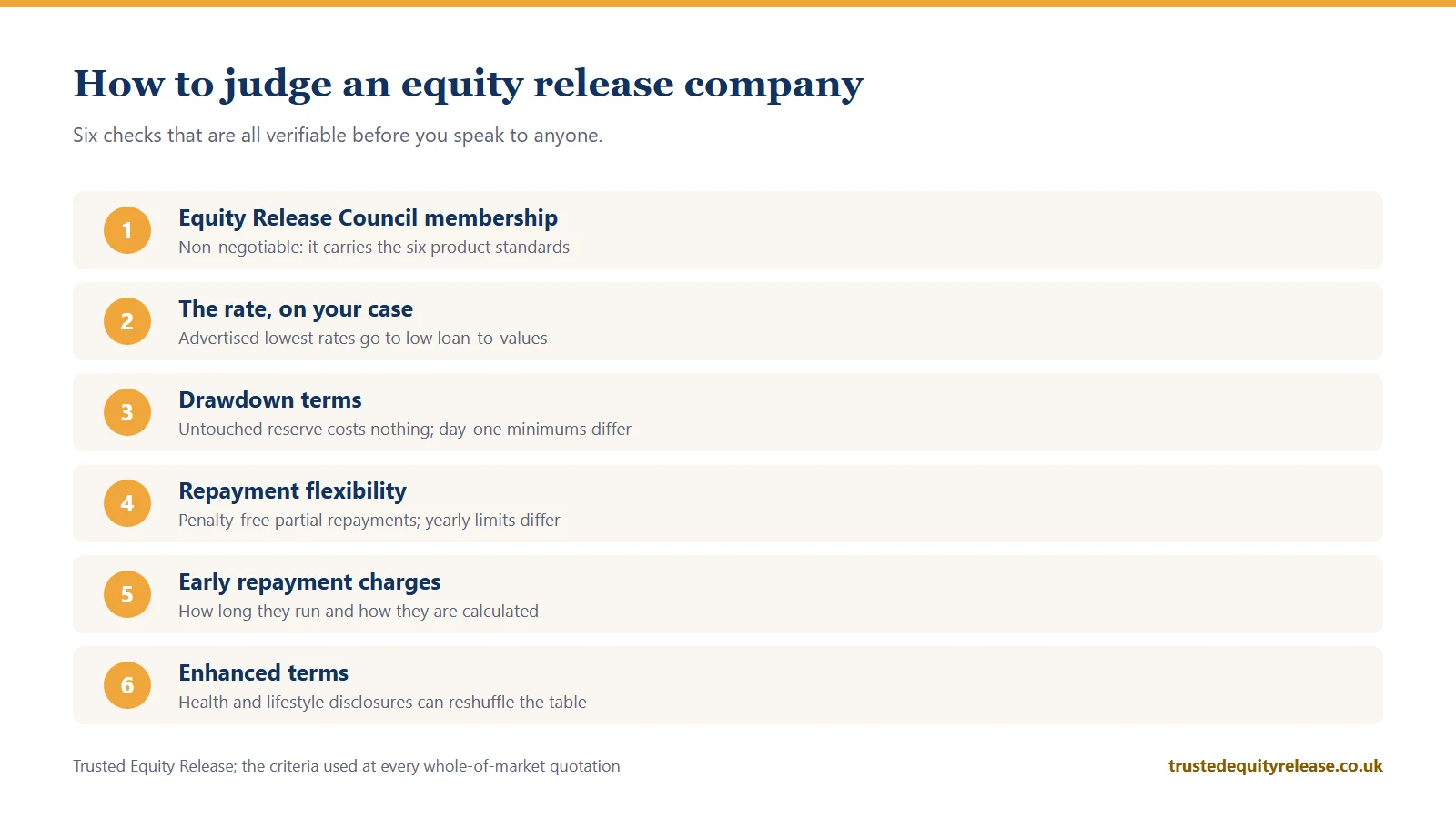
Six checks, all of them verifiable:
- Equity Release Council membership. Non-negotiable. It carries the six product standards, including the no negative equity guarantee.
- The rate, on your case. Advertised lowest rates go to low loan-to-values; the rate YOU are offered is the only one that matters.
- Drawdown terms. How much must you take as the day-one lump sum, and what does the reserve cost? On a drawdown lifetime mortgage the untouched reserve costs nothing, and the differences between equity release plans here are large.
- Repayment flexibility. Every Council plan allows penalty-free partial repayments since March 2022; lenders differ on how much per year.
- Early repayment charges. How long they run and how they are calculated, in case life changes.
- Enhanced terms. Some lenders improve the offer for health and lifestyle disclosures; some do not. This alone can reshuffle the whole table.
One example of why features beat headlines: Aviva lets you repay up to 10% of the borrowed amount each year without penalty, from a £50 minimum, and offers downsizing protection after three years. On the right case that outweighs a slightly cheaper rate elsewhere; on the wrong case it is irrelevant. That trade is the whole job. My independent Aviva review shows the method on one lender in full.
Companies vs advisers: which are you actually choosing?
Both, and the order matters. The lender makes the plan; the adviser decides which lenders even reach your shortlist. Choose a tied or single-lender adviser and the "best company" question has been answered for you before you sat down, whatever the answer should have been. Whole-of-market equity release advice exists precisely so the comparison is real. Advice is not optional in this market: FCA rules require it on every plan.
What percentage do equity release companies take?
None. Equity release is a loan, not a sale: the company charges interest on what you borrow rather than taking a share of your home. In September 2026 advertised lifetime rates run from about 6.25% MER at the lowest to just over 10.5% at the top of the market; the full picture, updated monthly, is on my equity release interest rates page. The other costs are one-off: valuation, your own solicitor, and advice fees, all confirmed in writing before anything proceeds.
Is equity release a rip-off?
The regulated product is not; the compounding is simply real. Make no repayments and the debt grows, exactly as a written illustration will show you before you sign, and that is why for every £1 released each year, households aged 55 and over hold £852 of housing wealth: most people look, understand the cost, and leave it. The scale of that caution is in my equity release statistics. The rip-off era of pre-standards plans is what the Council's rules were built to end, and a plan outside those rules is the thing actually worth avoiding.
FAQ
Who is the biggest equity release provider in the UK?
How much does a solicitor charge for equity release?
Are smaller equity release companies safe?
Sources
Book your free initial consultation today.
Pick up the phone and speak to Jeremy directly. If equity release is not the right choice, I will say so.
07768 972861 Or try the quick calculator