
Can you buy a house with a lifetime mortgage?
Quick answer: can a lifetime mortgage help you buy a home?
Yes. A lifetime mortgage can pay for part of a new home from age 55, secured on the home you're buying. The sale of your current home or your savings covers the rest. Nothing has to be paid monthly, but unpaid interest compounds and reduces what you leave.
Why ask me about buying with a lifetime mortgage?
Because a purchase has a completion date, and the money has to be there on the day. I come to your home before you start viewing, I'll help with the application forms, and it's me from the first call to completion, so there's one person to ring when the chain wobbles. I've advised on later-life lending since 2009, I hold CeMAP, CERT CII (ER) and the SOLLA Later Life Lending Advice Standard, and I'm a member of the Equity Release Council. Trusted Equity Release is a trading name of Pellucid Ltd, authorised and regulated by the Financial Conduct Authority, FRN 981845.
“He thoroughly explained all options and even assisted my gran with completing complex application forms. Within a week of the initial visit, my gran secured funding from a reputable lender.”
What is a lifetime mortgage, and how is it different when you're buying?
A lifetime mortgage is a loan secured on your home that you don't have to repay in your lifetime. It's repaid, with the interest that has built up, when the last borrower dies or moves permanently into long-term care, usually from the sale of the home. You stay the legal owner throughout.
Most people use one on the home they already live in. Buying is the same product pointed at a different house: as Aviva puts it, you sell your current home, pay off any outstanding mortgage and buy the new one at the same time, with the lifetime mortgage secured on the new home. The full explainer is on my lifetime mortgages page.
| Standard residential mortgage | Lifetime mortgage used to buy | |
|---|---|---|
| Who can apply | Adults, within the lender's age limit at the end of the term | From 55, both of you if it's joint |
| How much you can borrow | Set mainly by your income | Set by the youngest buyer's age, the home's value and sometimes your health |
| Monthly payments | Required, capital and interest | None required; you can choose to pay interest |
| When it ends | At the end of the term | When the last borrower dies or moves into long-term care |
| What the debt does | Falls to nothing | Grows unless you pay the interest |
| Who owns the home | You | You |
Who does buying with a lifetime mortgage suit?
It suits people over 55 who need part of the price but can't, or don't want to, take on monthly repayments. It tends to fit situations like these:
- Moving closer to family, where the new area costs more than the old one.
- Buying after a bereavement or a divorce, when one person needs a home on one income, or none.
- Moving to a bungalow or somewhere easier to manage, where the price gap catches people out.
- Cash buyers who are a little short, or who'd rather keep some savings back for furnishing or adapting the new home.
- People whose pension wouldn't pass a bank's income test, which a standard mortgage needs for the whole term.
One real case of mine fits the second of those: a grandmother who had recently lost her husband and wanted to buy her new home while probate on his estate was stuck. More on how that went below.
It doesn't suit you if your income comfortably covers a normal mortgage. That nearly always costs less, because you pay the interest as you go.
How does buying a house with a lifetime mortgage work, step by step?
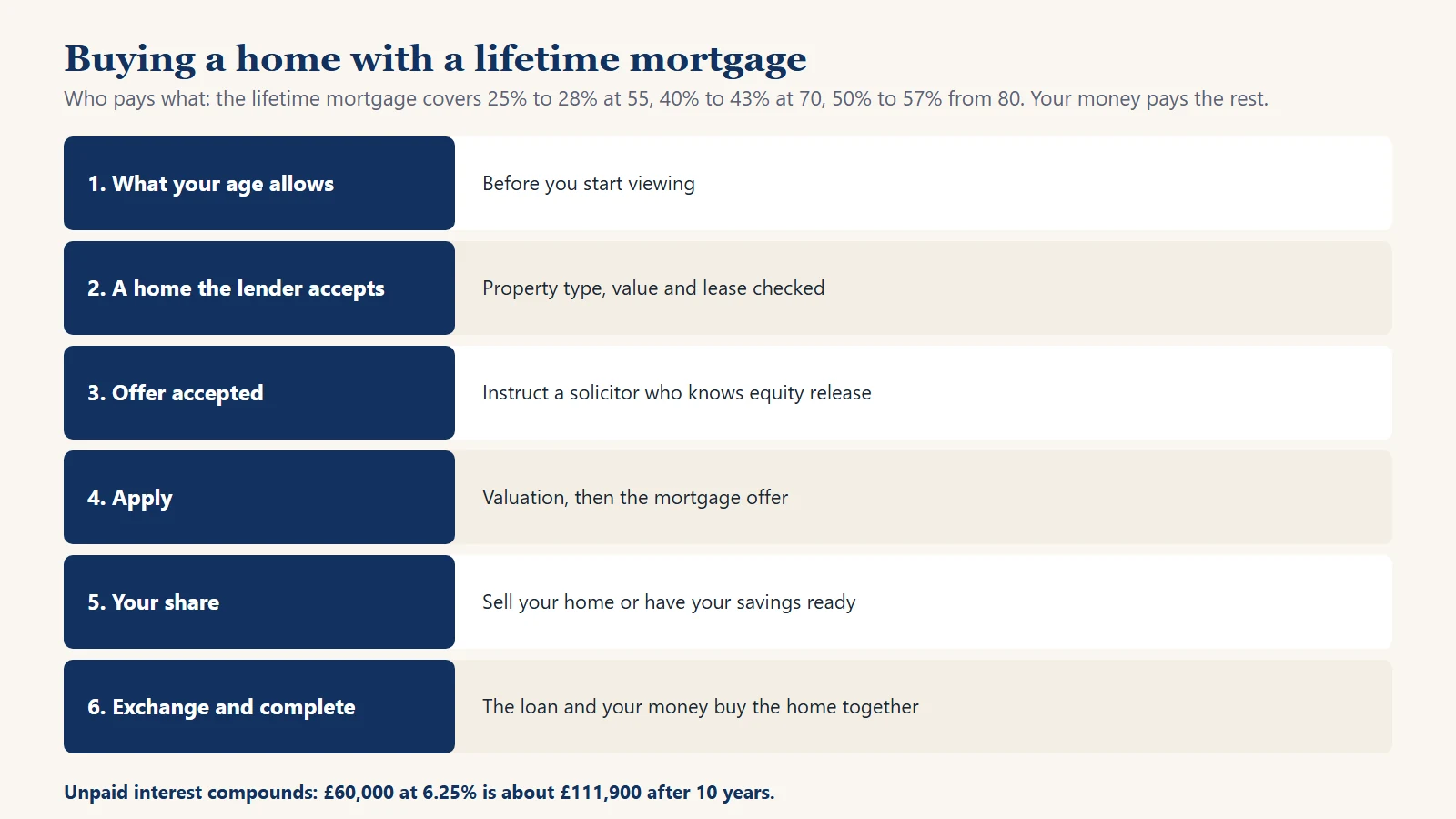
Much like any purchase, except part of the price comes from a lifetime mortgage on the home you're buying. These are the six steps, in the order they happen.
Step 1: Find out what your age allows before you start viewing
How much a lifetime mortgage can put towards the price depends mainly on the youngest buyer's age, then on the home's value and sometimes on your health. Typical shares of the price:
| Youngest buyer | Lifetime mortgage share of the price | Share you fund from your sale or savings |
|---|---|---|
| 55 | 25% to 28% | 72% to 75% |
| 70 | 40% to 43% | 57% to 60% |
| 80 and over | 50% to 57% | 43% to 50% |
Typical ranges, not an offer. Work backwards from the money you'll have from your sale or savings and you have a realistic price range before you fall for a house. My equity release calculator gives the figure for your age. This first conversation is free, and I can do it at your kitchen table or on the phone.
Step 2: Find a home the lender will accept
The lender lends against the house as well as you, so the house has to meet its rules: the type of property, how it's built, its value and, for a flat, the length of the lease. Minimum values vary from lender to lender. If you've seen somewhere specific, give me the address before you make an offer and I'll check it against the lenders who'd consider it. Finding out after a survey that no lender wants the house is the expensive way round.
Step 3: Make your offer and instruct a solicitor who knows equity release
Once your offer is accepted, you'll need a solicitor. Equity release needs independent legal advice: the Equity Release Council says all customers must receive it. I recommend a firm that does equity release day in, day out. The choice stays yours, but a general high street firm that rarely does these is the commonest way a purchase like this slows down.
Step 4: Apply, have the home valued and receive the offer
I put the application together with you and submit it. On a standard roll-up plan the lender doesn't need to see your income, only that you meet its age rules for the amount you've asked for. The lender then sends a valuer to the property. If the valuation comes in below the price you've agreed, the loan shrinks with it, because it's a share of the value, so have a plan for that gap. After the valuation, the lender issues a mortgage offer to you and your solicitor. Offers carry an expiry date, so a purchase that drags may need the offer reissuing.
Step 5: Sell your current home, or get your own money ready
Your share of the price usually comes from selling the home you're in, so the two sales normally run together and complete on the same day. Any mortgage on your current home is paid off from that sale. If your share is coming from savings instead, it goes to your solicitor before completion.
Step 6: Exchange contracts and complete
When the legal work is done, your solicitor exchanges contracts, and from then you're committed. On completion day your solicitor receives the lifetime mortgage funds and the money from your sale or savings, pays the seller, and pays stamp duty for you as on any purchase. You become the legal owner, with the lifetime mortgage secured on your new home.
How long the whole thing takes depends far more on the chain than on the lifetime mortgage. My page on how long equity release takes breaks down each stage.
What can go wrong when you buy with a lifetime mortgage?
Mostly the same things that go wrong with any purchase, plus one or two that are particular to this. A low valuation cuts the loan. A chain that collapses can run you past the offer's expiry date. And money can arrive from somewhere else mid-way, which is fine, as long as you tell me.
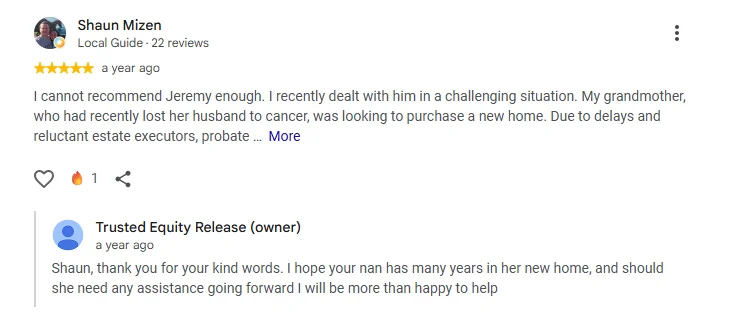
That's what happened in the grandmother's case. Her grandson contacted two firms; I met her and her daughter, with him joining by phone from another county, and I sat with her twice. She had a wobble along the way, stopped, then started again. Funding came through from the lender within a week of that first visit. Then probate was granted, she no longer needed the loan, and I cancelled the application for her, with no cancellation fee. You pay me nothing unless the plan completes.
How much interest builds up on a lifetime mortgage used to buy a house?
More than people expect, because interest is charged on interest. On my calculator's figures, at 6.25% a year compounded monthly, with nothing repaid:
| Borrowed towards the purchase | After 5 years | After 10 years | After 20 years |
|---|---|---|---|
| £60,000 | about £81,900 | about £111,900 | about £208,700 |
| £60,000, with all the interest paid monthly (£312.50 a month) | £60,000 | £60,000 | £60,000 |
Illustrative only. The loan and that interest come out of the home's sale, which is what your family would otherwise inherit. You can choose to pay some or all of the interest to stop the balance growing: I can arrange plans where you pay from £50 a month, or 25%, 50%, 75% or 100% of the monthly interest.
What are the benefits and drawbacks of buying with a lifetime mortgage?
The main benefit is that your income doesn't decide what you can borrow. The main drawback is the cost over time. Side by side:
| Benefits | Drawbacks |
|---|---|
| No income test on a roll-up plan | Unpaid interest compounds, so the debt grows |
| Nothing has to be paid monthly | Less to leave your family |
| Rates are fixed, or capped, for life on plans meeting the Equity Release Council's standards | Early repayment charges if you repay early |
| You own the home and can stay for life | The money can affect means-tested benefits |
| You can pay interest or capital if you want to | Rates are usually higher than a standard mortgage |
| You keep any rise in the home's value | The property has to meet the lender's rules as well as you |
The pros and cons of equity release go into each of these in more depth.
What protections do you get when you buy with a lifetime mortgage?
The same as any lifetime mortgage that meets the Equity Release Council's standards:
- The no negative equity guarantee: you or your estate will never owe more than the home is worth, after reasonable selling costs.
- A home for life: you can live there for the rest of your life, or until you move permanently into care, as long as it stays your main residence.
- The right to move: you can move to a suitable home and take the plan with you, subject to the lender's criteria at the time.
- Fixed interest, or a variable rate with a fixed cap, for the life of the loan.
- The ability to make repayments without charges, subject to the lender's criteria.
- Independent legal advice from your own solicitor.
What that guarantee means for your family is on my page about whether your family will end up in debt.
Can you move an existing lifetime mortgage to the house you're buying?
Often, yes. If you already have a lifetime mortgage, you may be able to take it with you rather than start again, if the new home meets the lender's criteria at the time. If the new home is worth less, you may have to repay part of the loan. Some lenders offer downsizing protection: Aviva, for example, may let you repay in full without an early repayment charge if you've had the plan three years or more and the new home doesn't meet its criteria, usually because it's worth less. My page on moving house with equity release covers the rest.
What are the early repayment charges if you sell the new house later?
If you repay the whole plan early, by selling and not moving the plan, or by switching lenders, an early repayment charge can apply. How it's worked out and how long it lasts are set out in your offer, and they vary between lenders, so it's something I go through with you before you choose a plan. There's no early repayment charge when the plan is repaid after death, or on a permanent move into long-term care with a plan meeting the Council's standards. Every Council-standard plan also lets you make repayments without a charge, subject to the lender's criteria.
Can you use equity release to buy a property abroad or a buy-to-let?
Yes, in both cases, but the lifetime mortgage stays on your UK home and the cash does the buying.
- Abroad: you release money from your main home and use it to buy the property overseas. Aviva notes you'll face the same costs as any second home, plus exchange rates and local laws.
- Second home or holiday home: you'll still need to live in your main home for at least six months of the year, Aviva says, and stamp duty applies to the second property.
- Buy-to-let: not every lender will lend for one (Aviva doesn't), and you may pay tax on the rental income.
The rules differ enough to need their own page: second homes and buy-to-let.
Can you get a lifetime mortgage at 60?
Yes. Lifetime mortgages start at 55, so at 60 you qualify on age, and on a joint purchase the youngest of you sets the amount. At 60 the share of the price will be towards the lower end of the table above, so your own money does more of the work. Some lenders offer plans from 50 where you make monthly payments; my page on equity release at 50 explains those.
What are the alternatives to buying with a lifetime mortgage?
There are four worth comparing before you commit:
| Alternative | When it fits | The catch |
|---|---|---|
| A standard residential mortgage | Your income covers repayments for a term inside the lender's age limit | Age limits and income tests get harder after 60 |
| A retirement interest-only mortgage | Your pension covers the interest, not the capital | Lenders usually test the survivor's income alone |
| Buying somewhere cheaper | The gap is small | You may not get the area or the home you wanted |
| Family help with the purchase | Someone can gift or lend part of the price | Their money, and possibly their tax position, are involved |
If your pension can carry the interest, a retirement interest-only mortgage usually costs less than a lifetime mortgage, because the debt doesn't grow. More options are on my page about alternatives to equity release.
FAQ
Can you buy a house with equity release if you have no income?
Can two people buy a house together with a lifetime mortgage?
Do you need a deposit to buy with a lifetime mortgage?
Can you pay off a lifetime mortgage early if you sell?
Does a lifetime mortgage affect stamp duty?
Final thoughts from me
What I'd want you to take away:
- A lifetime mortgage can pay for part of a new home from 55, with your sale or savings covering the rest.
- The youngest buyer's age sets the share, from about a quarter at 55 to around half from 80.
- There's no income test on a roll-up plan, but unpaid interest compounds: £60,000 becomes about £111,900 in ten years.
- You can pay some or all of the interest to stop the balance growing.
- The plan can usually move with you later, subject to the lender's criteria.
- If your income can carry a standard or retirement interest-only mortgage, that usually costs less.
Sources
- Aviva: releasing equity to buy another property
- Equity Release Council: product standards
- Shaun Mizen, Google review
- Trusted Equity Release equity release calculator
Book your free initial consultation today.
Pick up the phone and speak to Jeremy directly. If equity release is not the right choice, I will say so.
07768 972861 Or try the quick calculator