
Home › Where I work › Peterborough
Home-visiting equity release adviser for Peterborough: who comes to you?
If you're looking for an equity release adviser in Peterborough who will come and sit down with you at home, you're in the right place. I'm Jeremy Furnell, a whole-of-market later-life adviser based just outside March, 14 miles from the city centre, so Peterborough is one of the nearest places I visit.

- On the FCA register, reference JLF01060 check the register
- Pellucid Ltd, FCA number 981845 check
- Equity Release Council member my profile
- SOLLA Later Life Lending Advice Standard
Quick answer: who will come to my home for equity release advice in Peterborough?
I will. I'm an Equity Release Council member living near March, 14 miles from Peterborough, and I visit homes across the city and its villages, from Werrington to Yaxley. The first conversation is free, and you pay me nothing unless your plan completes.
Why speak to Jeremy about equity release in Peterborough?
Because the person you ring is the person who visits, recommends, helps with the forms and sees it through to completion. There's no call centre and no hand-off to an administrator. I've worked in financial services since 1996 and in later-life lending since 2009. I hold CeMAP and CERT CII (ER) and the SOLLA Later Life Lending Advice Standard, and I'm a member of the Equity Release Council, which since April 2026 has meant passing an exam every year to stay in. I compare plans from the lenders I work with, and I explain them in plain English.
I'm a Fenman, and I'll talk to you at a level we both understand rather than over your head. Trusted Equity Release is a trading name of Pellucid Ltd, authorised and regulated by the Financial Conduct Authority, FRN 981845.
“Would not hesitate to recommend this Company. Professional, honest and always available to help at any point of the procedure. Would absolutely recommend them to anyone needing their services”
Will you come to my home, or can we talk by phone or video?
I'll come to you; that's how I prefer to work. I'd rather put the illustration in your hands on paper at your own table than email you a PDF. You can't build much of a relationship over a video link.
| How we talk | What it's for |
|---|---|
| Home visit | The fact-find, the recommendation and the paperwork, with family welcome |
| Phone call | The first conversation and quick questions; family can join from wherever they live |
| Video | Only if you'd prefer it. I'm happier on the phone, and I won't pretend otherwise |
My listed hours run to 7.30pm on Mondays, Tuesdays, Thursdays and Fridays, to 5pm on Wednesdays, and 9am to 12.30pm on Saturdays.
How does equity release work?
You borrow against your home and stay living in it, with nothing to repay until the house is sold. The plan I arrange is a lifetime mortgage, available from age 55. You remain the owner, there are no compulsory monthly payments, and the loan plus the interest that's built up is repaid from the sale when the last of you dies or moves into long-term care.
There are three ways to take the money. A lump sum pays everything at once, which suits clearing a mortgage or a big one-off cost. A drawdown plan pays a smaller first amount and keeps a reserve you can draw on later; you pay interest only on what you've taken. And you can combine the two. A lot of plans also let you pay some or all of the interest each month, or ring-fence part of the home's value as an inheritance.
The other type of equity release is home reversion, where you sell part or all of your home to a provider. I advise only on lifetime mortgages, and I'm happy to explain the difference. Reversion is rare: FCA figures show 25 sales across the four years 2022 to 2025, against around 27,000 lifetime mortgages sold in 2025 alone, which you can see on my equity release statistics page. The detail of how lifetime mortgages work, and what I check, is on its own page.
Is equity release safe?
Yes, in the ways that protect your home. It can only be arranged with advice, and the FCA's rules list what an adviser must weigh first: your benefits, tax, health, cheaper alternatives and what you want to leave. Equity Release Council members' lifetime mortgages must also meet these product standards:
| Standard | What it means for you |
|---|---|
| Fixed or capped rate | The rate is fixed, or capped, for the life of the loan |
| Home for life | You can stay for the rest of your life, or until you move into long-term care |
| Option to move | You can take the plan to a new home that meets the lender's criteria |
| No negative equity guarantee | You never owe more than the home sells for |
| Penalty-free partial repayments | You can pay some back without a charge, within the lender's limits |
| Independent legal advice | Your own solicitor explains the plan before it completes |
You can check me on the FCA register under Pellucid Ltd, FRN 981845. There's more on how safe lifetime mortgages are.
What is the bad side of equity release?
The debt grows, and your family inherits less. That's the honest headline, and there are three other costs worth knowing before you go near an application:
| The downside | What it means | What softens it |
|---|---|---|
| Compound interest | With nothing paid, the debt roughly doubles in about eleven years at 6.25% | Paying some interest, partial repayments, or drawdown |
| A smaller inheritance | The loan and interest come out of the sale | Inheritance protection, or involving family from the start |
| Means-tested benefits | A lump sum held as savings can reduce benefits such as Pension Credit | Drawdown, so you only hold what you need |
| Early repayment charges | Paying the plan off early can bring a charge | Check how long it lasts and when it doesn't apply, before you sign |
None of these is hidden, and every one should be in front of you, in figures, before you decide. If they outweigh what the money would do for you, I'll say so.
What are the common equity release myths, and what's actually true?
A few beliefs about equity release come up again and again, and a lot of them are out of date:
| What people have heard | What's actually true |
|---|---|
| "You can end up owing more than the house is worth" | Not with an Equity Release Council plan: the no negative equity guarantee stops that |
| "You have to make monthly payments" | No. Paying interest is optional |
| "The lender owns your house" | Not with a lifetime mortgage: you stay the owner. Home reversion is different |
| "You can't do it if you still have a mortgage" | You can, if the release is big enough to clear it |
| "You can't leave anything to the family" | You leave less, but inheritance protection and partial repayments can keep a share safe |
| "You can never move house" | You can take the plan to a new home that meets the lender's criteria |
| "Once you apply, you're committed" | You can stop any time before completion without owing the lender anything |
Why are equity release rates higher than a normal mortgage?
Because the lender takes on more. It gets nothing back until the house is sold, which could be decades away, and it carries the no negative equity guarantee if the sale doesn't cover the debt. That's built into the price. The gap matters more than it looks, because the interest compounds. You can see what lenders are charging this month before we speak.
What do people in Peterborough use equity release for?
Whatever they like; once it's released, it's yours. The money is tax-free, though a lump sum can affect means-tested benefits. These are the reasons I see, and what I look at for each:
| What the money is for | What I check first |
|---|---|
| To pay off existing debts or a residential mortgage | Whether the release clears it all, and whether a retirement interest-only mortgage would cost less |
| To fund home improvements or adapt your home so you can continue living there | Whether drawdown would mean borrowing less up front |
| To add to your retirement income for day-to-day living costs | The effect on any means-tested benefits |
| To help children or grandchildren with a 'living inheritance', usually used for housing costs, a wedding or education | The tax position of gifts, and fairness between children |
| To go on holiday or travel more | Taking only what you need, when you need it |
| To fund care at home or private medical bills | How long the money has to last |
If gifting is part of the plan, I'll go through whether you pay tax on equity release before any money changes hands.
Is there a better way than equity release?
Sometimes, and I check before I recommend a lifetime mortgage. Equity release is Marmite: some people love it and some hate it, and neither is wrong. What matters is whether something cheaper would do the job for you.
| Option | When it can beat equity release | What to watch |
|---|---|---|
| Downsizing | You're open to moving, and a smaller home frees enough | Moving costs and stamp duty eat into the gain |
| Retirement interest-only mortgage | Your pension comfortably covers the monthly interest | From age 50, but hard to get; I place them only occasionally |
| Savings | The sum is small and your savings can cover it | Keep an emergency fund |
| Family help | Someone can lend or gift what you need | Put it in writing |
| Benefits you aren't claiming | A benefits check finds income you're missing | Costs nothing to ask |
To put downsizing in Peterborough terms, purely as an illustration: selling at the city's July 2026 average detached price, £377,346, and buying at the average semi-detached price, £241,846, frees about £135,500 before moving costs, with no interest to pay. If you'd be happy to move, that often beats borrowing. I've set out the alternatives I weigh first, and the retirement interest-only mortgage has its own page.
How does the equity release process work, step by step?
Eight steps from the first call to the money. The advice stage runs at your pace with no deadline. From the application going in, four to eight weeks to the money is normal for a lifetime mortgage. You'll see longer estimates quoted, ten weeks on one site in this search; that can happen when the legal stage drags, which is why the solicitor matters so much.
| Step | Who does the work | Typical time |
|---|---|---|
| 1. First phone call | You and me | One call |
| 2. Home visit and fact-find | You and me, family welcome | Booked to suit you |
| 3. Recommendation and illustration | Me | Days, at your pace |
| 4. Application | Me, with you | The week you decide |
| 5. Valuation | Lender's surveyor | Within 1 to 2 weeks |
| 6. Offer | Lender | Days after the valuation |
| 7. Independent legal advice | Your solicitor | 2 to 4 weeks |
| 8. Completion | Lender and solicitor | Money same or next working day |
Step 1: the free first call
We talk through your age, roughly what the house is worth, any mortgage left and what the money is for. That tells me whether I can help. If equity release plainly isn't right, you'll hear it from me on that call, and it costs you nothing.
Step 2: the visit to your home
I come to you in Peterborough for the full fact-find: income, benefits, health, debts and what you'd like to leave. Family are welcome at the table or on the phone. Have your ID, a recent council tax bill and any mortgage statement ready, because missing paperwork is what slows cases later.
Step 3: my recommendation and the illustration
I search the whole market and bring back a written recommendation with the lender's Key Facts Illustration, which shows the rate, the fees and how the debt grows. I'd rather go through it with you in person. If my answer is an alternative, or "not yet", that's what the recommendation says.
Step 4: the application
When you decide, I send the application, usually that same week, and I'll fill in the forms with you. Mention any health conditions now: some lenders offer better terms for them, and late disclosure can mean starting again.
Step 5: the valuation
The lender's surveyor visits, normally within one to two weeks. If the figure comes in lower than expected, the offer is reworked, and we talk it through before going any further.
Step 6: the offer
The formal offer usually follows within days. It has a validity period, so from here I keep the lender and the solicitors moving.
Step 7: independent legal advice
Your solicitor explains the plan and its effect on your estate before you sign. I can recommend a firm that does equity release every day, and the choice is yours. A solicitor who rarely handles these is the commonest reason I see a case slow down. Allow two to four weeks.
Step 8: completion
The lender sends the money to your solicitor, who clears any mortgage and pays you the balance, normally the same or the next working day. I'm still your adviser after that, for the life of the plan.
Up to completion you can stop without owing the lender anything. I once cancelled an application for a grandmother who'd arranged it to buy her new home while probate was stuck; when probate came through she didn't need the loan, and there was no cancellation fee.
What is the typical cost of an equity release in the UK?
There's no single figure, because several people are paid and the biggest cost, the interest, depends on how long the plan runs. Here's everything to budget for:
| Cost | Paid to | When | What to ask |
|---|---|---|---|
| Advice | The adviser, by fee or as lender commission | On completion | "How are you paid, and how much?" |
| Legal fee | Your solicitor | On completion | "Is it a fixed price?" |
| Valuation | The lender's surveyor | Before the offer | "Does this lender charge one?" |
| Arrangement or completion fee | The lender | On completion | "Can it be added to the loan?" |
| Interest | The lender | Added each month unless you pay it | "What will I owe after 10 and 20 years?" |
| Early repayment charge | The lender | Only if you repay early | "How long does it last?" |
How I'm paid is simple. The first conversation is free, and you pay me nothing unless your plan completes. My fee is fixed, not a percentage of what you borrow, it can be taken from the money released, and it covers you for the life of the plan, so you can still ring me in fifteen years. I'll tell you the figure on the phone, and the whole cost, solicitor included, before you commit.
Is a "no broker fee" adviser cheaper?
Not necessarily. Some advisers don't charge you a fee because the lender pays them commission instead. That's a fair way to work, but the adviser is still paid. Ask any adviser, me included, how they're paid and how much, whether they search the whole market, and whether the same person will see your case through. My answers: a fixed fee, whole of market, and me from start to finish.
How fast does a lifetime mortgage debt grow, and how do you slow it?
Faster than it feels at the start. This is my calculator's example, with nothing paid back, at September 2026's lowest advertised rate:
| £60,000 at 6.25% a year, nothing repaid (illustration) | Owed |
|---|---|
| At the start | £60,000 |
| After 10 years | about £111,900 |
| After 15 years | about £152,800 |
| After 20 years | about £208,700 |
Three things slow it. Paying some or all of the interest each month keeps the debt level. Penalty-free partial repayments, within the lender's limits, chip it down when you have spare money. And drawdown means you only pay interest on what you've actually taken.
What are homes in Peterborough worth, and what could that mean at my age?
Land Registry's figures for July 2026 put the average Peterborough home at £233,745, about 0.6% lower than a year earlier. By type:
| Type of home, City of Peterborough | Average price, July 2026 |
|---|---|
| Detached | £377,346 |
| Semi-detached | £241,846 |
| Terraced | £190,077 |
| Flat or maisonette | £112,099 |
| All homes | £233,745 |
Older homeowners hold a smaller share of the city's housing wealth than its neighbours. In 2021, households headed by someone 65 or over held 31.5% of Peterborough's owner-occupied housing value, against 36.2% across England and Wales. The numbers are still large: 13,448 of those households own outright, more than in the whole of Fenland.
| Area | Over-65s' share of housing value, 2021 | Over-65 households owning outright |
|---|---|---|
| Peterborough | 31.5% | 13,448 |
| Fenland | 41.9% | 11,050 |
| Huntingdonshire | 36.5% | 17,804 |
| South Kesteven | 39.9% | 15,600 |
| South Holland | 42.4% | 10,846 |
That's my own analysis of the 2021 Census and Land Registry prices; the method is on my housing wealth page.
What you could release depends on the youngest owner's age. To show what the typical lender maximums mean in pounds, here they are on Peterborough's average prices by type. This is an illustration, not an offer and not a figure for your home:
| Youngest owner's age | Typical maximum | Terraced (£190,077) | Semi-detached (£241,846) | Detached (£377,346) |
|---|---|---|---|---|
| 55 | 25% to 28% | about £48,000 to £53,000 | about £60,000 to £68,000 | about £94,000 to £106,000 |
| 65 | 35% to 38% | about £67,000 to £72,000 | about £85,000 to £92,000 | about £132,000 to £143,000 |
| 70 | 40% to 43% | about £76,000 to £82,000 | about £97,000 to £104,000 | about £151,000 to £162,000 |
| 75 | 45% to 49% | about £86,000 to £93,000 | about £109,000 to £119,000 | about £170,000 to £185,000 |
| 80 | 50% to 56% | about £95,000 to £106,000 | about £121,000 to £135,000 | about £189,000 to £211,000 |
Those are ceilings, and people usually take far less: FCA data for 2022 to 2025 puts the median lifetime mortgage at about 15% of the home's value, at a median age of about 71. Any mortgage still on the house comes off the top, and lenders usually want a home worth at least £70,000. Flats can be harder to place, especially above shops or in ex-local-authority blocks. The calculator further down this page gives an indicative figure for your own age and home.
How does equity release affect my family's inheritance and my benefits?
It reduces what you leave, and a lump sum held as savings can reduce means-tested benefits. Both are reasons I often look at drawdown, and both are reasons I want your family involved.
The complaints about equity release rarely come from the people who took it out; they come from children, later, when the inheritance is smaller than they'd hoped. So I'd like them in the conversation early: at the meeting, on the phone, or copied into my emails. Some plans let you protect part of the home's value as a guaranteed inheritance, which lowers what you can borrow. More on whether your family ends up in debt.
FAQ
Do you cover Whittlesey, Yaxley and the villages?
Am I eligible for equity release?
Can I release equity if I still have a mortgage?
Can my family be there when we meet?
Can I move house after taking equity release?
How long does equity release take?
Which parts of Peterborough do I cover, and how far are they from March?
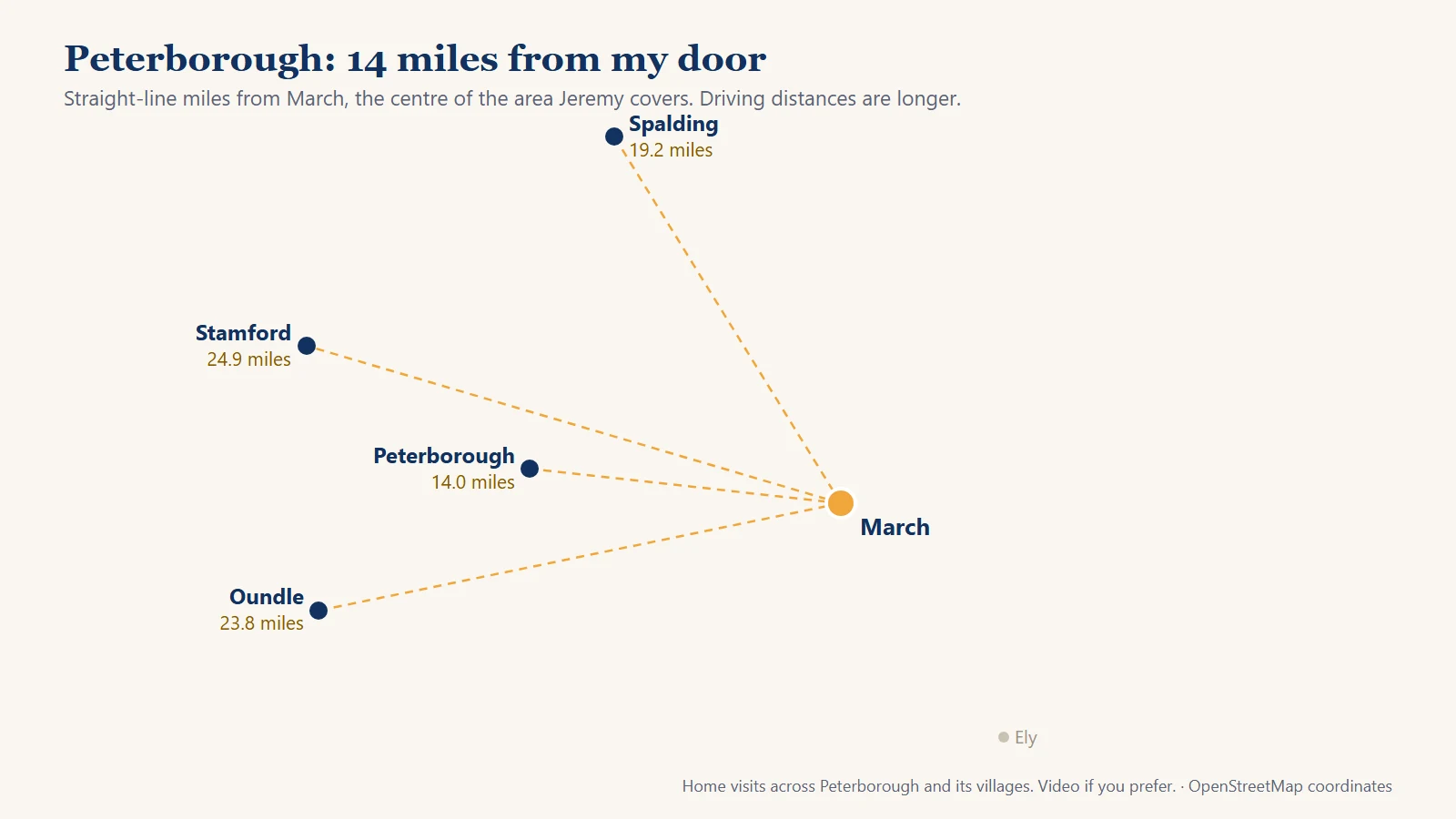
All of the city and every village around it. Peterborough is 14.0 miles from March as the crow flies, and Whittlesey, which sits between us, is under 9. These are straight-line distances from March, the middle of the area I cover:
| From March to | As the crow flies |
|---|---|
| Whittlesey | 8.9 miles |
| Thorney | 9.5 miles |
| Eye | 12.3 miles |
| Crowland | 13.9 miles |
| Peterborough city centre | 14.0 miles |
| Yaxley | 14.1 miles |
| Werrington | 15.8 miles |
| Glinton | 17.2 miles |
| Castor | 18.1 miles |
| Market Deeping | 19.1 miles |
| Oundle | 23.8 miles |
| Stamford | 24.9 miles |
I come to your home in Peterborough itself or in any of these: Alwalton, Castor, Eye, Farcet, Glinton, Haddon, Helpston, Marholm, Newborough, Northborough, Orton Waterville, Paston, Peakirk, Stanground, Upton, Walton, Water Newton, Werrington, Whittlesey and Yaxley.
Peterborough sits where three counties meet. North of the city I cover Spalding and the rest of south Lincolnshire; west, past Oundle, there's Northamptonshire; and south, Huntingdon.
Final thoughts from me
The short version, if you've scrolled straight here:
- Peterborough is 14 miles from March, and I come to your home in the city or any of its villages.
- A lifetime mortgage needs no monthly payments, and unpaid interest compounds, which shrinks the inheritance.
- What you can release depends on the youngest owner's age and your own home, and people usually take far less than the maximum.
- Check the cheaper routes first, from downsizing to a retirement interest-only mortgage.
- You can stop at any point before completion without owing the lender anything.
- The first conversation is free, and you pay me nothing unless your plan completes.
How much could you release from your home?
Three quick questions and an indicative figure straight away. No name, phone number or email needed to see it.
What clients and their families say
"Many companies take advantage of the elderly, but this was clearly not the case with Jeremy. He thoroughly explained all options and even assisted my gran with completing complex application forms. Within a week of the initial visit, my gran secured funding from a reputable lender."
"Had the pleasure of dealing with Jeremy on behalf of my mum for equity release on her home. If you want someone you can genuinely trust then don't go anywhere else! Jeremy is probably the most honest and genuine advisor that you will come across."
"Jeremy was very professional throughout the process, kept us uptaded at all times, nothing was too much trouble."
Book your free initial consultation today.
Pick up the phone and speak to Jeremy directly. If equity release is not the right choice, I will say so.
07768 972861 Or try the quick calculator