
Home › Equity release › Types of equity release
Types of equity release, with examples: which one suits you?
If you're looking to understand the types of equity release and see what each one looks like in pounds, you're in the right place. I'll explain both types, every kind of lifetime mortgage I arrange, and the one type I won't arrange, then put real numbers on a £300,000 home so you can see how they compare.

- On the FCA register, reference JLF01060 check the register
- Pellucid Ltd, FCA number 981845 check
- Equity Release Council member my profile
- SOLLA Later Life Lending Advice Standard
Quick answer: what are the types of equity release?
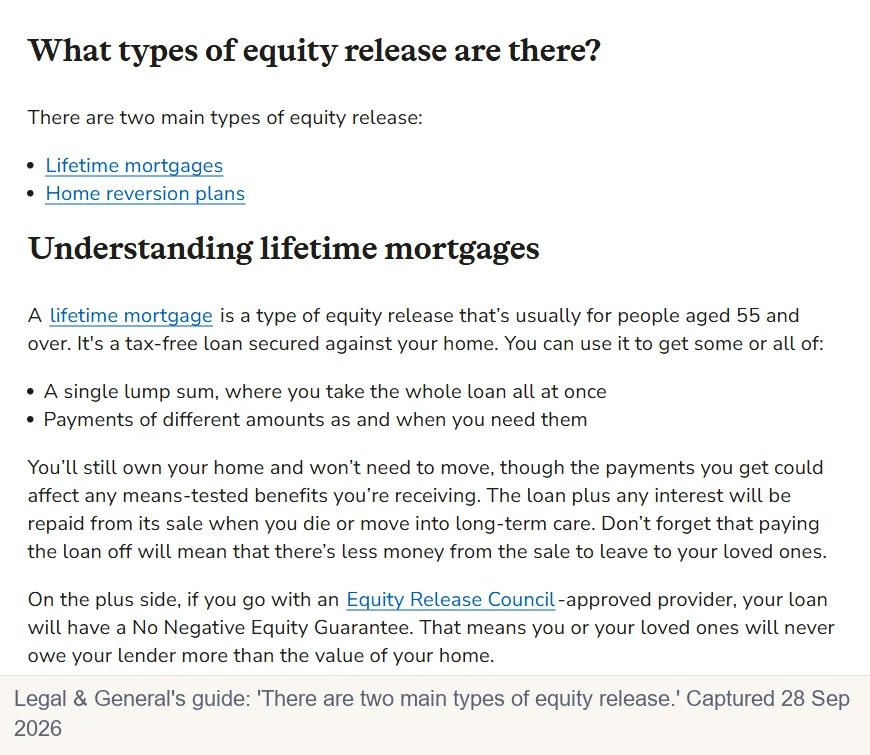
There are two. A lifetime mortgage is a loan against your home: you keep owning it, and the loan plus interest is repaid when the home is sold. Home reversion means selling part or all of your home, below its value, for the right to live there for life.
Why speak to Jeremy about the types of equity release?
Because I'll tell you which type I'd steer you away from, and why. I only advise on lifetime mortgages, and it has said so on my website for years: "We do not advise on Home Reversion as it doesn't fit with our ethos." Within lifetime mortgages I'm whole of market, so the choice between lump sum, drawdown, paying interest or not, and enhanced terms is made on your circumstances rather than one lender's range. I've specialised in later-life lending since 2009, hold CeMAP, CERT CII (ER) and the SOLLA Later Life Lending Advice Standard, and I'm an Equity Release Council member. It's me from the first call to completion, at your home or on the phone, and family are welcome in the room. Trusted Equity Release is a trading name of Pellucid Ltd, authorised and regulated by the Financial Conduct Authority, FRN 981845.
“He thoroughly explained all options and even assisted my gran with completing complex application forms.”
What are the two types of equity release?
A lifetime mortgage and a home reversion plan. The Equity Release Council lists these two, and both are regulated by the Financial Conduct Authority. Here they are side by side before I go into each:
| Lifetime mortgage | Home reversion plan | |
|---|---|---|
| What it is | A loan secured on your home | A sale of part or all of your home |
| Who owns the home | You do | The provider owns the share it bought |
| Usual minimum age | 55 (some plans from 50) | 60 |
| Monthly payments | None required; you can choose to pay | None; some plans charge a nominal rent |
| What you get | A lump sum, a reserve to draw on, or both | A lump sum or regular payments, well below the share's market value |
| What your family gets later | The sale price minus the loan and interest | The value of the share you didn't sell |
| Share of the market | Over 99% of plans | 25 sales in four years, on FCA figures |
*Usual terms, not any one lender's. Market figures are from my equity release statistics page.*
How does a lifetime mortgage work?
It's a loan secured on your home that doesn't have to be repaid while you live there. The lender takes a charge on the property, just as with any mortgage, but the deeds stay in your name. You can take the money in one go or in stages, and the loan plus interest is repaid when the last of you dies or moves into long-term care, normally from the sale of the home. It will reduce what you leave.
The basics most lenders work to:
- You're 55 or over, and on a joint plan the youngest owner's age sets the terms.
- The home is in the UK, it's your main residence, and it's worth at least about £70,000.
- Any mortgage or secured loan is paid off from the release first.
- There's a minimum amount, which MoneyHelper says is £10,000 with most lenders.
- You still maintain, run and insure the property, as Aviva puts it.
Every plan I recommend meets the Equity Release Council's standards: a fixed rate (or a capped variable one), the right to live in the home for life, the right to make penalty-free partial repayments, and the no negative equity guarantee, which means your estate never owes more than the home sells for. My lifetime mortgages page covers the product in full.
What kinds of lifetime mortgage are there?
Seven, and a real plan usually combines two or three of them. A drawdown plan can also be enhanced, for instance, or carry inheritance protection.
| Kind | How it works | Who it tends to suit |
|---|---|---|
| Lump sum | All the money on completion | One big cost now: clearing a mortgage, buying a home, adapting the house |
| Drawdown | A first amount plus a reserve you draw later; interest only on what you've taken | Spending spread over years |
| Interest-paying | You pay some or all of the monthly interest | Anyone with pension income to spare who wants the debt kept flat |
| Enhanced | Higher release or a lower rate where health or lifestyle counts | Anyone with a medical history; it's worth disclosing |
| Inheritance protection | A share of the home's value ring-fenced for family | Guaranteeing something is left |
| Payment term | You must pay the interest for a set term, then it rolls up | Under-55s still earning, on one lender's plan |
| Income | A regular payment, usually for a fixed period | Topping up income over a set number of years |
What is a lump sum lifetime mortgage?
The simplest kind: the whole amount is paid to you, or to your solicitor for a mortgage or a purchase, on completion. Interest is charged on all of it from that day and, unless you pay some, it compounds. It's the right shape when the money is going out in one go. It's the wrong one when it would sit in the bank for years, costing interest and possibly counting against means-tested benefits.
What is a drawdown lifetime mortgage?
The lender agrees a total, you take a first amount, and the rest sits in a reserve for later. You pay interest only on what you've drawn, so the debt grows more slowly. Two catches: lenders can reduce or withdraw the reserve (Legal & General says access isn't guaranteed), and each later amount is charged at the rate on the day you draw it. My page on drawdown lifetime mortgages has the minimums and the steps.
What is an interest-paying lifetime mortgage?
One where you choose to pay some or all of the interest each month, so the amount you owe grows slowly or not at all. On many of the plans I arrange you can pay from £50 a month, or 25%, 50%, 75% or 100% of the monthly interest. Lenders also call it interest-serviced or optional payment.
The safety net is what happens if you stop. Age UK explains that the plan then converts to an ordinary roll-up lifetime mortgage, which matters on a joint plan: if one of you dies and the income drops, the survivor isn't forced to keep paying.
What is an enhanced lifetime mortgage?
The same product priced for your health. Where a medical condition or lifestyle (smoking, for example) is likely to shorten the plan, some lenders will release more, or charge a lower rate. It means answering a health questionnaire, and a lot of people would rather not. Do it anyway: the answers can only help. More on my page about enhanced lifetime mortgages.
What is inheritance protection?
A promise from the lender that a percentage of the home's sale price goes to your family whatever the loan has grown to. Protect 20%, say, and at least 20% of the sale price is theirs. The cost is that you can borrow less, because the lender has less of the home to recover its money from.
What is a payment term lifetime mortgage?
A hybrid from Legal & General, available from age 50. You must pay the interest monthly for an agreed term, which can run to age 75, and after that it rolls up like an ordinary lifetime mortgage. It's the one kind where payments aren't optional, and Age UK warns that if you can't keep them up your home could be at risk of repossession. It only makes sense if you're sure the payments are affordable for the whole term.
Can a lifetime mortgage pay you a regular income?
Some can. Legal & General describes income lifetime mortgages that pay a regular tax-free amount, usually for a fixed period, sometimes with a small lump sum at the start. Age UK adds a warning: if the income is fixed, inflation reduces what it buys each year. A drawdown reserve, taken in larger sums a few times a year, can do a similar job with more control, though drawdown minimums (£1,000 a time with Legal & General) rule out small monthly amounts.
Are lifetime mortgage interest rates fixed or variable?
Fixed for life, on the plans available today. The Equity Release Council's standards allow a variable rate only if it has a cap fixed for the life of the loan, as Age UK sets out, and one adviser's guide notes that no lender currently offers a variable lifetime mortgage at all. A fixed rate means you know from day one what the debt will be in any year if you pay nothing, and that's how the tables further down can be worked out. It also means you don't benefit if rates fall. You can still repay part of the loan without a charge within the lender's limits, but switching the whole plan means repaying it, which can bring an early repayment charge.
How does a home reversion plan work?
You sell a share of your home, or all of it, to a reversion company. In return you get a tax-free lump sum or regular payments, and a lease that lets you live there for the rest of your life, rent-free or for a nominal rent. When the home is sold, after the last of you dies or moves into care, the provider takes its share of the sale price.
What Legal & General, Aviva and Age UK set out:
- The minimum age is usually 60.
- Legal & General describes selling between 20% and 60% of the home; Aviva says up to 100%.
- You're paid well below the share's market value, and less the younger you are, because the provider may wait many years for its money. Unbiased puts it at a maximum of about 60% of market value, often as little as 20%.
- Sell 50% and the provider gets 50% of the sale price, including 50% of any rise in value. The growth on the half you kept stays with you.
- If you die soon after, you've effectively sold that share cheaply. Some plans offer a rebate for an early death (capital protection), but only if you choose it at the start, and it reduces what you're paid.
Lifetime mortgage vs home reversion: what's the difference?
Ownership, and what happens to growth. With a lifetime mortgage you borrow, so the debt grows with interest but every pound of rise in your home's value is yours. With home reversion you sell, so there's no interest at all, but the provider owns its share of the growth for as long as you live.
| Lifetime mortgage | Home reversion | |
|---|---|---|
| Interest | Yes, compounding unless you pay it | None: it's a sale, not a loan |
| If house prices rise | The gain is yours | The provider gets its share of the gain |
| If you die within a couple of years | Your estate repays the loan plus two years' interest | The share has gone, unless you bought capital protection |
| Certainty for family | Inheritance protection can ring-fence a share | You know the share left, not its value |
| Moving home | Usually allowed if the new home suits the lender | Harder; check the lease |
| Ending it early | Repay, possibly with an early repayment charge | Buy the share back, usually for more than you received |
Home reversion has real advantages for some people: it can release more for some older homeowners, nothing ever compounds, and you know from the start what share your family keeps, if not what it will be worth.
Why don't I advise on home reversion?
Because you sell a slice of your home for a fraction of its value, and the provider keeps the growth on that slice for as long as you live. For the people I see, a lifetime mortgage almost always does the same job and leaves the family more. The market has reached the same view: 25 home reversion sales in four years, against tens of thousands of lifetime mortgages.
If home reversion still looks right for you after we've talked it through, I'm not the person to arrange it, and I'll tell you so plainly so you can find a specialist who does.
Were there other types of equity release in the past?
Yes, and one of them still colours how people talk about equity release. Between 1996 and 1998 a few banks sold shared appreciation mortgages: an interest-free loan of around a quarter of the home's value, repaid with a large share of any rise in its value. House prices then climbed fast, and many borrowers ended up owing far more than they'd expected. They haven't been sold for over 25 years, and nothing like them exists under today's Equity Release Council standards, but MoneyRelease, another adviser, points out that they still harm the industry's reputation, and when people call equity release a con it's often that era they're remembering.
Is a retirement interest-only mortgage a type of equity release?
No. A retirement interest-only mortgage is a mortgage: you pay the interest every month, the lender checks you can afford it on your income, including the income one of you would have if the other died, and the loan is repaid when the home is sold. It often sits on the same shortlist, though, and I arrange both. They're hard to qualify for and I only do them occasionally; my page comparing a RIO with equity release sets the two side by side, and the product itself is on my retirement interest-only mortgages page.
Equity release examples: what do the numbers look like?
The same £300,000 home, worked through each type of plan. Every figure comes from my equity release calculator: its release bands by age, and a 6.25% rate (September 2026's lowest advertised lifetime mortgage rate) compounded monthly. They're illustrations, not quotes. Your own figure depends on your home, your health and the lender.
How much could you release from a £300,000 home at each age?
| Youngest owner's age | Typical maximum (calculator band) | On a £300,000 home |
|---|---|---|
| 55 | 25% to 28% | £75,000 to £84,000 |
| 60 | 30% to 32% | £90,000 to £96,000 |
| 65 | 35% to 38% | £105,000 to £114,000 |
| 70 | 40% to 43% | £120,000 to £129,000 |
| 75 | 45% to 49% | £135,000 to £147,000 |
| 80 | 50% to 56% | £150,000 to £168,000 |
| 85 and over | 52% to 57% | £156,000 to £171,000 |
*Illustrative only. Maximums for standard health on a standard-construction home.*
These are ceilings, not targets. FCA data shows the typical lifetime mortgage is about 15% of the home's value, taken at about 71.
Example 1: what if you still have a mortgage?
The mortgage comes off first. On the calculator's own example, a 70-year-old in a £300,000 home can release £120,000 to £129,000. With £40,000 still owed, that clears the mortgage and leaves £80,000 to £89,000 in cash. There's no monthly payment any more, and for a lot of people in this position that's the point. But the whole £120,000 or more now carries interest. My page on equity release with an existing mortgage goes into that case.
Example 2: what does a £60,000 lump sum cost over time?
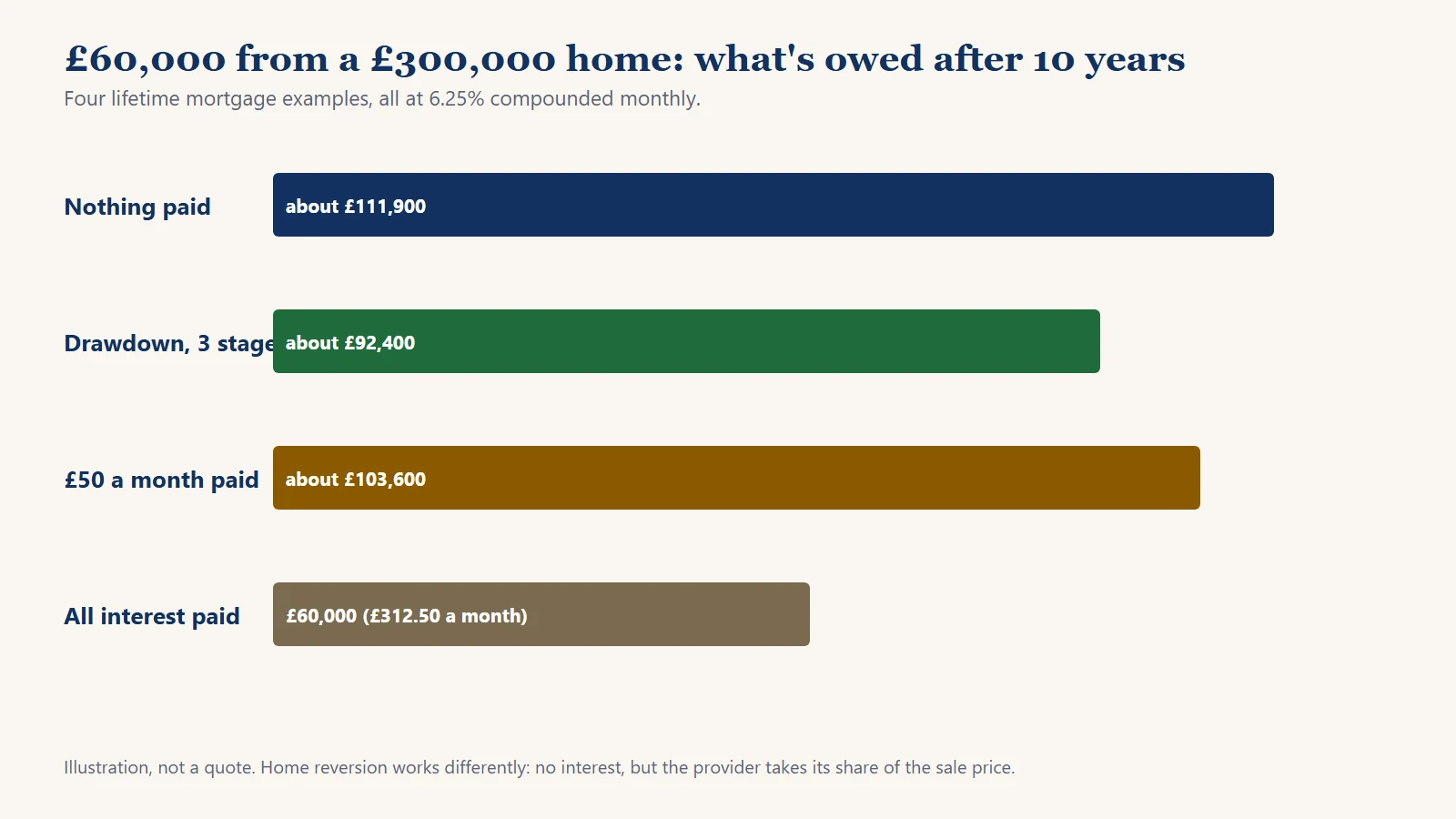
| £60,000 lump sum, nothing paid | Owed | Of which interest |
|---|---|---|
| After 10 years | about £111,900 | about £51,900 |
| After 15 years | about £152,800 | about £92,800 |
| After 20 years | about £208,700 | about £148,700 |
*Illustrative: 6.25% a year, compounded monthly, no repayments.*
The debt nearly doubles in ten years and more than triples in twenty. That's the single most important number on this page, and it's why I'd never suggest taking money years before you need it.
Example 3: how much does drawdown save on the same £60,000?
| £60,000 needed over ten years | Taken | Owed after 10 years | Less than the lump sum |
|---|---|---|---|
| Lump sum | All on day one | about £111,900 | |
| Two halves | £30,000 now, £30,000 at the start of year 5 | about £99,600 | about £12,300 |
| Three thirds | £20,000 now, then at the start of years 4 and 8 | about £92,400 | about £19,600 |
*Illustrative: assumes the reserve is still available when each amount is drawn and every amount is charged 6.25%.*
The saving comes from money sitting in reserve for years without costing anything. In real life each later amount is charged at the rate on the day, which could be higher or lower.
Example 4: what if you pay some or all of the interest?
| £60,000 at 6.25% | Monthly payment | Owed after 10 years | Owed after 20 years |
|---|---|---|---|
| Nothing paid | £0 | about £111,900 | about £208,700 |
| £50 a month | £50 | about £103,600 | about £184,900 |
| Half the interest | £156.25 to start, rising as the balance grows | about £82,000 | about £112,000 |
| All the interest | £312.50 | £60,000 | £60,000 |
*Illustrative: 6.25% a year compounded monthly, payments made every month.*
Paying all the interest costs £37,500 over ten years and keeps the debt at £60,000. Paying nothing costs nothing now but adds about £51,900 to the debt. Somewhere between the two suits a lot of people, and you can change your mind later, or stop paying altogether without any penalty.
Example 5: what changes with enhanced terms?
The release bands above assume standard health. With enhanced terms a lender may go above them, or charge less than 6.25%, if your health or lifestyle counts. I won't put a number on it here, because it depends entirely on the lender's reading of your answers and lenders read the same answers differently. What I can say is that a lower rate compounds in your favour exactly as the tables show: every fraction of a percent saved on £60,000 is worth more each year the plan runs.
Example 6: what would home reversion look like on the same home?
Sell a 50% share of a £300,000 home and that share is worth £150,000 on paper. You wouldn't be paid £150,000: you'd be paid a percentage of it set by your age, well below its value. Then, whenever the home is sold, the provider takes half the sale price. If the home is worth £400,000 by then, that's £200,000 to the provider, and you've paid no interest at all. If you'd died two years in, the provider would still take half. That trade, a lower payment now against no interest later, is the whole of the home reversion decision.
What do people actually use equity release for?
The reasons people bring to me are the six listed on my website: paying off a mortgage or other debts, home improvements or adapting the house so you can stay in it, topping up retirement income, helping children or grandchildren while you can see them enjoy it, travel, and paying for care at home. Two real ones from my reviews:
- A couple who wanted to travel. When they left me a review, I replied that I hoped they could now enjoy their Nordic cruises. Money for trips spread over several years is where a drawdown reserve earns its keep.
- A grandmother buying a new home after losing her husband, while probate was held up. I sat with her twice, her grandson joined by phone from another county, and funding was agreed within a week of my first visit. Then probate came through and she no longer needed the loan, so I cancelled the application, with no cancellation fee. She'd also had a wobble earlier and paused before restarting; that's allowed, and nobody should hurry you.
Which type of equity release is best for you?
For almost everyone I advise, a lifetime mortgage, and then the real question is which kind. The things that decide it:
| If this is you | The kind I'd look at first |
|---|---|
| One big cost now | Lump sum |
| Spending spread over years, or benefits to protect | Drawdown |
| Pension income to spare and family to leave money to | Interest-paying |
| A medical history, or a smoker | Enhanced (combined with any of the above) |
| A promise to the children that something will be left | Inheritance protection |
| Under 55, still earning, sure of the payments | Payment term, with care |
Your home matters too: its value, how it's built and where it is all affect which lenders will look at it. I work it out with you at your kitchen table rather than on a web form, and the recommendation goes in writing. Family are welcome in that conversation, and in my experience it's the children, not the borrower, who later have questions, so I'd rather they heard it all first. As I tell people, there's no right and no wrong: you've got to be happy with whatever you choose. Some people finish the conversation choosing neither type, and that's a fine outcome.
What is the bad side of equity release?
Mainly the interest: on a lifetime mortgage with nothing paid, the debt roughly doubles in ten years, as Example 2 shows. Add a smaller inheritance, possible effects on means-tested benefits, and early repayment charges if you repay the whole plan early. Home reversion's bad side is different: you sell below value and give up the growth. I've set out both sides in full on my page about the pros and cons of equity release.
FAQ
Is equity release a big con?
What is the best age to take out equity release?
What is the cheapest way to get equity out of a house?
Who owns the house with each type of equity release?
Can you switch from one type to another?
Can you have more than one equity release plan?
Final thoughts from me
If you only remember a few things from this page:
- There are two types of equity release: lifetime mortgages, which are over 99% of plans, and home reversion.
- A lifetime mortgage is a loan and you keep owning your home; home reversion is a sale, below value, of part or all of it.
- Lifetime mortgages come as lump sum, drawdown, interest-paying, enhanced, inheritance protection, payment term and income plans, often combined.
- £60,000 left to roll up at 6.25% becomes about £111,900 in ten years; paying the interest keeps it at £60,000.
- Drawdown in three stages left about £19,600 less to repay after ten years than the same £60,000 taken at once.
- I don't advise on home reversion, and I'll say so if it's the thing you need.
Book your free initial consultation today.
Pick up the phone and speak to Jeremy directly. If equity release is not the right choice, I will say so.
07768 972861 Or try the quick calculator