Home › Mortgages for over 50s
Mortgages for over 50s and over 55s: can you still get one, and for how long?
If you're looking for a mortgage in your 50s, whether you're 50, 55 or nearer 60, you're in the right place. I arrange equity release and the later-life mortgages myself, my colleagues at Pellucid, the same firm, arrange ordinary mortgages, and below I've set out what each lender told me on its own website about age when I checked on 2 November 2026.

- On the FCA register, reference JLF01060 check the register
- Pellucid Ltd, FCA number 981845 check
- Equity Release Council member my profile
- SOLLA Later Life Lending Advice Standard
Quick answer: can you get a mortgage over 50?
Yes. The big banks' age limits for the end of the term run from 75 to 80, so at 50 that's 25 to 30 years; some building societies lend to 85, 95 or have no limit. From 55 the term shortens and lenders test your pension income more closely.
Why ask me about a mortgage in your 50s?
Because I arrange the later-life routes myself: retirement interest-only and term interest-only mortgages, payment term lifetime mortgages from 50 and lifetime mortgages from 55, across the whole market. For an ordinary mortgage, my colleagues at Pellucid, the same firm, do the arranging, so whichever route fits, it starts with one conversation, and I'll say so if an ordinary mortgage is the cheaper answer. I've specialised in later-life lending since 2009, I hold CeMAP, CERT CII (ER) and the SOLLA Later Life Lending Advice Standard, and I'm a member of the Equity Release Council. It's me from the first call to completion, at your kitchen table or on the phone. Trusted Equity Release is a trading name of Pellucid Ltd, authorised and regulated by the Financial Conduct Authority, FRN 981845. Email me, request a printed brochure, or get in touch.
“Excellent, professional and friendly service, we highly recommend Jeremy. He was very quick to reply to our enquiry and kept us posted at all times during the process. Thanks so much for all your help.”
Can you get a mortgage at 50?
Yes, and at 50 you still have most of the market open to you. Every lender I checked accepts a new borrower at 50; what changes is how long the mortgage can run, because each lender sets an age by which it must end, and whether that end date falls after you plan to retire.
Lending that runs into retirement is normal now. In 2024 Q1, 42% of new UK mortgage lending ran beyond the borrower's 67th birthday, up from 27% in 2019 Q1, according to Bank of England staff analysis of FCA data. Around 6% of standard mortgage sales each year go to borrowers aged 55 or over who will be 68 or over when the term ends, about 350,000 sales since 2021 (FCA). Both figures are on my page of statistics on lending into retirement.
Long terms are normal at every age, too. 62% of first-time buyers in England with a mortgage took a term of 30 years or more in 2024-25, up from 47% five years earlier, according to A Little Mortgage Advice's first-time buyer statistics.
So at 50 the questions a lender asks are the ordinary ones (income, outgoings, credit record, deposit or equity) plus two more: when do you plan to retire, and what will you live on afterwards? If the term ends before your planned retirement, a lot of lenders treat you much like a 40-year-old. If it runs past it, they want evidence of pension income, which I cover further down.
Can you get a mortgage at 55, and what changes from 50?
Yes. Five years makes three practical differences.
First, the term is shorter. At a lender whose limit is 75, the longest term at 55 is 20 years, against 25 at 50, which puts the monthly payment up on the same loan (the worked example below shows by how much).
Second, retirement gets closer, and several lenders change how they test income once you're within 10 years of it. HSBC asks for pension projections once you're within 10 years of 70; Nationwide and Leeds Building Society use the lower of your current income and your expected retirement income once retirement is less than 10 years away; Barclays may assess affordability on pension income within 10 years of retirement.
Third, more doors open. Lifetime mortgages start at 55, and so does the retirement interest-only range at Nottingham Building Society and Leeds Building Society (Leeds takes applicants aged 55 to 80). Older Persons Shared Ownership, for buying a home, also starts at 55. A lot of the "over 55 mortgage" searches I see are really asking about those later-life products, and I explain each one further down.
How long a mortgage can you get at 50, 55 or 60?
As long as the gap between your age today and the lender's maximum age at the end of the term, up to the lender's maximum term. This table works it out for the ages people search most, using the limits each lender publishes (checked 2 November 2026):
| Your age when you apply | Lenders ending at 75 (Nationwide, Santander, NatWest, Nottingham BS) | Lenders ending at 80 (Halifax, Barclays, HSBC) | Lenders ending at 85 (Leeds BS) | Suffolk BS (no age limit, 40-year maximum term) |
|---|---|---|---|---|
| 50 | 25 years | 30 years | 35 years | 40 years |
| 54 | 21 years | 26 years | 31 years | 40 years |
| 55 | 20 years | 25 years | 30 years | 40 years |
| 57 | 18 years | 23 years | 28 years | 40 years |
| 58 | 17 years | 22 years | 27 years | 40 years |
| 60 | 15 years | 20 years | 25 years | 40 years |
These are ceilings, not promises. If you're still working, NatWest and Santander stop the term at your intended retirement age, and HSBC won't consider any new lending once a borrower is 70. Nationwide's maximum term is 40 years, and Family Building Society lends to 95 but doesn't publish the maximum term alongside its age limits, so I've left it out of the table.
Can you get a 25-year mortgage at 50 or 55?
At 50, yes, at every lender in the table: a 25-year term ends at 75, exactly the limit at Nationwide, Santander, NatWest and Nottingham Building Society. At 55, a 25-year term ends at 80, which narrows it to Halifax, Barclays and HSBC (all to 80), Leeds Building Society (85), Family (95) and Suffolk (no limit).
Can a 54-year-old get a 25-year mortgage?
Yes, with the right lender. A 25-year term at 54 ends at 79, which is inside the limit at Halifax, Barclays and HSBC (80), Leeds Building Society (85), Family Building Society (95) and Suffolk Building Society (none). It's outside the limit at Nationwide, Santander and NatWest, which stop at 75, so with them the most you could have is 21 years.
Can you get a 30-year mortgage at 50 or 55?
At 50, yes: a 30-year term ends at 80, the limit at Halifax, Barclays and HSBC, and Leeds Building Society goes to 85. At 55, a 30-year term ends at 85, so only Leeds, Family and Suffolk among the lenders I checked can offer it. Either way, your income has to cover the payments to the very end, pension years included, and at Halifax a term past 70 needs a Customer Working Age Form.
Can you get a mortgage at 57 or 58?
Yes. At 57 the longest term is 18 years at a lender that stops at 75 and 23 at one that stops at 80; at 58 it's 17 and 22. At that age the term will almost always run past your retirement date, so the lender looks hard at your pension. If a full repayment term makes the monthly payment too high, that is usually the point where a retirement interest-only mortgage or, if the sums still don't work, a lifetime mortgage comes into the conversation.
How much more does a longer term cost?
A longer term lowers the monthly payment and raises the total interest. This is an illustration, not a quote: a £150,000 repayment mortgage at a fixed 5% a year for the whole term.
| Term (illustrative, £150,000 at 5%) | Monthly payment | Total interest paid |
|---|---|---|
| 10 years | about £1,591 | about £40,900 |
| 15 years | about £1,186 | about £63,500 |
| 20 years | about £990 | about £87,600 |
| 25 years | about £877 | about £113,100 |
| 30 years | about £805 | about £139,900 |
Going from 20 to 30 years saves you about £185 a month and costs about £52,300 more in interest. That's why I'd rather see you on the shortest term you can comfortably afford, and why overpaying when you can (within your lender's overpayment allowance) is worth doing.
What is the maximum age for a mortgage in the UK?
There's no single legal maximum: each lender sets its own, and the age when the term ends matters more than your age when you apply. These are the limits on each lender's own site, checked on 2 November 2026:
| Lender | Mortgage must end by | Interest-only must end by | If you're still working |
|---|---|---|---|
| Nationwide | before the oldest borrower's 75th birthday | retirement, or 70 at the latest | maximum retirement age 70 |
| Santander | 75th birthday | 70th birthday | the term can't run past your intended retirement age |
| NatWest | 75 | 70 | no lending into retirement: the term stops at your intended retirement age |
| Halifax | 80 | 70 | retirement income verified past your retirement or working age (normally 75) |
| Barclays | the oldest borrower's 80th birthday | 75 (70 above half the home's value) | maximum retirement age 75 |
| HSBC | the day before your 80th birthday | the day before your 70th | no new lending once any borrower is 70; pension projections within 10 years of 70 |
| Nottingham Building Society | 75 (85 on its Make it Possible range) | not stated separately | assumes you retire at 68 |
| Leeds Building Society | 85 | retirement, or 70 at the latest | maximum retirement age 70 |
| Family Building Society | 95 | 94 | earned income usually counted to 70 (75 for professionals) |
| Suffolk Building Society | no maximum | no maximum | pension income assessed past retirement; over-75s need independent legal advice |
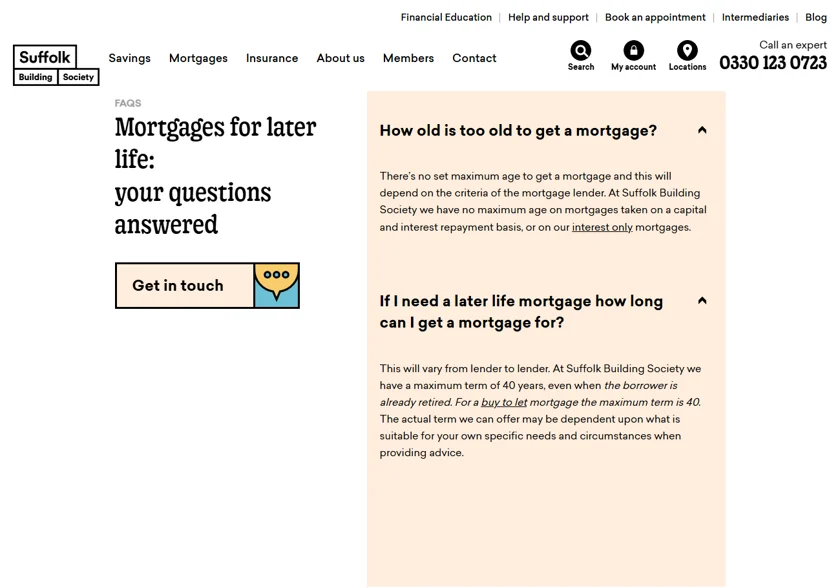
For older borrowers, the big banks cluster at 75 to 80 and watch your retirement date, while the building societies range from 75 at Nottingham to no limit at all at Suffolk. If you're still working, the retirement rule can bite before the age limit does. If you've already retired, it falls away: NatWest and Santander both consider retired applicants within their age limits. Lenders change these limits, so I check them again before any recommendation.
Which lenders offer mortgages up to age 85?
Of the lenders I checked, Leeds Building Society lends on a repayment mortgage to 85, and Nottingham Building Society's Make it Possible range goes to 85 (its standard range stops at 75, with a maximum retirement age of 75 on Make it Possible). Family Building Society goes further, to 95, and Suffolk Building Society sets no maximum. Interest-only is different: Leeds stops interest-only at retirement or 70, whichever comes first.
Which mortgage lenders lend to age 75?
Nationwide, Santander, NatWest and Nottingham Building Society's standard range all need the mortgage to end by 75 (Nationwide says before the oldest borrower's 75th birthday). So does Skipton's Track Record mortgage, which I come to in the no-deposit section. Nationwide also says it will "continue to lend to existing borrowers over 75 in certain circumstances", which matters if you're already with them.
What is the maximum retirement age for a mortgage?
It's the latest retirement age a lender will accept when it works out whether you can afford the payments from earnings. Nationwide and Leeds Building Society accept 70; Barclays accepts 75, with an underwriter review above 70; Halifax's "Maximum Working Age" is normally 75 but drops to 70 for capital-raising remortgages and any interest-only lending; Nottingham Building Society assumes you'll retire at 68 unless your adviser confirms in writing that you'll work to 75. Past that age, the lender counts your pension, not your salary.
Can you get a mortgage at 50 with no deposit?
Only in narrow cases. If you rent and haven't owned a home recently, there is a 100% mortgage for you. If you already own a home, the equity in it does the job of a deposit. If you own nothing and don't rent, I don't know of a no-deposit route at 50.
If you rent: is there a 100% mortgage at 50?
Yes: Skipton Building Society's Track Record mortgage says "You can apply without a deposit". It's for renters who haven't owned a home in the UK in the last 3 years, are aged 21 or over, have paid their rent on time for 12 months in a row within the last 18, and have kept up all credit payments for the last 6 months. Borrowing goes up to £600,000.
The age catch is in Skipton's own FAQ: "your mortgage needs to end by the time you turn 75." So at 50 the term can run to 25 years, at 55 to 20, and Skipton may also look at your expected retirement income. With no deposit you own no equity on day one, so if prices fall you can owe more than the home is worth, which makes moving or remortgaging harder for a while. Ordinary mortgages are my colleagues' area at Pellucid, so they'd be the ones to compare it with the rest of the market.
If you already own a home
Then you probably don't need a deposit in cash. When you move, the equity from your sale becomes the deposit on the next home; when you remortgage, the equity already in the home is what the lender lends against. The lenders watch the loan-to-value later in life, though: Nottingham Building Society goes to 80% of the home's value when lending into retirement and 70% once you're relying on pension income only, and Suffolk Building Society says the same 80% and 70%.
Can you buy through shared ownership over 55?
Yes, if you qualify for Older Persons Shared Ownership (OPSO) in England. Homes England's rules on gov.uk: you must be aged 55 or over, the home must be advertised under OPSO, your household income must be £80,000 a year or less (£90,000 in London), and you can't afford a suitable home outright. You buy a share of between 10% and 75%, usually with a deposit of 5% to 10% of the share, and pay rent on the rest. Once you own 75%, you pay no rent on the remaining 25%.
It isn't a no-deposit route, and if you already own a home you must have agreed its sale before buying. One rule people miss: someone under 55 who inherits the home can't carry on living there unless they were your spouse or civil partner living with you.
How much can you borrow at 55?
As much as the lender believes you can repay over the term it will allow, which at 55 is shorter than it used to be. Lenders work from your income and outgoings, and once the term runs past retirement, from your pension income too. The term limit is what shrinks the figure: the same monthly budget supports a smaller loan over fewer years.
An illustration, not a quote, at a fixed 5% a year on a repayment mortgage:
| If you can afford £1,000 a month over | You could repay a loan of about |
|---|---|
| 10 years | £94,300 |
| 15 years | £126,500 |
| 20 years | £151,500 |
| 25 years | £171,100 |
At 55, a lender that stops at 75 gives you 20 years at most, and one that stops at 80 gives you 25. That difference, on the same £1,000 a month, is about £19,600 of borrowing. The lender also sets its own cap on borrowing against income and on loan-to-value, so treat this as the ceiling the term creates, not what a lender will offer.
What do lenders check about your income in retirement?
Affordability: whether your income covers the payments for the whole term, including the years after you stop work. If the term runs past your planned retirement, the lender wants evidence of your pension income, and some test it years ahead:
- HSBC asks for current income documents and pension projections dated within the last 12 months once you're within 10 years of 70, and tests affordability both to 70 and on your projected retirement income.
- Nationwide uses the lower of your current and expected retirement income once retirement is under 10 years away; if it's further off, it asks for proof of a pension other than the State Pension.
- Leeds Building Society does much the same, and uses your pension income alone once you've retired.
- Nottingham Building Society assumes you'll retire at 68 and asks for evidence you can pay on a reduced income after that.
- Barclays wants proof of pension income where the term goes beyond 75 and your income is needed for affordability.
If the numbers don't stretch, the usual answers are a shorter term with bigger payments, a retirement interest-only mortgage, or, from 55, a lifetime mortgage, which needs no income test on a roll-up plan.
What if you're self-employed over 50?
The age rules are the same; the evidence is different. Instead of payslips, lenders want to see your trading income from accounts or tax returns, and the retirement question still applies: when will you stop, and what pension will you have? Once the term runs past your planned retirement, it's your pension, not the business, that the lender leans on, so a plan to keep trading into your 70s doesn't replace pension evidence.
What is the average mortgage for a 55-year-old?
I can't give you a reliable current figure, because I haven't found an official one I can check at source: the numbers quoted online come from surveys of different years and methods, and I won't repeat a figure I can't stand behind. What the official data does show is that a lot of people now carry a mortgage well past 55: 42% of new lending runs beyond 67, and in 2024 a quarter of mortgage holders aged 55 and over were on interest-only, against 11% across all ages (FCA Financial Lives).
The average matters less than your own numbers anyway. What decides your options at 55 is how much you still owe against what the home is worth, how many years your lender will give you, and what your pension will pay. If you send me those three, I can tell you which routes are open.
What are the best mortgages for over 50s?
The best one is the mortgage whose age limit, income test and term fit you, and that changes from person to person. At the banks in my table, a mortgage for someone over 50 is their ordinary mortgage with the age rules applied, so the rates are the same ones a younger borrower sees; what you're really choosing is the lender whose rules let you have the term you need. I don't quote rates on this page because they change weekly.
| Your situation | Where I'd look first (from the published limits) |
|---|---|
| 50 to 55, working, term ending before you retire | Any lender: Nationwide, Santander and NatWest all lend to 75 |
| Term running past retirement into your late 70s | Halifax, Barclays or HSBC (to 80), with pension evidence |
| Need a term to 85 or beyond | Leeds Building Society (85), Family (95), Suffolk (no limit) |
| Want interest-only past 70 | Barclays (to 75 at half the home's value or less), Family or Suffolk; or a retirement interest-only mortgage |
| Pension won't cover the payments | A lifetime mortgage from 55, or a payment term lifetime mortgage from 50 |
Does Nationwide offer mortgages for over 50s, 55s and 70s?
Yes for standard mortgages, with a firm age limit: the mortgage must end before the oldest borrower's 75th birthday, on a maximum term of 40 years. Its intermediary criteria put it as "Minimum 18, maximum 75 for new borrowers." Interest-only can only run to retirement, 70 at the latest, and it isn't available if you're retired or the term would go into retirement. The maximum retirement age Nationwide accepts is 70.
So at 50 Nationwide can offer up to 25 years and at 55 up to 20. Over 70 it's a short term at most: someone applying at 71 would need the mortgage to end before 75, so under four years. Its retirement mortgages are closed to new customers ("We no longer offer new retirement mortgages"), though existing borrowers can switch deals, borrow more or move, and it says it will continue to lend to existing borrowers over 75 in certain circumstances. If you're over 70 and not already with Nationwide, the building societies in my table with higher or no limits are the better place to look.
What are your mortgage options over 50?
Five routes, and the right one depends on your income now and in retirement:
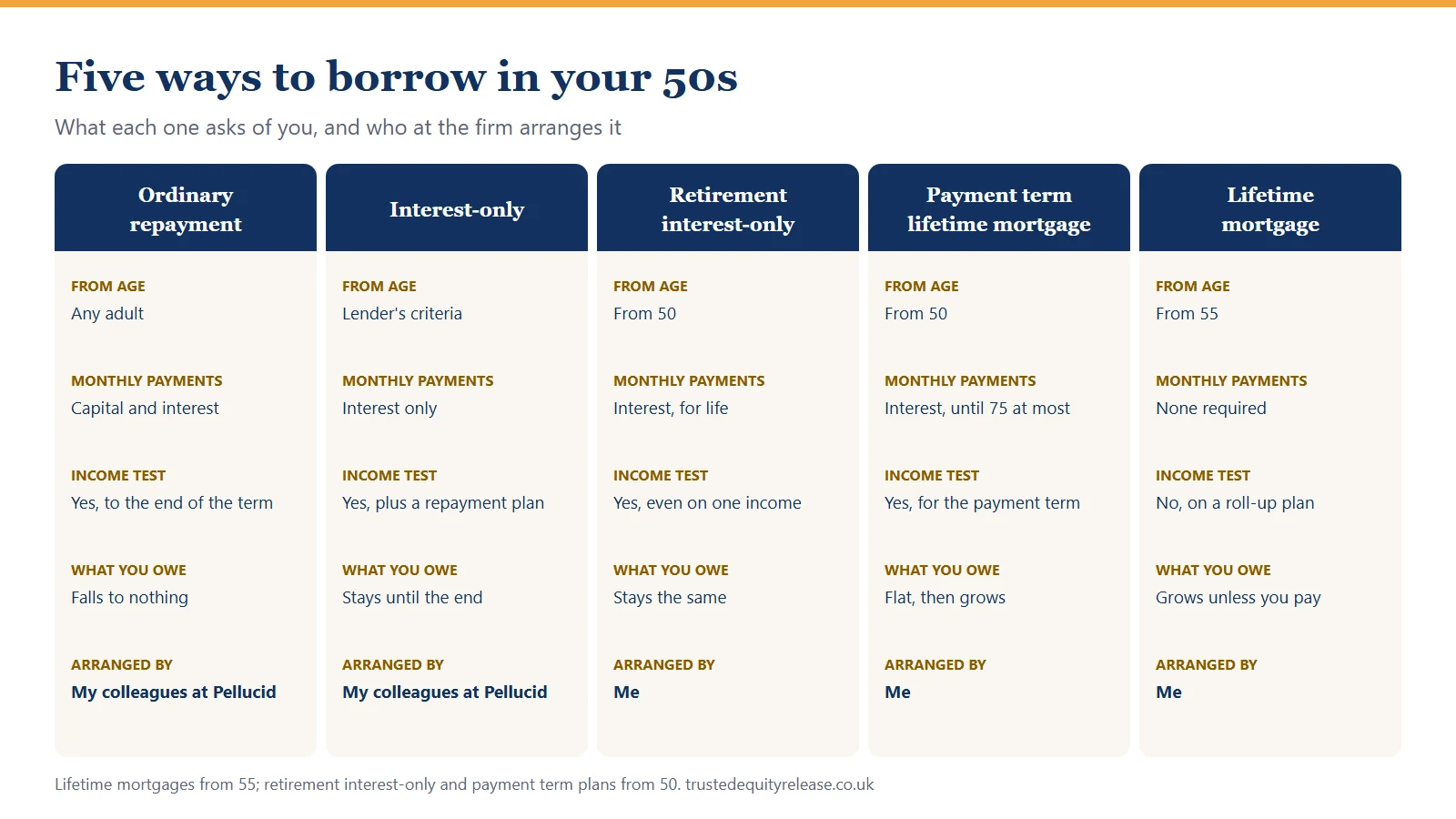
| Ordinary repayment | Interest-only | Retirement interest-only | Payment term lifetime mortgage | Lifetime mortgage | |
|---|---|---|---|---|---|
| From what age | Any adult | Lender's criteria | From 50 at some lenders (55 at Leeds and Nottingham) | From 50 | From 55 |
| Monthly payments | Capital and interest | Interest, plus a plan to repay | Interest, for life | Interest, up to age 75 at most | None required |
| Income test | Yes, to the end of the term | Yes, and the repayment plan | Yes, including on one income | Yes, for the payment term | No, on a roll-up plan |
| What you owe | Falls to nothing | Stays until the end | Stays the same | Flat, then grows | Grows unless you pay |
| Arranged by | My colleagues at Pellucid | My colleagues at Pellucid | Me | Me | Me |
Can you get an interest-only mortgage over 50 or 55?
Yes, but the interest-only age limits are lower than the repayment ones and you need a believable plan to repay at the end. Nationwide, Leeds Building Society and Santander stop interest-only at 70 (or retirement, if sooner); NatWest and HSBC at 70; Halifax at 70; Barclays considers interest-only up to 75, or 70 where you borrow more than half the home's value, and won't let a new interest-only term run into retirement. Family Building Society goes to 94 and Suffolk Building Society has no maximum. Nottingham Building Society allows interest-only up to 80% of the home's value.
What is a retirement interest-only mortgage?
A mortgage where you pay only the interest each month and the loan is repaid when the last borrower dies or moves into long-term care, usually from the sale of the home. There's no end date: Nottingham Building Society says so in as many words. You must pass an affordability test, including on one income if one of you dies. Suffolk Building Society doesn't offer them; Leeds and Nottingham start at 55. The detail, and who it suits, is on my page explaining how a retirement interest-only mortgage works.
What are the later life mortgage options from 55?
From 55 you add the lifetime mortgage to the list: you borrow a tax-free lump sum against your home, you don't have to make monthly payments, and the loan is repaid from the sale of the home when the last of you dies or moves into long-term care. The age rule is strict: on a joint plan, both of you must be at least 55. The cost is the trade-off. Interest compounds, so with nothing paid, £60,000 at 6.25% a year grows to about £111,900 after 10 years and about £208,700 after 20 (illustration from my calculator), which reduces what you leave. A lump sum can affect means-tested benefits, and plans usually carry early repayment charges if you repay early. More on how a lifetime mortgage works.
Can you get equity release at 50?
Yes, but only one kind. A payment term lifetime mortgage starts at 50: you take a tax-free lump sum and pay the interest every month until an agreed age, up to 75 with Legal & General, after which it rolls up. Standard lifetime mortgages start at 55, and on a joint plan both of you have to be 55.
The monthly payments are compulsory, so the lender checks your income for the whole term, and there's no drawdown. At 50, a retirement interest-only mortgage often costs less, and waiting until 55 opens up the whole market. The catches of each route are on my page about equity release before 55.
Can you remortgage over 55 or 60?
Yes, on the same footing as a new mortgage: the new term has to end inside the lender's age limit, and the payments have to fit your income into retirement. At 60, that's 15 years with a lender that stops at 75, 20 with one at 80 and 25 with Leeds Building Society at 85.
Two things work differently. A product transfer, meaning a new deal with your current lender on the same loan, often involves fewer checks, which can matter if your income has dropped. And raising extra money is tested harder: Halifax applies a Maximum Working Age of 70, not 75, to remortgages with any capital raising or additional borrowing. If a remortgage won't work on your pension, a retirement interest-only mortgage or a lifetime mortgage can replace the existing loan, and that's the part I'd look at with you.
Is it a good idea to take a mortgage in your 50s?
It can be, if the payments suit your income now and your pension later. The risk is reaching retirement with a payment you can't meet: in 2024, 9% of UK residential mortgage holders aged 55 and over said they did not think they could afford their mortgage payments in retirement and did not know what they would do (FCA Financial Lives).
The worked example above shows the other side: stretching a term from 20 to 30 years makes the monthly payment easier and costs tens of thousands more in interest. Sometimes the better answer is a shorter term, overpaying while you're still earning, or downsizing to a smaller property, and I'll tell you if I think so, even when it means there's nothing for me to arrange.
FAQ
Can you still get a mortgage at 60?
Can you get your first mortgage at 55?
Can you get a 50-year mortgage?
What if your interest-only mortgage is ending?
Final thoughts from me
If you're in your 50s and weighing up a mortgage, this is what I'd keep in mind:
- At 50 the big banks will usually give you 25 to 30 years, because their age limits for the end of the term run from 75 to 80.
- At 55 the term shortens and lenders start testing your pension income, often within 10 years of retirement.
- Leeds Building Society lends to 85, Family Building Society to 95, and Suffolk Building Society sets no age limit.
- A no-deposit mortgage at 50 is open to renters through Skipton's Track Record mortgage, which must end by 75.
- A longer term lowers the payment but costs more in interest, so the shortest affordable term costs least.
- When an ordinary mortgage won't stretch, a retirement interest-only mortgage or, from 55, a lifetime mortgage may.
Book your free initial consultation today.
Pick up the phone and speak to Jeremy directly. If equity release is not the right choice, I will say so.
07768 972861 Or try the quick calculator