
Quick answer: what are the criteria for equity release, and can you get it if you have a mortgage?
You need to be 55 or over (both of you, if it's joint), living in a UK home you own, usually worth £70,000 or more. Yes, you can have a mortgage: it's paid off from the money released, so the release has to be big enough to clear it.
Why ask me about the criteria?
Because the rules that decide a case aren't the headline ones. The people who ring me are usually over 55 and own their home; what trips people up is a lease that's too short, a concrete or timber frame, a flat above a shop, a son who lives at home, or a secured loan they'd forgotten about. Every lender draws those lines in a different place, and I compare them across the whole market, so a no from one lender is often a yes from another. I've specialised in later-life lending since 2009 and I'm a member of the Equity Release Council. Trusted Equity Release is a trading name of Pellucid Ltd, authorised and regulated by the Financial Conduct Authority, FRN 981845.
“Would not hesitate to recommend this Company. Professional, honest and always available to help at any point of the procedure. Would absolutely recommend them to anyone needing their services”
What are the equity release criteria?
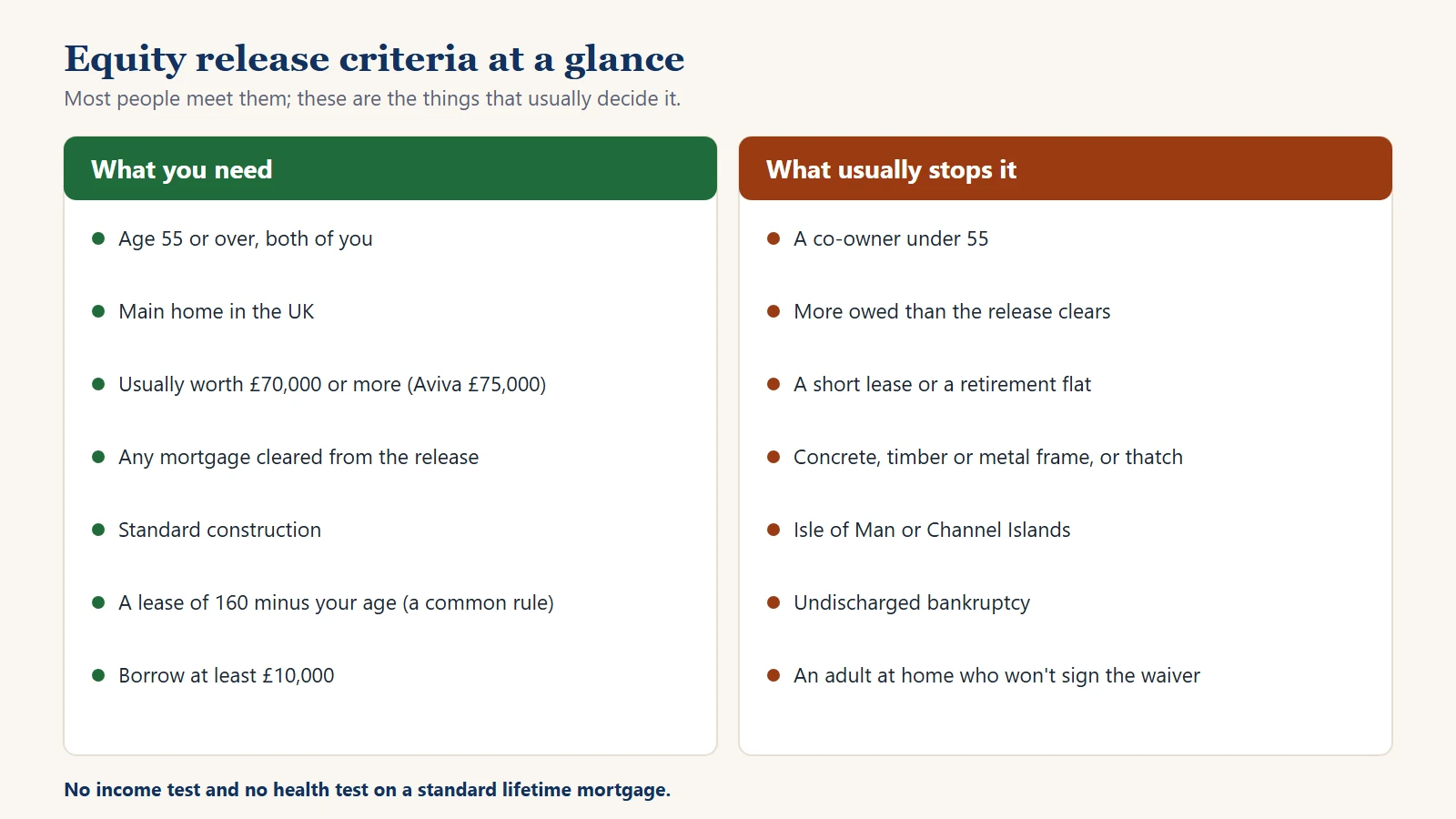
Here is the whole list in one table, with the usual rule and where it catches people out. The sections below take each one in turn.
| Criterion | The usual rule | Where it trips people up |
|---|---|---|
| Age | 55 or over; the youngest borrower's age sets the amount | A partner under 55 on the deeds |
| Joint owners | Everyone on the deeds is a borrower and meets the age rule | A younger co-owner who can't come off the deeds |
| Main residence | You live there; Aviva says it mustn't be empty more than six months at a time | Second homes, buy-to-lets, long stays elsewhere |
| Property value | Usually at least £70,000 (Aviva wants £75,000) | Ex-local-authority flats, where some lenders want about £200,000 |
| Construction | Standard brick or stone with a tiled or slate roof | Concrete, timber or metal frames, thatch |
| Lease | Enough years left: some lenders use 160 minus the youngest borrower's age | Short leases, retirement flats |
| Location | Mainland England, Wales and Scotland widely accepted | Isle of Man and the Channel Islands; few lenders in Northern Ireland |
| Condition | Habitable and in reasonable repair, and kept that way | Major repairs pending |
| Existing mortgage and secured loans | Repaid from the release on day one | A balance bigger than the release |
| Credit | Checked, but good credit isn't required | Undischarged bankruptcy |
| Income | Not tested on a standard plan | Plans with compulsory payments |
| Health | Not a requirement; it can raise the amount | Nothing, unless capacity is in doubt |
| Who else lives there | Other adults usually sign a waiver | Someone who won't sign |
| Minimum loan | Typically £10,000 | Needing only a small sum |
How old do you have to be for equity release?
55, for a lifetime mortgage. LV= and Aviva both say every applicant on a joint plan has to be at least 55, and the lender works out how much it will lend from the youngest borrower's age, because the plan runs until the last of you dies or moves into long-term care.
Age also sets the amount. At 55 the typical maximum is 25% to 28% of the home's value; at 70 it's 40% to 43%; from 80 it's 50% to 57%. The full table by age is on my equity release calculator, which asks for no personal details.
What if one of you is under 55?
Then a standard lifetime mortgage usually has to wait. Some advisers suggest the younger owner comes off the deeds, which moneyrelease.co.uk describes as a requirement for going ahead. I'm wary of that: the person who comes off gives up their legal share of the home and their right to stay there under the plan, so it needs proper legal advice and a lot of thought. The other routes are a retirement interest-only mortgage from 50, if your income covers the interest, or waiting until you're both 55. My page on equity release at 50 sets out each one.
Is there a maximum age for equity release?
There isn't one figure across the market. Older borrowers can release more, not less, and my calculator's bands run to 85 and over, at 52% to 57%. Where an individual lender sets an upper age for a product, I check it before recommending that plan, so it never surfaces as a surprise after you've applied.
What kinds of property qualify for equity release?
Most houses and bungalows do, and plenty of flats. What lenders care about is whether the home will sell easily when the plan ends, because that's how they get repaid. So the questions are value, construction, lease, location and condition.
What is the minimum property value?
Usually £70,000. LV=, Royal London and moneyrelease.co.uk all use that figure; Aviva's own minimum is £75,000. Some property types need more: LV= says that for a former local authority flat the minimum value is often at least £200,000, and if the council still owns the freehold the lender may want you to buy it first.
Which construction types make equity release harder?
Standard construction, meaning brick or stone walls and a tiled or slate roof, is accepted by every lender. Concrete, timber-framed and metal-framed buildings are harder, and LV= adds thatched roofs. It usually comes down to the type and age of the construction, and one lender will take what another refuses. Lenders have softened on some things: homes with an annexe, flat roofs and some business use are now considered by some, according to both LV= and moneyrelease.co.uk.
If you're not sure what your house is built from, the survey from when you bought it, or a builder's description, will usually say. Send me what you have and I'll tell you which lenders will look at it.
Can you get equity release on a leasehold flat?
Yes, if there are enough years left on the lease. A common lender rule is 160 years minus the youngest borrower's age: a 70-year-old would need at least 90 years left. If the lease is too short, it can often be extended as part of the application, though that adds time and some upfront cost. Retirement flats are the exception: Aviva rules out retirement apartments and age-restricted homes altogether, and Age UK warns that leasehold retirement housing may not be accepted. The detail, lender by lender, is on equity release on a leasehold property.
Does where you live affect equity release?
Two ways. First the region: LV= says homes in mainland England, Scotland and Wales have the widest choice, only a handful of lenders cover Northern Ireland, and equity release isn't available on the Isle of Man or in the Channel Islands. Second, what's next door. LV= lists a pub, a railway station, a busy road or a flood plain as things that can make a lender less willing, because they affect how easily the home sells.
Does the house have to be in good condition?
It has to be habitable and in reasonable repair, and the lender's surveyor checks that when they value it. The duty carries on after completion. Age UK points out that you stay responsible for repairing and insuring the home, and if you don't keep it up, the provider can do the repairs and add the cost to what you owe.
Does the home have to be your main residence?
Yes. You have to live there day in, day out. Aviva says the home mustn't be left empty for more than six months at a time, which matters if you winter abroad or spend long spells with family. You can't take a lifetime mortgage on a holiday home or a rental, though you can sometimes use one on your own home to help buy another: my page on second homes and buy-to-let explains the difference.
Can you get equity release if you have a mortgage or other debts?
Yes, as long as the release is big enough to clear every loan secured on the home, because the lifetime mortgage has to be the only charge on the property. Your solicitor repays the old mortgage from the money on completion, and you get what's left. A 70-year-old in a £300,000 home could typically release £120,000 to £129,000; with £40,000 owed, the cash in hand is £80,000 to £89,000. How that works, and what happens when the mortgage is too big, is on equity release with an existing mortgage.
Other debts matter less. Some lenders want county court judgments or an IVA cleared, and you can usually use the release to do it.
Do you need a good credit score or an income for equity release?
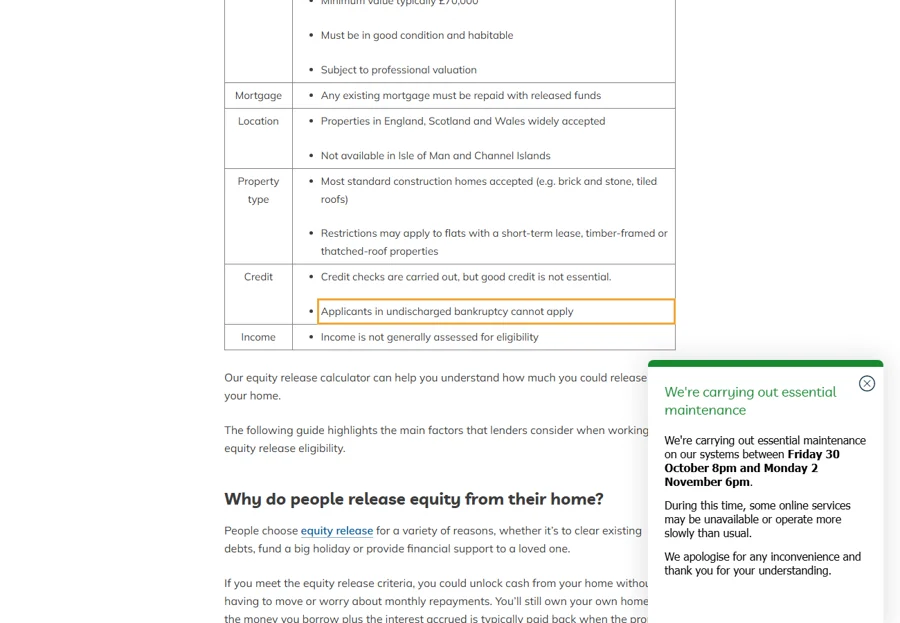
No to both, on a standard lifetime mortgage. LV= says credit checks are carried out but good credit isn't essential, and income isn't generally assessed, because nothing has to be paid each month. The one thing that does stop you is an undischarged bankruptcy: you'd need to be discharged first. LV= also asks for three years' residence in the UK, so a recent return from abroad can delay things.
Plans with compulsory payments are different. A payment term lifetime mortgage or a retirement interest-only mortgage tests your income and credit like an ordinary mortgage does.
Does your health affect whether you can get equity release?
No, you don't need to be in good health. It works the other way: some lenders offer more, or a lower rate, where health or lifestyle is likely to shorten the plan. That's an enhanced lifetime mortgage. I always ask whether you're happy to answer a few medical questions before I ask any, and you can say no.
What does matter is that you understand the plan and can agree to it yourself. If someone holds a lasting power of attorney for you, Age UK notes that lenders vary on whether they'll deal with the attorney, so tell me at the first meeting.
Who else can live in the house?
Anyone you like, but adults who aren't borrowers usually have to sign a waiver. Age UK explains that a family member or friend who moves in later, for company or to care for you, must sign an occupancy waiver giving up any right to stay once the plan ends, and should get their own legal advice first.
It catches people in two situations. A grown-up son or daughter living at home, who has to sign. And a single person who takes out a plan and later marries or moves a partner in: Age UK warns the plan may not transfer into joint names, so the partner may have to repay it or move out when you die or go into care. If either might apply, say so at the start.
Do you need to own all of your home?
Usually, yes. Equity release lenders lend on homes you own outright, and Legal & General states you need to own 100% of a shared ownership home before it will lend. Some people buy the remaining share with the release itself. That's covered on equity release on shared ownership.
How much do you have to borrow?
At least £10,000 with most lenders, according to Age UK and LV=. Some set the bar higher: Aviva's minimum is £15,000, which can be split as £10,000 up front and a £5,000 reserve. If you need less than that, a lifetime mortgage is probably the wrong tool, and I'd rather tell you so on the phone.
What would stop you from getting equity release?
Usually one of six things, and most can be fixed or worked round before you apply:
| What stops it | What can be done |
|---|---|
| A borrower under 55 | Wait, or look at a retirement interest-only mortgage from 50 |
| More owed on the home than the release can clear | Pay some off first, or look at a remortgage or downsizing |
| A lease that's too short | Extend it as part of the application |
| Non-standard construction or a hard-to-sell location | Find the lender whose rules fit; there often is one |
| Undischarged bankruptcy | Wait until you're discharged |
| An adult in the home who won't sign the waiver | Talk it through as a family; sometimes the plan isn't right |
A lower valuation than expected doesn't usually stop a plan, but it shrinks the maximum. The other reasons applications fail are on my page about whether you can be refused equity release.
How can you check whether you qualify before you apply?
Five steps, most of which you can do at the kitchen table in an evening.
Step 1: check the ages
Note the age of everyone on the deeds. If anyone is under 55, stop here and read the under-55 section above.
Step 2: find out what the house is built from and the lease length
Your purchase survey or the title deeds will usually say. For a flat, the lease shows the start date and term; work out the years left.
Step 3: estimate the value and list what's owed
Recent sale prices on your street give a rough value. Then add up the mortgage and anything else secured on the home.
Step 4: run the numbers
Put your age and value into my calculator, linked above. If the figure for your age doesn't comfortably clear what you owe, that's the first thing to talk about.
Step 5: ring an adviser before any application
I'll check your property type, lease and location against the lenders' rules on the phone, for free, before anyone pays for a valuation. The lender's surveyor makes the final call on value and condition.
FAQ
Is there a better way than equity release?
What is the bad side of equity release?
Can you get equity release at 80?
Can you get equity release with bad credit?
Can you get equity release if you're on benefits?
Final thoughts from me
The criteria, boiled down:
- You need to be 55 or over, and on a joint plan both of you do.
- It has to be your main home in the UK, usually worth at least £70,000.
- Any mortgage or secured loan is cleared from the money released.
- Credit and income aren't tested on a standard lifetime mortgage, but bankruptcy must be discharged.
- Construction, lease length and location are where lenders differ most.
- Other adults living with you will usually need to sign a waiver.
Sources
- LV=: equity release criteria, who is eligible?
- Aviva: are you eligible for our equity release?
- Aviva: equity release on leasehold property
- Age UK factsheet 65, Equity release, February 2026
- Legal & General: frequently asked equity release questions
- Woodhall Mortgages: mortgage age limits. Each lender sets its own maximum age, based on how old you'll be when the mortgage ends; with larger lenders it is often between 75 and 85.
Book your free initial consultation today.
Pick up the phone and speak to Jeremy directly. If equity release is not the right choice, I will say so.
07768 972861 Or try the quick calculator