
Home › Equity release › Retirement interest-only mortgages
Retirement interest-only (RIO) mortgages
If you're looking for a retirement interest-only mortgage, you're in the right place, and you've already done better than most: hardly anyone has heard of them. I arrange RIOs as well as equity release, which matters, because many of the people who ask me about one should really be looking at the other.

- On the FCA register, reference JLF01060 check the register
- Pellucid Ltd, FCA number 981845 check
- Equity Release Council member my profile
- SOLLA Later Life Lending Advice Standard
Quick answer: what is a retirement interest-only mortgage?
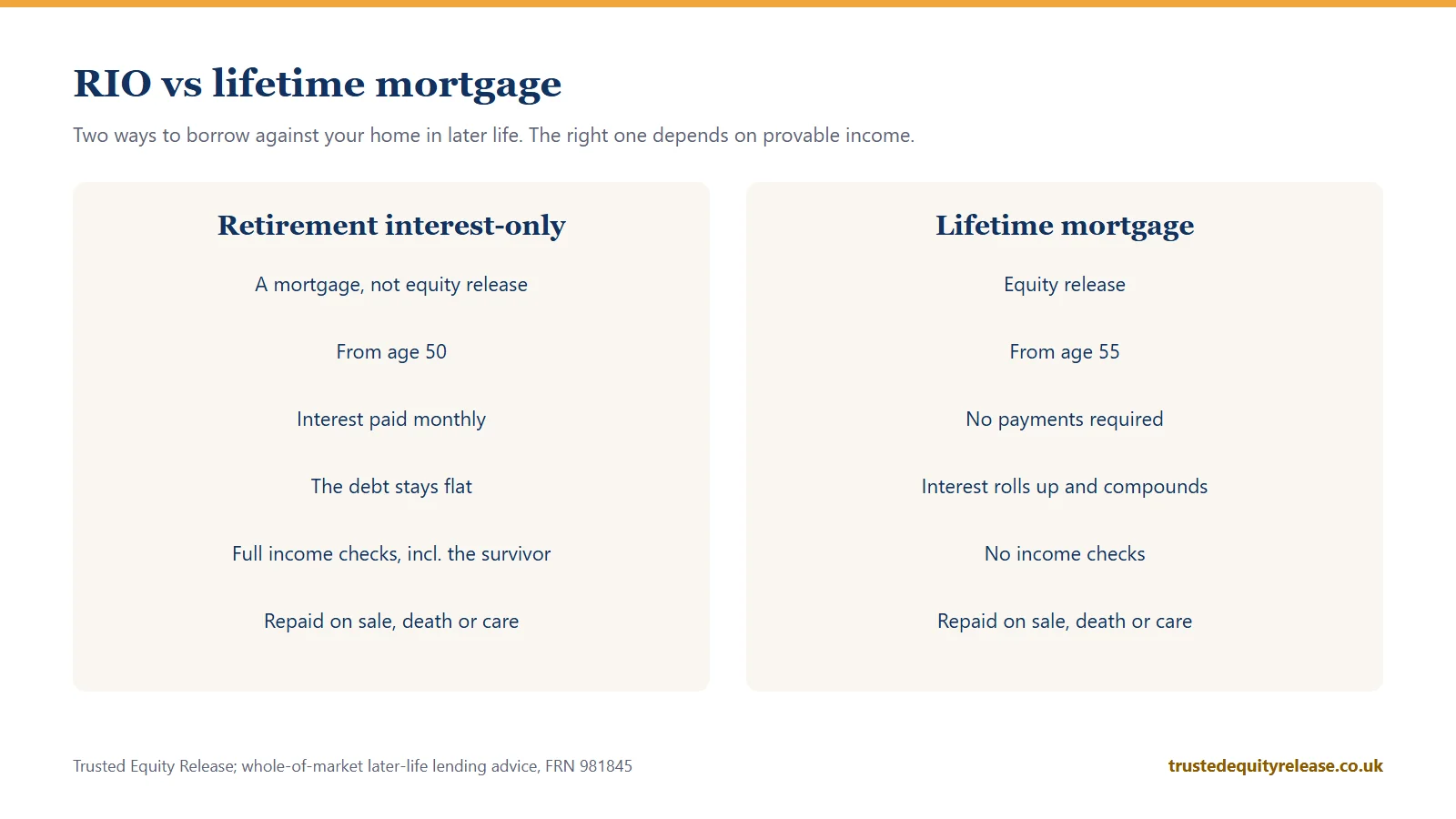
A RIO is a later-life mortgage, not equity release. You borrow against your home from age 50, pay the interest every month so the debt never grows, and the loan is repaid when the property is sold, on death or a move into long-term care.
Speak to a RIO mortgage specialist
Jeremy Furnell has specialised in later-life lending since 2009 and searches the whole market for RIO lenders. Book a free initial consultation by phone or at home.
Call 07768 972861How I arrange your RIO
Your home may be repossessed if you do not keep up repayments on your mortgage.
How does a RIO mortgage work?
You borrow a lump sum secured against your home and pay only the interest each month. Because you never pay interest on interest, the amount you owe stays the same. The loan itself is repaid when your home is sold. Your rate can be fixed or variable, and you can usually make overpayments to reduce the balance over time.
When is a retirement interest-only mortgage repaid?
Most RIOs have no end date. The loan is repaid from the sale of your home when the last borrower dies or moves into long-term care, or earlier if you choose to sell. A few RIOs have a fixed term. Repaying during a fixed-rate period may trigger early repayment charges.
Is a RIO equity release?
No. Since 2018 the FCA has regulated RIOs as standard mortgages, not equity release. You make monthly interest payments and your affordability is checked. A lifetime mortgage doesn't require payments and lets interest roll up. I'm qualified to advise on both, so I can compare them for you.
RIO mortgage rates
RIO rates are usually closer to standard mortgage rates than to lifetime mortgage rates. They vary by lender and loan-to-value, so I don't publish a rate table. Instead, you get a written quote based on your circumstances.
What affects retirement interest-only mortgage rates?
Lenders set your rate according to how risky the loan looks to them. The main factors are:
- Loan-to-value: borrowing a smaller share of your home's value usually gets a lower rate.
- Fixed or variable: and, for fixed rates, how long the rate is fixed for.
- The lender: each building society prices RIOs differently.
- Fees: a lower rate often comes with a higher product fee.
- Your property: non-standard construction or short leases can limit your choice of lenders.
Fixed vs variable RIO rates
A fixed rate keeps your monthly payment the same for 2, 5 or 10 years, and some lenders fix for life. A variable rate can rise or fall but usually has fewer early repayment charges. With payments coming from a fixed pension income, many borrowers prefer the certainty of a fixed rate.
What a RIO could cost you each month
Because you only pay interest, the monthly cost is easy to estimate: multiply the loan by the rate and divide by 12. These figures are illustrative only and are not quotes.
| Loan | 5% | 6% | 7% |
|---|---|---|---|
| £50,000 | £208 | £250 | £292 |
| £100,000 | £417 | £500 | £583 |
| £150,000 | £625 | £750 | £875 |
How to find the best RIO mortgage rates
Few RIOs appear on comparison sites, and many lenders only accept applications through an adviser. As a whole-of-market adviser, I can compare lenders on the total cost, including fees and early repayment charges, not just the headline rate. Borrowing a smaller share of your home's value also helps.
Who can get a retirement interest-only mortgage?
Each lender sets its own criteria, but they all look at the same things: your age, your income in retirement, your home and how much equity you have in it. Passing the income check is usually the hardest part, and I can tell you early whether you're likely to pass.
Can you get a RIO at 50?
Yes. Some lenders offer RIOs from age 50, five years before equity release becomes possible. For people aged 50 to 54 who need to restructure their borrowing, a RIO is often the main option. Other lenders set a minimum age of 55 for alternative products like equity release mortgages. See my guide to mortgages for over 50s for your other options.
Income and affordability checks
You must show you can afford the interest payments for life. Lenders assess your current and future retirement income, including:
- state, workplace and private pensions
- annuities
- rental or investment income
- earnings, if you're still working
For couples, most lenders check whether the survivor's income alone would cover the payments.
Property and equity requirements
The property must be your main home in the UK. Lenders also set a minimum property value and a minimum level of equity. Non-standard construction, short leases or homes with commercial elements can limit your choice of lenders.
How much can you borrow with a RIO?
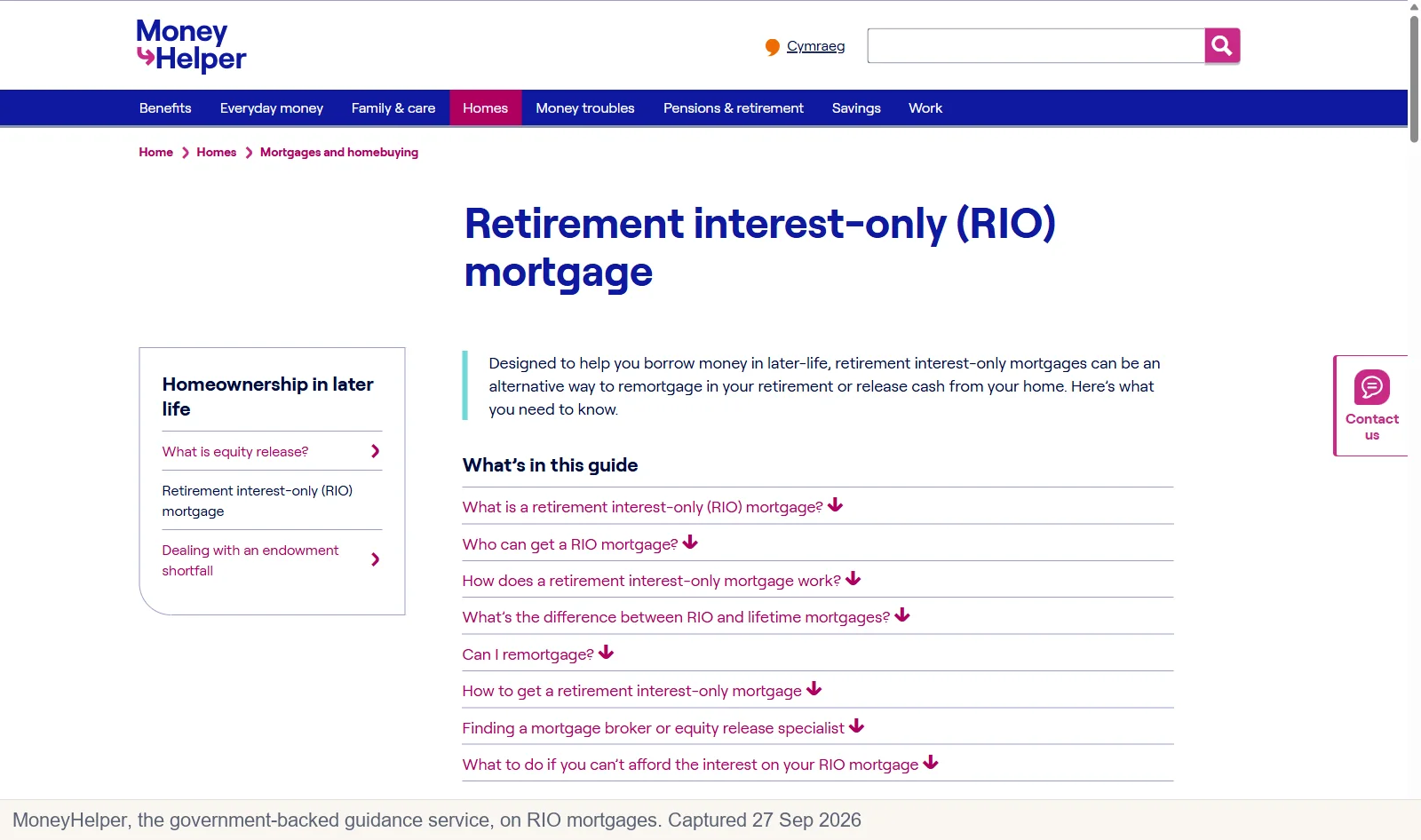
How much you can borrow depends on your income and your home's value. Because you're paying the interest, a RIO can lend far more than a lifetime mortgage. MoneyHelper suggests 50–60% of your home's value at age 50, compared with 10–20% on a lifetime mortgage at 55.
Which lenders offer retirement interest-only mortgages?
Mostly building societies, not high-street banks. As of September 2026, they include Leeds, Nottingham, Vernon, Scottish, Hanley and the Family Building Society, plus Legal & General and Royal London. Two lenders can reach opposite answers on the same pension income, so it pays to compare them all.
Why are RIO mortgages hard to get?
The affordability test is strict. You must prove the interest is affordable from retirement income, and for couples, most lenders test the survivor's income alone. That check declines more RIO applications than age does. When the income is there, a RIO is excellent. When it isn't, I'll say so.
RIO vs interest-only vs lifetime mortgages
All three let you borrow later in life without repaying the capital each month, but they work very differently.
| Standard interest-only mortgage | RIO mortgage | Lifetime mortgage | |
|---|---|---|---|
| Type | Mortgage | Mortgage | Equity release |
| Minimum age | Varies by lender | From 50 (varies by lender) | From 55 |
| Monthly payments | Interest | Interest | Optional |
| Debt grows? | No | No | Yes, unless interest is paid |
| End date | Fixed term | None | None |
| Affordability check? | Yes | Yes, for life | No income test, unless paying interest |
| Repaid by | Repayment plan at term end | Sale on death or care | Sale on death or care |
RIO vs a standard interest-only mortgage for over-50s
A standard interest-only mortgage has a fixed term, and you need a plan to repay the loan when it ends. A RIO has no end date because it's repaid when your home is sold. With around 601,000 interest-only and part-and-part mortgages outstanding at the end of 2025 (UK Finance, June 2026), and maturities peaking in 2031–32, many borrowers switch to a RIO when their term ends.
RIO vs lifetime mortgage (including interest-only lifetime mortgages)
Some lifetime mortgages let you pay the interest monthly, so they can look like a RIO. The key difference is that they're equity release: you can usually stop paying and let interest roll up, and you're protected by a no-negative-equity guarantee. A RIO requires payments for life and is often cheaper.
The choice usually comes down to one question: can you comfortably prove the monthly interest from pension income, for life? If yes, a RIO keeps the debt flat. If not, a lifetime mortgage may suit you better, and you can see what one costs on my equity release calculator.
Who is a RIO mortgage right for?
A RIO tends to suit you if:
- Your interest-only mortgage is ending: you can't repay the capital, but you can keep paying the interest.
- You want to release cash and protect your inheritance: the debt stays level instead of growing.
- You want to help family or improve your home: for example, a deposit gift or home improvements.
Are retirement interest-only mortgages a good idea?
For the right person, a RIO is one of the best-kept secrets in later-life lending: the debt never grows, the home stays yours, and the estate isn't eaten into by compounding interest. RIOs are often framed as a last resort next to equity release, but with dependable pension income they are often the option that costs the estate least.
A RIO is also one of the few clean answers when an old interest-only term ends and the lender wants its money back. The full picture is in my retirement mortgage debt statistics.
Advantages
- Your debt never grows, so more of your inheritance is protected.
- It's usually cheaper overall than a lifetime mortgage, because interest doesn't compound.
- It's available from age 50 and has no fixed end date.
Disadvantages and risks
- You must pass strict affordability checks, including on a survivor's income.
- Your home may be repossessed if you don't keep up repayments.
- Fees and early repayment charges can apply, and borrowing reduces your estate.
What if you can't keep up the payments?
Contact your lender straight away, and talk to me too. Lenders must treat you fairly and may be able to offer options. Switching to a lifetime mortgage, which doesn't require monthly payments, may help, but interest will then compound. Free, confidential debt advice is available through MoneyHelper.
RIO mortgage costs and fees
A RIO has costs beyond the monthly interest. Some you pay once when the mortgage is set up, and others can come up while you have it. MoneyHelper says setup fees alone can reach £3,000, so it's worth knowing what to expect before you apply.
Initial setup costs
These are one-off costs paid when you take out the RIO. Some lenders let you add certain fees to the loan, but you'll then pay interest on them.
- Arrangement or product fee: charged by the lender. Deals with a lower rate often carry a higher fee.
- Valuation fee: pays for the lender's valuation of your home. Some lenders offer this free.
- Legal fees: your solicitor's costs for conveyancing, title checks and searches.
- Early repayment charge on your current mortgage: only applies if you're leaving a fixed or discounted deal early.
Ongoing and management costs
The monthly interest is the main ongoing cost. A few other charges can come up over the life of the mortgage.
- Monthly interest payments: they stay the same on a fixed rate but change with the lender's rate on a variable one.
- Rate changes when a fixed period ends: some RIOs are fixed for life, while others move to the lender's variable rate after 2, 5 or 10 years.
- Early repayment charges: may apply if you repay, switch lender or move during a fixed-rate period.
- Fees for changes: switching product, borrowing more or moving the RIO to a new home can each bring new valuation, legal or product fees.
- Buildings insurance: lenders require you to keep your home insured for as long as you have the mortgage.
How I arrange your RIO mortgage
Retirement interest-only mortgages are a specialist product. Only a small number of lenders offer them, and each one sets its own age, income and property criteria. I have specialised in later-life lending since 2009. I am CeMAP and CERT CII (ER) qualified and search the whole market, so you aren't limited to one lender's range. I also arrange lifetime mortgages, so I can tell you plainly whether a RIO is the right fit or whether another option suits you better.
1. Free initial consultation. Talk it through with me by phone or at your home. I'll ask about your property, any existing mortgage, your pension income and what you need the money for. I'll then tell you whether a RIO is realistic before you spend any time or money on an application.
2. Search the market and check affordability. I compare RIO lenders whose criteria match your age, income and property. For joint applicants, I check whether the payments would still be affordable on the survivor's income alone, because most lenders test this. You'll get a written recommendation that sets out the rate, fees and monthly interest cost.
3. Application to completion. Once you're happy to go ahead, I handle the application, valuation and lender questions, and work with your solicitor through to completion. I stay your point of contact if you later want to move home, switch rates or borrow more.
Call Jeremy on 07768 972861 or request your free brochure.
Your home may be repossessed if you do not keep up repayments on your mortgage.
RIO mortgage FAQs
Can pensioners get a mortgage?
Can a RIO replace an interest-only mortgage that's ending?
Can I get an interest-only mortgage in my 60s or 70s?
What happens to a joint RIO if one of us dies?
Can I make overpayments on a RIO?
Sources
- MoneyHelper: retirement interest-only mortgages
- FCA: later life lending market study (MS26-1)
- UK Finance: interest-only mortgages update, published 17 June 2026
- Trusted Equity Release: retirement mortgage debt statistics
- FCA register: Pellucid Ltd, FRN 981845
Book your free initial consultation today.
Pick up the phone and speak to Jeremy directly. If equity release is not the right choice, I will say so.
07768 972861 Or try the quick calculator