
Home › Equity release › Pros and cons
Equity release pros and cons: is it a good idea for you?
If you're looking to weigh up the pros and cons of equity release before you decide, you're in the right place. The first thing I tell people is that equity release is Marmite: you're either going to love it or hate it, and both reactions can be right, so this page sets out the balance sheet I go through at the kitchen table, with the numbers.

- On the FCA register, reference JLF01060 check the register
- Pellucid Ltd, FCA number 981845 check
- Equity Release Council member my profile
- SOLLA Later Life Lending Advice Standard
Quick answer: what are the pros and cons of equity release?
The pros: tax-free cash, no monthly repayments, the right to stay in your home for life, and never owing more than it's worth. The cons: unpaid interest compounds, your family inherits less, a lump sum can cut means-tested benefits, and repaying early can cost a charge.
Why speak to Jeremy about the pros and cons?
Because I'll tell you when the cons win. It's on my website and I mean it: if equity release isn't the right choice for you, I'll say so, and some conversations end with "not yet" or "not at all". When a client no longer needs a plan, I cancel it without a fee, as the review below records. I've specialised in later-life lending since 2009, hold CeMAP, CERT CII (ER) and the SOLLA Later Life Lending Advice Standard, and I'm an Equity Release Council member and whole of market. It's me from the first call to completion, at your home or on the phone, with your family welcome. Trusted Equity Release is a trading name of Pellucid Ltd, authorised and regulated by the Financial Conduct Authority, FRN 981845.
“He promptly cancelled the application on our behalf, with no cancellation fees, no resentment, and no animosity.”
What are the pros and cons of equity release at a glance?
Here's the whole ledger for a lifetime mortgage (over 99% of equity release is one) before I go through each line:
| Pros | Cons |
|---|---|
| Tax-free cash, as a lump sum or in stages | Interest compounds if you pay nothing: £60,000 becomes about £111,900 in ten years |
| No monthly payments required | Rates are usually higher than ordinary mortgage rates |
| You stay in your home for life, and keep owning it | Your family inherits less |
| You can never owe more than the home sells for | A lump sum can reduce or end means-tested benefits |
| Partial repayments without a penalty | Repaying the whole plan early can bring an early repayment charge |
| You can usually move house and take the plan with you | Set-up costs: advice, valuation, solicitor, sometimes an arrangement fee |
| No income or affordability test | You can't borrow against the home from another lender |
| Drawdown: interest only on what you take | Conditions on how you use and look after the home |
| Inheritance protection can ring-fence a share | Less equity left for care or a later move |
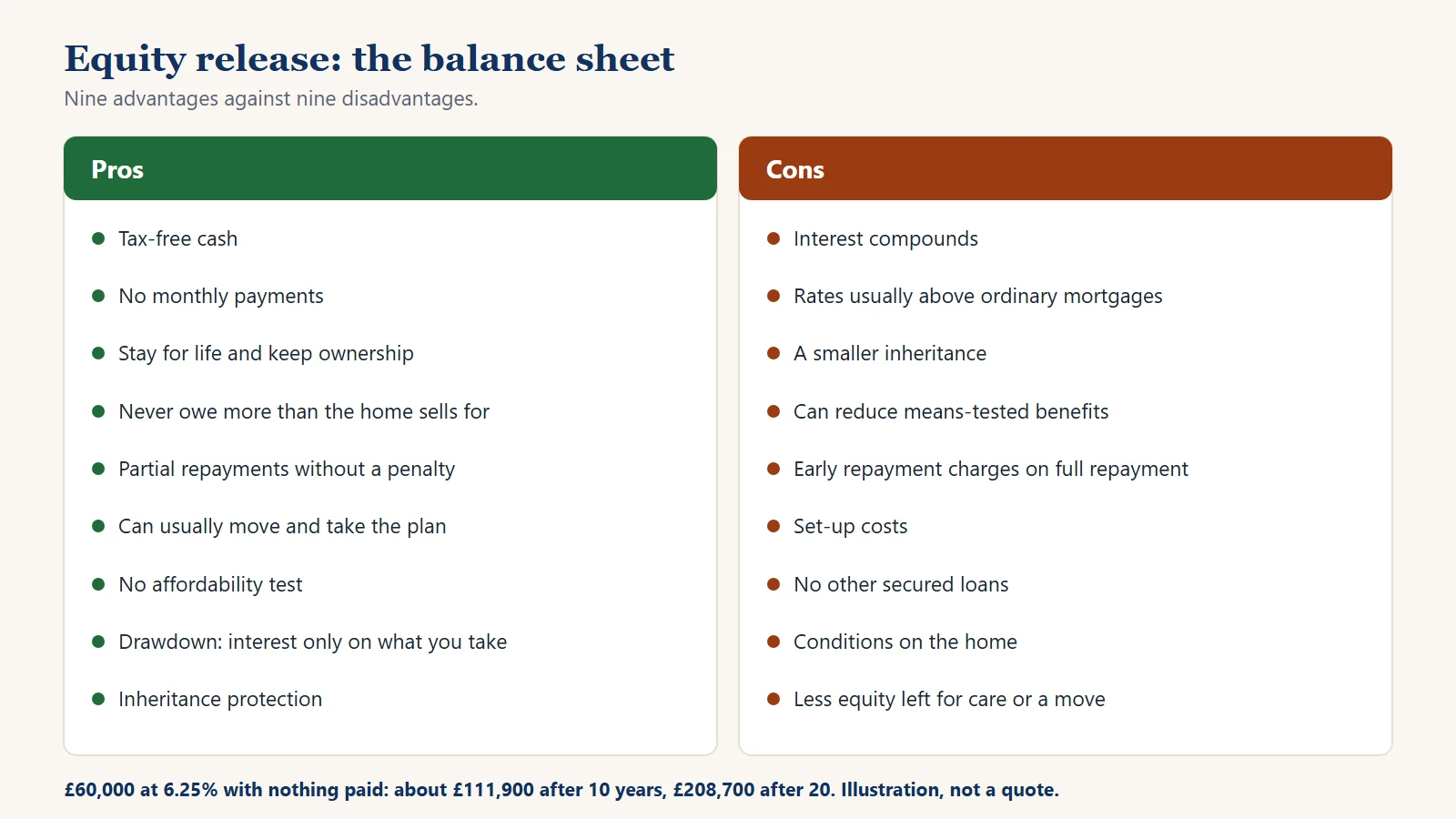
*Illustration at 6.25% a year compounded monthly, the rate my equity release calculator uses. Home reversion has a different set of pros and cons: it's a sale, not a loan.*
What are the advantages of equity release?
The short version: you get money out of your home without moving, and without a monthly bill. Each of these comes with a condition, which I've put alongside it.
Is the money from equity release really tax-free?
Yes. It's a loan, not income, so there's no income tax or capital gains tax on the money you release. Two things can still bring tax into it: interest earned if the money sits in savings, and inheritance tax on gifts if you die within seven years of making them. The detail is on my page do you pay tax on equity release?
Can you stay in your home for the rest of your life?
Yes, on any plan that meets Equity Release Council standards: the right to live there for life, or until you move into long-term care, as long as it stays your main home and you keep to the terms. On a joint plan, nothing changes when the first of you dies or goes into care. The survivor stays, and nothing is repaid until they die or move into care too.
Do you have to make monthly repayments?
No. Nothing has to be paid while you live there. Since March 2022, every Council plan has also let you make partial repayments without a penalty, within the lender's yearly limit, and on many plans I arrange you can pay from £50 a month or a set share of the interest. That lets you keep the debt down while your income allows it, and stop if things change.
Can you ever owe more than your home is worth?
No. The no negative equity guarantee means that when the home is sold, neither you nor your estate will owe more than the sale price after reasonable selling costs, even if the loan has grown past it. It's a standard on every Equity Release Council plan.
Can you still move house?
Usually, yes. Council standards give you the right to move and take the plan with you, as long as the new home is acceptable to the lender as security. If it's worth less, you may have to repay part of the loan from the sale, and Age UK notes that some lenders won't accept age-restricted or leasehold retirement housing. My page can I move house? covers the rest.
Do you need to pass an income or affordability check?
No. There's no affordability assessment, as MoneyHelper points out, because nothing has to be paid monthly. That's the big practical difference from a mortgage or a retirement interest-only mortgage, where the lender has to be sure you can pay the interest for life.
Can you take the money in stages?
Yes, with a drawdown plan. You take a first amount and leave the rest in a reserve, and you only pay interest on what you've drawn. On £60,000 needed over ten years, taking it in three stages leaves about £19,600 less to repay than taking it all on day one. The catch is that the reserve isn't guaranteed.
Can you still leave an inheritance?
Yes, in two ways. Inheritance protection ring-fences a percentage of the sale price for your family, at the cost of a smaller release. And paying some of the interest keeps the debt from growing, which protects what's left without any promise from the lender.
Do you still benefit if house prices rise?
With a lifetime mortgage, yes: you own the whole home, so any rise in value is yours, and it's your family's once the loan is repaid. With home reversion you don't, on the share you sold. It's one reason I don't advise on it.
What can you spend the money on?
Almost anything. The six reasons on my website cover what people bring to me: paying off a mortgage or debts, improving or adapting the home, topping up income, helping children or grandchildren, travel, and paying for care at home. Lenders may ask what it's for, and Age UK notes that most won't lend for investment.
What are the disadvantages of equity release?
The biggest is the cost over time, then the effect on what you leave and on any benefits. Here they are one at a time, with the numbers where I have them.
How quickly does equity release interest build up?
Faster than most people expect, because it compounds: interest is charged on the interest already added. These are the figures from my calculator for £60,000 with nothing paid:
| £60,000 at 6.25%, nothing paid | Owed | Of which interest |
|---|---|---|
| After 10 years | about £111,900 | about £51,900 |
| After 15 years | about £152,800 | about £92,800 |
| After 20 years | about £208,700 | about £148,700 |
| After 30 years | about £389,300 | about £329,300 |
*Illustrative: 6.25% a year, compounded monthly, no repayments.*
The 30-year line is why age matters so much. A plan started at 55 has far more years to run than one started at 80, and every extra year compounds on the last. Age UK makes the same point from the lender's side: the younger you are, the less you can borrow, because the debt has longer to grow.
Are equity release interest rates higher than ordinary mortgages?
Usually, yes. Legal & General says lifetime mortgage rates rise with ordinary mortgage rates and are usually higher than them, and MoneyHelper says the same. The rate is fixed for life once you take it. That protects you if rates rise, but you don't benefit if they fall. Where rates sit now is on my page about equity release interest rates.
How much less will your family inherit?
Everything the plan has grown to comes off the sale price first. Here's the same £300,000 home with £60,000 released, and, purely to keep the arithmetic clear, assuming its value doesn't change:
| £300,000 home, £60,000 released, nothing paid | Owed when the home is sold | Left for the family before sale costs |
|---|---|---|
| No equity release | £0 | £300,000 |
| Sold after 10 years | about £111,900 | about £188,100 |
| Sold after 15 years | about £152,800 | about £147,200 |
| Sold after 20 years | about £208,700 | about £91,300 |
*Illustrative: flat house price assumed for clarity, not a forecast. In practice the value could rise or fall.*
And here's the guarantee doing its job. Release £120,000 at 70 instead and leave it 20 years, and the debt reaches about £417,500. If the home still sold for £300,000, your family would receive nothing, but they wouldn't owe the £117,500 difference either. That's the no negative equity guarantee. What the family has to do in practice is on my page will my family end up in debt?
Will equity release affect your benefits?
It can, and this is the one people most often don't see coming. The money counts as savings while it sits in the bank, so it can reduce or end means-tested benefits: Pension Credit, Council Tax Reduction and Universal Credit among them, and Saga adds Savings Credit. For Pension Credit, GOV.UK says savings above £10,000 count as £1 a week of income for every £500.
| Lump sum left in the bank (no other savings) | Counted above £10,000 | Treated as weekly income for Pension Credit |
|---|---|---|
| £10,000 | £0 | £0 |
| £20,000 | £10,000 | £20 |
| £30,000 | £20,000 | £40 |
*Illustrative, using GOV.UK's rule. Your actual entitlement depends on everything else you have.*
Benefits that aren't means-tested, such as the State Pension, Attendance Allowance and Personal Independence Payment, aren't usually affected, LV= says. Age UK adds that if the council funds care at home, it may start charging you or ask you to pay more, and that money released for essential repairs can sometimes be ignored for Pension Credit for 12 months. That's why I check your benefits before suggesting an amount, and why drawdown, which keeps money out of your account until you need it, is often the better shape.
What are early repayment charges, and when do they apply?
A charge for repaying the whole plan early, outside the situations where it's waived. Lenders price a lifetime mortgage on it running for life, so repaying early costs them. Since May 2025 the Equity Release Council's standards waive the charge when the last borrower moves permanently into long-term care, with a medical certificate. Partial repayments within the yearly limit are free. Legal & General also warns that your existing mortgage may have its own early repayment charge when equity release pays it off. The detail of how charges are worked out is on my page about whether you can pay back equity release.
What does equity release cost to set up?
There's the lender's side: a valuation, sometimes an arrangement fee, and your own solicitor, which Council standards require. Then there's advice. My own fee works like this: the first conversation is free, there's nothing to pay unless the plan completes, it's a fixed fee rather than a percentage, it can be taken from the money released, and it covers you for the life of the plan, so later questions cost nothing. I'll tell you the figure on the phone. Ask any adviser to show you every fee in writing before you commit; it'll be in your illustration either way.
Can you borrow against your home again?
Not from another lender. Once you have an equity release plan, LV= and Saga both say you can't secure further loans on the home elsewhere. You may be able to borrow more later from the same lender, as a further advance or from a drawdown reserve, but neither is guaranteed.
Are there rules on how you use and look after your home?
Yes. You still maintain, repair and insure it, and Age UK says that if you don't, the lender can carry out repairs and charge you, or add the cost to the loan. MoneyHelper lists other restrictions that can apply: not letting it as a holiday let, not leaving it empty for long periods, and not making large structural changes. Breaking the terms, renting the home out for example, can put the plan in breach.
Could equity release limit your options later?
It can. Money released now isn't there later, so if you need care at home or want to downsize in a few years, Age UK warns there may not be enough equity left to fund it. MoneyHelper makes the same point about care. If you think a care home is likely soon, a lifetime mortgage may not suit at all, because it's designed to be repaid when you move into care.
What if someone moves in with you later?
Anyone who moves in after the plan starts, an adult child or a carer for instance, has to sign a waiver giving up any right to stay when the plan ends, and Age UK says they should get legal advice first. Age UK also warns that if you take a plan alone and later marry or a partner moves in, you may not be able to add them, so they could have to leave or repay the loan when you die or go into care. If there's any chance of either, I'd want to know before we choose a plan.
Can gifts from equity release cause problems?
Two. If you give money away and die within seven years, the gift can count towards inheritance tax, Legal & General and GOV.UK both note. And if you give money away and later need council help with care, the council may say you deliberately deprived yourself of it, Age UK warns, and charge as though you still had it. Neither is a reason not to help your family. Both are reasons to plan the gift properly.
What is the catch with equity release?
There's no hidden one. Advice is compulsory, and before you sign you get a personalised illustration showing what the plan will cost, plus a written recommendation explaining why it suits you. The FCA's rules make the adviser weigh your benefits, the alternatives, what you want to leave, your health and your plans before recommending anything.
The real catch is in plain sight: time. The compounding is modest in the first few years and heavy after ten or fifteen, and it's the later years that decide what your family receive. That's why I show the long-run figure first.
What are the pitfalls people fall into?
The ones I watch for:
| Pitfall | What it costs | What I'd do instead |
|---|---|---|
| Taking more than you need now | Interest on money sitting in the bank | Drawdown, or a smaller release |
| A lump sum sitting in savings | Lost Pension Credit or Council Tax Reduction | Check benefits first; draw down as needed |
| Starting too young | Decades more compounding | Wait, or look at the alternatives |
| Leaving the family out | Shock, and arguments, at probate | Family in the room, or on the phone |
| Not planning for a move or care | Not enough equity left later | Talk about the next ten years before the first figure |
| A solicitor who rarely does equity release | Delays and errors | A solicitor who does it every day; the choice stays yours |
| Paying nothing when you could pay something | The full compounding cost | Even £50 a month slows it |
Is equity release safe?
Yes, in the sense that matters most: on a Council plan you can't be made to leave your home while you keep to the terms, and you can't owe more than it's worth. Equity release is regulated by the FCA, advice is required, and Unbiased reports the Equity Release Council saying it's rare for a lender to take possession of a home. The conditions are the ones above: it stays your main home, you keep it in repair and insured, and you don't let it out without permission. More on my page are lifetime mortgages safe?
Is equity release a good idea for you?
It depends on you, not on the product. As I tell everyone: there's no right and no wrong, it's down to personal preference, and you've got to be happy with whatever choice you make. I'll give a recommendation, in writing, and I'll tell you why if it's no. People don't always appreciate that when they hear it. Some come back later and say it was the right call.
When is equity release a good idea?
- You want to stay in your home and wouldn't downsize, or can't.
- You have a clear use for the money now, not "just in case".
- You've a clear plan for how the money covers any gap in your income.
- Your family know, or you have nobody whose inheritance you're worried about.
- The cheaper alternatives have been looked at and don't fit.
When is equity release a bad idea?
- You'd be happy to downsize and keep the estate whole.
- A lump sum would knock out benefits you rely on.
- You're in your fifties, with no pressing need, and decades of compounding ahead.
- A care home is likely soon.
- Leaving as much as possible to your children is your top priority.
- You could borrow more cheaply, from a mortgage or a retirement interest-only mortgage, and afford the payments.
What is better than equity release?
Whatever does the same job for less, in your case. Downsizing keeps the estate whole and costs no interest. A retirement interest-only mortgage keeps the debt flat if your income can carry the monthly interest; my page comparing a RIO with equity release sets the two side by side. Savings or investments, help from family, a council or charity grant for adaptations, and renting a room (up to £7,500 a year tax-free under the government's Rent a Room scheme) can each cover a gap. A real recommendation rules these out before it rules equity release in; they're all on my page about alternatives to equity release.
What should your family know before you decide?
Everything, ideally, and early. In my experience the people who complain about equity release are rarely the ones who took it out. It's the children, because the inheritance is smaller than they'd hoped. So I ask for family to be involved wherever you're happy for them to be: at a meeting, on the phone from another county, or copied in on emails. I've got nothing to hide, and a plan the family understands is one nobody is surprised by later.
FAQ
Who owns the property after equity release?
What is the best age to take out equity release?
What happens to equity release when you die?
Does equity release affect your State Pension?
Can you lose your home with equity release?
Can you change your mind after taking out equity release?
Final thoughts from me
The ledger, in six lines:
- The money is tax-free, you stay in your home for life, and nothing has to be paid monthly.
- Unpaid interest compounds: £60,000 becomes about £111,900 in ten years and £208,700 in twenty.
- Your family inherit less, so they belong in the conversation from the start.
- A lump sum in the bank can reduce Pension Credit and other means-tested benefits.
- You can never owe more than the home sells for, and you can repay part without a penalty.
- Downsizing, a retirement interest-only mortgage or family help can each do the same job for less.
Book your free initial consultation today.
Pick up the phone and speak to Jeremy directly. If equity release is not the right choice, I will say so.
07768 972861 Or try the quick calculator