
Home › Equity release
UK equity release advice: how much cash can you free up from your home?
If you're looking for UK equity release advice, you're in the right place. I'm Jeremy Furnell, an equity release adviser based just outside March in Cambridgeshire, and this page answers the questions people ask me on the first phone call: how much, what it costs, how I'm paid, and what happens at each step.

- On the FCA register, reference JLF01060 check the register
- Pellucid Ltd, FCA number 981845 check
- Equity Release Council member my profile
- SOLLA Later Life Lending Advice Standard
Quick answer: how much cash can you free up with equity release?
Typically 25% to 28% of your home's value at 55, 40% to 43% at 70 and 50% to 57% from 80, less any mortgage that has to be cleared. Health, property and the lender move the figure. Interest compounds if you pay nothing, so release only what you need.
Why speak to Jeremy about equity release advice?
Because the person you ring is the person who visits, recommends and sees it through. With the big firms you can deal with a salesperson who passes you to an administrator; with me, it's me from the first call to completion, and afterwards. I've worked in financial services since 1996 and qualified in equity release in 2009. I hold CeMAP, CERT CII (ER) and the SOLLA Later Life Lending Advice Standard, and I'm a member of the Equity Release Council, which since April 2026 means passing its exam every year.
I tell people equity release is Marmite: you'll either love it or hate it, and if it isn't right for you I'll say so and explain why. Trusted Equity Release is a trading name of Pellucid Ltd, authorised and regulated by the Financial Conduct Authority, FRN 981845.
“Excellent, professional and friendly service, we highly recommend Jeremy. He was very quick to reply to our enquiry and kept us posted at all times during the process. Thanks so much for all your help.”
What is equity release, and how does a lifetime mortgage work?
Equity release lets a homeowner aged 55 or over take money out of their home without moving. The correct name for the plan I arrange is a lifetime mortgage: a loan secured on your home that you take out once and that stays in place for the rest of your life. You keep owning the house. Nothing has to be repaid until the last borrower dies or moves into long-term care, when the house is normally sold and the lender is repaid from the sale.
You can take the money as one lump sum, or as a smaller first amount with a reserve to draw on later, which keeps the interest down because you're only charged on what you've drawn. Interest is fixed, or capped, for life. You can let it roll up, or pay some or all of it each month: the plans I arrange can take interest payments from £50 a month, or at 25%, 50%, 75% or 100% of the monthly interest. Everything about how they work is on my page about lifetime mortgages.
What about home reversion?
There are two types of equity release. The other one, home reversion, means selling all or part of your home to a provider for less than its market value in return for the right to stay there. I don't advise on home reversion, because it doesn't fit my ethos, but I'm always happy to explain the difference. It's rare now: the FCA counted 25 home reversion sales in the four years from 2022 to 2025, against lifetime mortgages at more than 99% of the market (my equity release statistics page has the detail). A side-by-side comparison is on my page about the types of equity release.
How much cash can you free up at your age?
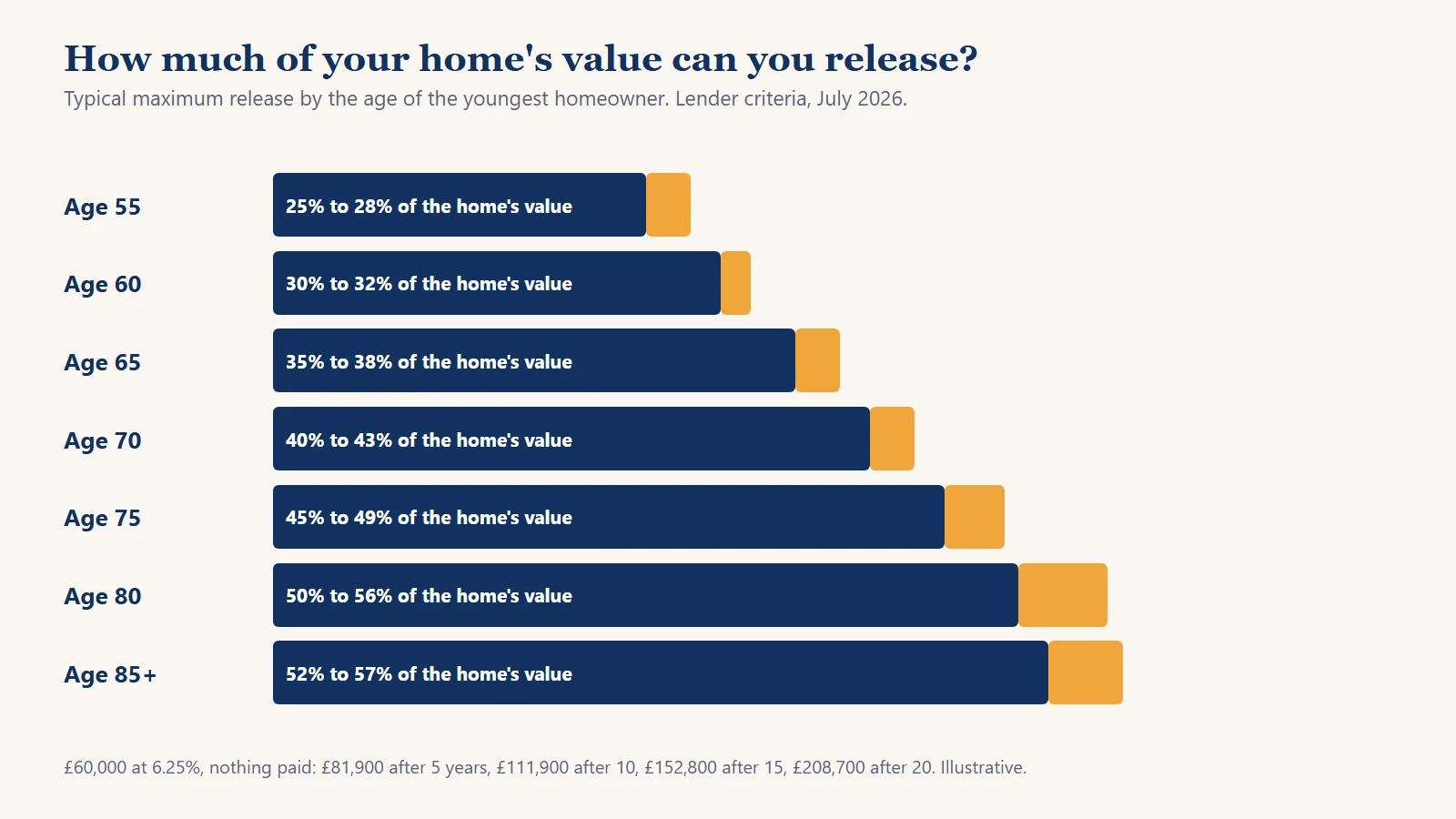
Between about a quarter and a little over half of your home's value, and age decides most of it. These are the bands my calculator works from, taken from lender criteria published in July 2026 and rounded down. They're maximums, not targets.
| Age of the youngest homeowner | Typical maximum release |
|---|---|
| 55 | 25% to 28% of the home's value |
| 60 | 30% to 32% |
| 65 | 35% to 38% |
| 70 | 40% to 43% |
| 75 | 45% to 49% |
| 80 | 50% to 56% |
| 85 and over | 52% to 57% |
How much could you release from your home?
Three quick questions and an indicative figure straight away. No name, phone number or email needed to see it.
*Illustrative bands from lender criteria, July 2026. Your actual figure comes in a written quotation after advice.*
It works on the youngest borrower's age because a joint plan runs until the second of you dies or moves into care. A worked example, the same one my calculator uses: a 70-year-old in a £300,000 house could typically release 40% to 43%, which is £120,000 to £129,000. With £40,000 still on the mortgage, that has to be cleared first, so the cash in hand is £80,000 to £89,000.
In practice most people take much less than the maximum. FCA sales data for 2022 to 2025 puts the median lifetime mortgage at about 15% of the home's value, with a median borrower age of about 71. You can run your own figures, with no name or phone number asked, on my equity release calculator.
What changes the figure a lender will offer you?
Five things, roughly in order of how much they move it:
| What moves it | How it changes the figure |
|---|---|
| Age of the youngest borrower | The biggest single factor: older means a higher percentage |
| Your health and lifestyle | Some lenders offer more, or a lower rate, where health or lifestyle is likely to shorten the plan. That's an enhanced lifetime mortgage |
| The property | Standard construction in a saleable spot gets the full bands. Flats above shops, ex-local-authority blocks and non-standard construction can get a smaller offer or a decline. Most lenders want the home worth at least £70,000 |
| The valuation | The percentage is applied to the lender's valuation, not your estimate. If the surveyor comes in lower, the maximum falls with it |
| Lump sum or drawdown | Taking a smaller first amount with a reserve doesn't raise the maximum, but it cuts the interest you pay, because the reserve isn't charged until you use it. How the reserve works is on my page about drawdown lifetime mortgages |
I ask before I ask anything medical. Some people would rather not discuss their health, and that's their choice, but on an enhanced plan it can make a real difference to the figure.
How much does a lifetime mortgage grow if you pay nothing back?
It roughly doubles in about 11 years at today's rates, because interest is charged on interest. These figures are for £60,000 at 6.25% a year, compounded monthly, the lowest advertised rate when my calculator was last updated:
| Years since release | What you owe, paying nothing | What you owe, paying all the interest monthly |
|---|---|---|
| 5 | about £81,900 | £60,000 |
| 10 | about £111,900 | £60,000 |
| 15 | about £152,800 | £60,000 |
| 20 | about £208,700 | £60,000 |
*Illustrative, from the Trusted Equity Release calculator. Your own rate is fixed when the plan starts.*
Paying all the interest on that £60,000 would cost about £312.50 a month. Paying part of it, or making penalty-free partial repayments, which every Equity Release Council plan has allowed since March 2022 within the lender's yearly limit, slows the growth. The debt can never be more than the house sells for, but the bigger it grows, the less your family inherits. Current rates and what moves them are on my equity release interest rates page.
Who can get equity release, and is it difficult?
It isn't difficult for most homeowners over 55, provided the house and any existing debt fit the lender's rules. What's harder is getting the right terms, which is why comparing lenders matters. The basics:
| Criterion | What lenders usually want |
|---|---|
| Age | 55 or over for a lifetime mortgage; both of you if it's joint |
| Your home | Your main residence, in the UK, in reasonable condition |
| Value | Usually at least £70,000 |
| Existing mortgage | Allowed, if the release is big enough to clear it on day one |
| Who lives there | Anyone else living there may need to sign a waiver |
| Income | No income test on a plan where the interest rolls up |
Every lender's detail is different, and leasehold, construction and location rules vary most. The full list is on am I eligible for equity release?, how a mortgage is cleared is on equity release with an existing mortgage, and the reasons applications fail are on can you be refused equity release?
What does equity release cost, apart from the interest?
There are usually four costs to set up a plan, plus a charge if you repay the whole thing early. National Debtline lists the same ones, and I'd want you to know each before you apply:
| Cost | Who charges it | When it's paid |
|---|---|---|
| Advice fee | Your adviser | With me: only if the plan completes, and it can come out of the money released |
| Legal fee | Your own solicitor | Agreed with your solicitor. Get it in writing first |
| Valuation fee | The lender's surveyor | Usually when you apply. Depends on the lender and the home's value |
| Lender's application or completion fee | The lender | On completion, and some lenders let you add it to the loan |
| Early repayment charge | The lender | Only if you repay the whole plan early, outside the exceptions in your offer |
Ask any adviser for the whole set in writing before you say yes. I'll tell you every figure on the phone, my own included.
Should you pay for equity release advice, or can you get it free?
You can get free guidance, but advice that recommends a plan is a regulated service and someone pays for it, either you or the lender. Before a lifetime mortgage goes ahead you have to take that advice.
Free help exists and is worth using. Age UK gives free information about equity release, and says plainly that it doesn't offer equity release itself. MoneyHelper, the government-backed service, explains how it works. Neither will look at your circumstances and recommend a plan.
How are equity release advisers paid?
In one of three ways, and you're entitled to know which before you start:
| How the adviser is paid | What it means for you |
|---|---|
| A fee you pay | Fixed or a percentage of the loan. Often payable only on completion |
| Commission from the lender | No separate fee to you. Aviva, for example, pays its own advisers commission on completion, and those advisers can only recommend Aviva's plan |
| Both | A fee from you plus commission from the lender, disclosed up front |
With me, the first conversation is free and there's nothing to pay me unless your plan completes. My fee is fixed, not a percentage of what you borrow, so it doesn't grow with the loan. It can be taken from the money released, and it covers you for the life of the plan: if you want to draw more, move house or repay part of it years later, you ring me and I help. I'll tell you the figure on the phone. Independent legal advice is compulsory too, so there's a solicitor's fee whoever you use.
Does it matter if an adviser is independent, whole of market or tied?
Yes, because it decides which plans you're even shown. A tied adviser can recommend one lender's plans only; a restricted adviser works from a shortlist; a whole-of-market adviser can recommend any lender's. Lenders differ on property types, health, drawdown and early repayment charges, and those details decide cases.
| Type of adviser | Plans they can recommend | The question to ask them |
|---|---|---|
| Tied to a lender | That lender's only | "Would another lender pay out more, or charge less?" |
| Restricted | A panel or shortlist | "Which lenders are on your panel, and why?" |
| Whole of market | Any lender's | "Which lenders did you compare for me?" |
I'm whole of market, and declared as independent on the Later Life Lending Advice Standard register. What that means when you're choosing someone is on my page about choosing an equity release broker.
What happens at each step of equity release advice?
Seven steps, from the first phone call to the years after completion. Here's who does what, and where it tends to go wrong.
Step 1: a free first phone call
You ring, or I ring you back. I want to know what the money's for, roughly what the house is worth, what's owed on it and who lives there. It's a conversation, not a sales pitch, and sometimes it ends with me saying equity release isn't the answer. Some people want a figure without talking to anyone; the calculator is there for that, and I don't mind.
Step 2: a meeting at your home, or by phone
Most of my advice happens at a kitchen table, because I like to see the whites of people's eyes and know they've understood. I ask about income, savings, benefits and health (with your permission first), what you'd like to leave your family, and whether you might move. Family members are welcome, in the room or on the phone. I'll tell you beforehand what paperwork to have ready.
Step 3: research and a written recommendation
I compare lenders across the market for your age, property and health, and check the routes that might cost less. FCA rules require that, and I'd do it anyway. If a lifetime mortgage fits, you get my recommendation and a personalised illustration on paper to keep and read at your own pace. If it doesn't, I'll say so. The commonest mistake I see is choosing a plan on the interest rate alone and ignoring early repayment charges or whether it can move with you.
Step 4: the application and the valuation
When you're ready, I complete the application with you; one grandson's review describes me helping his gran complete complex application forms. The lender then sends a surveyor to value the house. If the valuation is lower than you expected, the maximum release falls, and we look again before anything is signed.
Step 5: the offer and your solicitor
The lender sends a formal offer, and your own solicitor gives you independent legal advice, which is an Equity Release Council requirement. I recommend a firm that does equity release day in, day out, but the choice is yours. Using a general high-street firm is the commonest cause of delay I see: one client's own solicitor, a friend, made a straightforward case much harder work.
Step 6: completion and the money
Your solicitor completes, any existing mortgage is paid off first, and the rest reaches your bank account. How long it takes varies with the lender and the solicitor; the stages are on my page about how long equity release takes. The quickest case I can point to in writing is Shaun Mizen's gran, who had funding secured within a week of my first visit.
Step 7: after completion
The plan runs for life, and so does my involvement. If you want to draw from a reserve, make a partial repayment, move house or ask whether something's changed, you ring me. You can also change your mind before completion. Shaun's gran had a wobble, stopped and restarted, and when probate came through and she no longer needed the money, I cancelled the application with no cancellation fee.
What are the pros and cons of equity release?
The main advantage is cash without moving or making monthly payments; the main disadvantage is the cost, which comes out of your estate. The bad side, honestly put:
| Pros | Cons |
|---|---|
| A tax-free lump sum or reserve | Interest compounds if you pay nothing, as the table above shows |
| You stay in your home and keep owning it | Your family inherits less, possibly nothing from the house |
| No monthly payments required | A lump sum in the bank can reduce means-tested benefits |
| Interest fixed or capped for life | Repaying the whole plan early can bring an early repayment charge |
| You can move, if the new home suits the lender | Set-up costs: advice, legal, valuation and lender fees |
| The no negative equity guarantee | If house prices fall, the debt takes a bigger share of the home |
| You can protect a share for inheritance | Anyone moving in later may need the lender's agreement |
The longer version is on my page about the pros and cons of equity release, and whether your family could ever owe money is answered on will my family end up in debt? (they can't, under the guarantee).
Is there a better way than equity release?
Sometimes, and an adviser has to look. Aviva says its advisers recommend a lifetime mortgage to only about a quarter of the people they speak to, which tells you how often the answer is something else. The routes I check first:
| Alternative | When it fits | The catch |
|---|---|---|
| Downsizing | You'd move anyway, and want no debt | Moving costs, and leaving a home you love |
| Savings or investments | You have them and the sum is modest | Less of a cushion later |
| Help from family | They can lend or give | It changes family finances and expectations |
| A benefits check | Your income is low | Only helps if you're entitled, and it takes a claim |
| Council grants | You need adaptations for a disability | Means-tested, and for adaptations only |
| A remortgage | Your income covers monthly payments | Lender age limits; see equity release vs remortgage |
| A retirement interest-only mortgage | Your pension covers the interest | Affordability tested; I arrange these from age 50, see retirement interest-only mortgages |
| An unsecured loan | You need a small sum and can repay it | Monthly repayments from your income, but no charge on the home |
Each one is weighed properly on my page about alternatives to equity release.
What protects you if you take out equity release?
Two layers: the FCA's rules on the advice and the lender, and the Equity Release Council's product standards on the plan. Every plan I recommend meets the Council's standards:
- Interest fixed, or variable with a cap, for the life of the loan.
- The right to live in your home for life, or until you move into long-term care, as long as it stays your main residence.
- The right to move to a suitable new home and take the plan with you, subject to the lender's criteria.
- The no negative equity guarantee: neither you nor your estate will owe more than the home sells for.
- Independent legal advice from your own solicitor before you commit.
- Penalty-free partial repayments, within the lender's limits, on plans taken out since March 2022.
On the advice side, FCA rules require me to look at whether other ways of raising the money would suit you better, and at your benefits and tax, before recommending anything. If something goes wrong, you complain to the adviser or lender first, and then to the Financial Ombudsman Service. My page on whether lifetime mortgages are safe goes through each protection.
How does equity release affect benefits, tax and inheritance?
It can affect all three, and I go through each before recommending anything.
Benefits. Money you release and keep in the bank counts as savings for means-tested benefits. Age UK lists Pension Credit, Universal Credit, Council Tax Support and income-related Employment and Support Allowance among those that can be reduced or stopped. Taking a smaller amount with a reserve is often the answer.
Tax. The money you release isn't income, so there's no income tax on it. Gifting it on can bring inheritance tax rules into play, and I never sell equity release as an inheritance tax plan. The detail is on do you pay tax on equity release?
Inheritance. Your family inherits the home's value less the loan and the rolled-up interest. Some plans let you protect a percentage of the value for them. What happens when someone inherits a house with a plan on it is on inheriting a house with equity release.
Should your family be involved in equity release advice?
I'd always rather they were. In my experience the people who take equity release don't complain about it; it's the children, when the inheritance turns out smaller than they'd hoped. So I get them involved wherever I can: at the meeting, on the phone, or copied in on emails, if you're happy for me to.
It matters legally too. Age UK points out that anyone living with you may have to sign a waiver accepting they can't stay in the home after you die or go into care, and should take their own legal advice first. If you're a son or daughter reading this on a parent's behalf, my page on equity release advice for elderly parents is written for you.
Who is the best person to speak to about equity release?
A specialist equity release adviser: qualified in equity release, authorised by the FCA, a member of the Equity Release Council and able to recommend across the whole market. Equity release needs its own qualification on top of the usual mortgage ones, so not every financial adviser can give it.
You can check any adviser for free on the FCA register and the Council's directory. The step-by-step checks, with my own entries as the worked example, are on how to find a trustworthy equity release adviser. If you're comparing lenders rather than advisers, my page on the best equity release companies covers who lends.
I should be straight about one thing. I have six Google reviews, all five stars, and the bigger firms near me have hundreds. What I can offer them is the same person from the first call to the last.
Where do you give equity release advice in person?
Within about 70 to 80 miles of March: Cambridgeshire, Norfolk, Suffolk, south Lincolnshire and Northamptonshire, with Hertfordshire now and then. I'm happy with a good hour's drive, and I'll go further when a case needs it. The towns I visit most are on my where I work page. I'd much rather sit at your kitchen table and hand you the paperwork than send a PDF, and if you'd prefer a phone call, that's fine too.
If you live well outside that area, the Equity Release Council's Find a Member directory lists advisers by postcode, and the same rules and protections apply wherever you are in the UK.
FAQ
Do I need a financial adviser for equity release?
Can you get equity release at 50?
Can you pay equity release back early?
Can you move house if you have equity release?
Is equity release a good idea?
Final thoughts from me
If you only remember a handful of things from this page:
- How much you can free up depends mostly on age: typically 25% to 28% at 55, rising to 50% to 57% from 80.
- Unpaid interest compounds, so £60,000 at 6.25% becomes about £111,900 in ten years.
- Advice is compulsory before a lifetime mortgage, and free guidance is not the same thing.
- Ask any adviser how they're paid and which lenders they can recommend.
- With me, the first conversation is free and there's nothing to pay unless your plan completes.
- Bring your family in early, because they're the ones who inherit what's left.
What clients say about Trusted Equity Release
"Many companies take advantage of the elderly, but this was clearly not the case with Jeremy. He thoroughly explained all options and even assisted my gran with completing complex application forms. Within a week of the initial visit, my gran secured funding from a reputable lender."
"Jeremy was very professional throughout the process, kept us uptaded at all times, nothing was too much trouble."
"Would not hesitate to recommend this Company. Professional, honest and always available to help at any point of the procedure. Would absolutely recommend them to anyone needing their services."
Book your free initial consultation today.
Pick up the phone and speak to Jeremy directly. If equity release is not the right choice, I will say so.
07768 972861 Or try the quick calculator