
Do you pay tax on equity release?
If you're trying to find out whether you pay tax on equity release, you're in the right place, and the short answer will please you. The longer answer is the one worth reading: I have advised on later-life lending since 2009, and the people who get caught out are never caught by the taxman. They are caught by two quieter things this page covers.
Quick answer: do you pay tax on equity release?
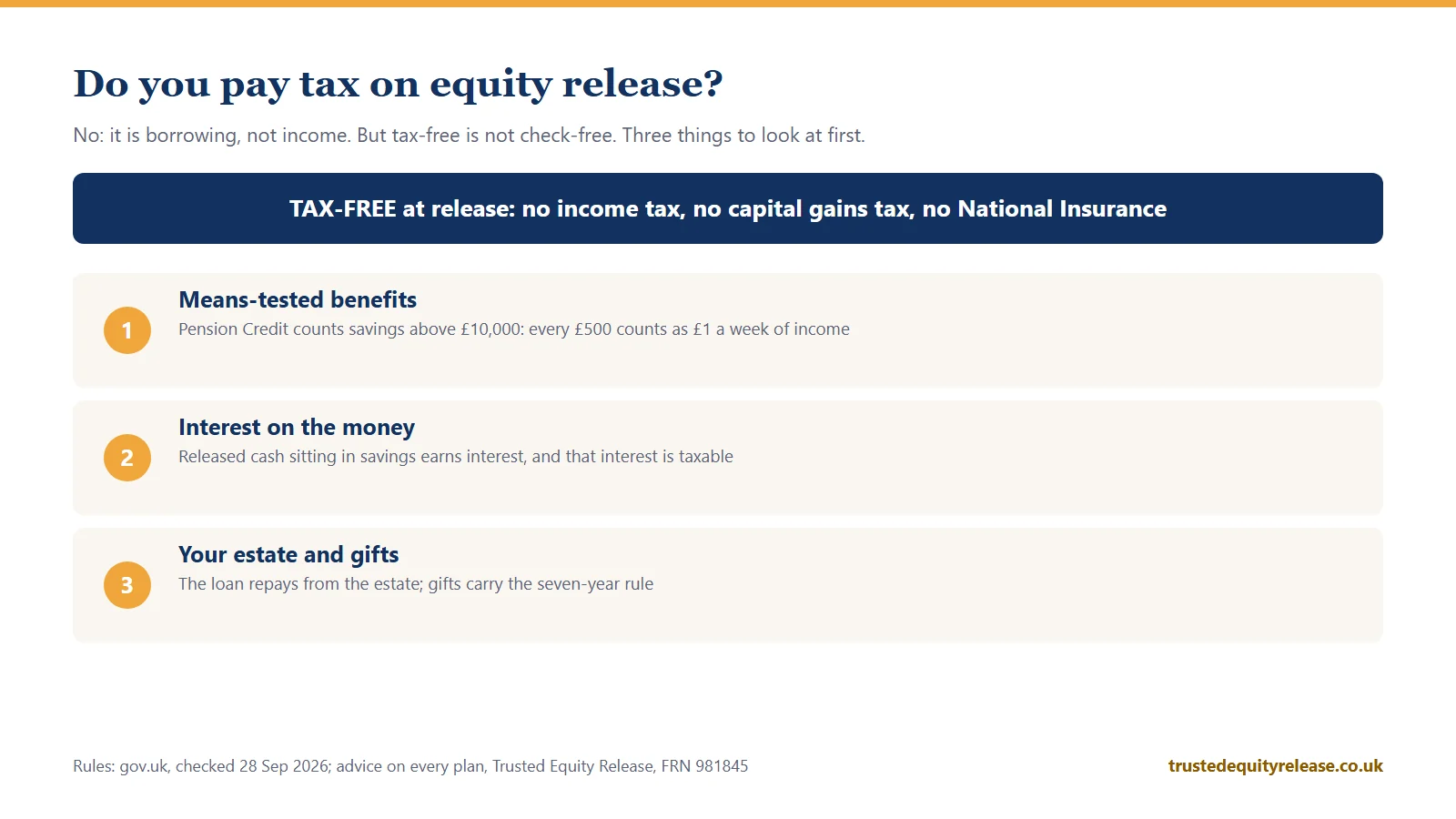
No. Money from equity release is a loan secured on your home, not income, so there is no income tax, no capital gains tax and no National Insurance on it. Two things still need checking: means-tested benefits, and any interest the money earns once it is sitting in your savings.
“Would not hesitate to recommend this Company. Professional, honest and always available to help at any point of the procedure.”
Why ask me about the tax side?
Because checking it is part of the job, not an extra. Before recommending anything I will discuss what a plan means for any inheritance, your eligibility for means-tested benefits, and your tax position, and FCA rules make that advice compulsory on every plan. I have specialised in later-life lending since 2009 and hold the SOLLA Later Life Lending Advice Standard. Trusted Equity Release is a trading name of Pellucid Ltd, authorised and regulated by the Financial Conduct Authority, FRN 981845. The first conversation costs nothing. Email me, request a printed brochure, or get in touch on the number at the top of this page.
Why is the money from equity release tax-free?
Because you are borrowing, not earning. HMRC taxes income and gains; a lifetime mortgage is neither, any more than a bank loan is. You are releasing value from a home you already own, and since it stays your main residence, selling it later would not normally attract capital gains tax either. The cost of the money is not tax. It is the interest, which compounds if you choose not to make repayments, and my equity release calculator shows what that costs by year.
Does equity release reduce inheritance tax?
You will read elsewhere that it does, usually with a worked example showing a five-figure saving. Here is the version I give clients across the kitchen table. The mechanics are true: the loan is repaid from your estate's value, so the taxable estate shrinks. But you pay compound interest, currently from 6.25% a year, to shave a band that takes 40% of the excess, and most estates never reach it: 4.72% of UK deaths led to an inheritance tax (IHT) bill in 2023-24. The scale is on my inheritance and housing wealth statistics page: £5.80 of housing passed through taxed estates for every £1 released.
If IHT is the reason you are looking at equity release, sit with a tax specialist first. If they still point this way, that is when I can help.
What about gifting the money to family?
A living inheritance, helping children or grandchildren while you can see them enjoy it, is one of the commonest reasons my clients release money, and the gift itself is not taxed when you make it. The rule to know, from gov.uk: die within seven years of a gift and it can count back into your estate, on a sliding scale.
| Years between gift and death | Tax rate on the gift |
|---|---|
| Under 3 | 40% |
| 3 to 4 | 32% |
| 4 to 5 | 24% |
| 5 to 6 | 16% |
| 6 to 7 | 8% |
| 7 or more | 0% |
One trap worth naming: give something away but keep the benefit of it, and HMRC treats it as still yours. That mostly bites people who try to gift the house itself, not the money from it.
The catch nobody searches for: means-tested benefits
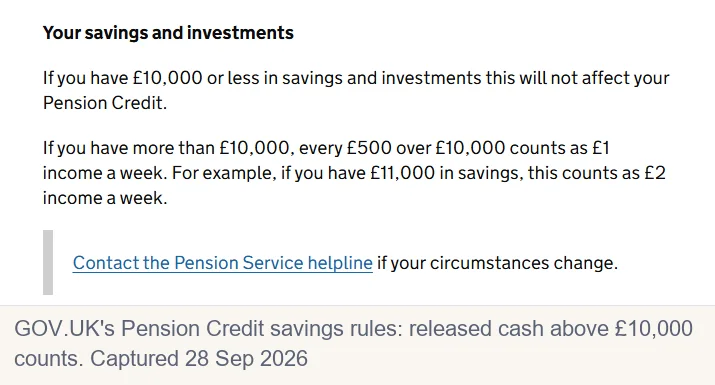
Tax-free is not means-test-free, and this is the check with the sharpest tax implications in practice, because losing Pension Credit can cost more than any tax would have. The rules, per gov.uk: savings of £10,000 or less do not affect Pension Credit; above that, every £500 counts as £1 a week of income. Release a £60,000 lump sum into the bank and on paper you have £100 a week of extra income. Council tax support runs on its own locally set limits too.
The shape of the plan is often the fix: a drawdown lifetime mortgage releases money in slices as you need it, rather than one counted pile. It is why I ask about benefits before amounts.
What about interest earned on the money you release?
If released cash sits in a savings account, the interest it earns is ordinary savings interest, taxable once it passes your personal savings allowance for your tax band. Nothing dramatic, but it is the one way equity release money ends up on a tax return, and it is a good argument for not releasing more than you need. Between the means test and the interest, "take the maximum because it is there" is advice you will never hear from me.
Does equity release affect your state pension or tax code?
No. The state pension is not means-tested, so it is unaffected, and borrowed money does not change your tax code. The benefits that need checking are the means-tested ones above, plus any care support the council contributes to.
FAQ
Is equity release classed as income?
Do you pay capital gains tax on equity release?
Do you pay tax if you use the money to buy a second property?
Does equity release have to go on a tax return?
Does releasing equity affect Pension Credit?
Sources
- GOV.UK: tax when you get a pension and Pension Credit eligibility
- GOV.UK: inheritance tax on gifts
- Equity Release Council: standards
- Trusted Equity Release: inheritance and housing wealth statistics
Book your free initial consultation today.
Pick up the phone and speak to Jeremy directly. If equity release is not the right choice, I will say so.
07768 972861 Or try the quick calculator