
Quick answer: can you get equity release if you still have a mortgage?
Yes, if what you can release is enough to clear what's left. The old mortgage, and any exit charge on it, is paid off from the money when the plan completes, and the rest is yours. If the release falls short, pay some off first, wait, or look elsewhere.
Why ask me about equity release with a mortgage?
Because clearing a mortgage is one of the main reasons people release equity, and an interest-only loan with no way to repay it is the hardest version of it. I compare lifetime mortgages across the whole market and arrange retirement interest-only mortgages too, and my colleagues at Pellucid, the same firm, arrange ordinary remortgages, so I can show you more than one way out and have no reason to favour any of them. I'm a member of the Equity Release Council, and it's me from the first call to completion. Trusted Equity Release is a trading name of Pellucid Ltd, authorised and regulated by the Financial Conduct Authority, FRN 981845.
“Amazing support from start to finish. Highly recommend this company. Jan”
Why does the existing mortgage have to be paid off?
Because a lifetime mortgage has to be the only loan secured on your home. Age UK puts it plainly: you'll have to pay off any outstanding mortgages or loans secured against your home at the same time as taking equity release. That includes secured loans as well as the main mortgage. Unsecured debts such as credit cards don't have to be cleared, though a lot of people choose to clear them from the same money.
The question isn't really whether you can have both. It's whether the release is big enough to clear the mortgage and still leave you what you need.
How much can you release, and will it clear what you owe?
That depends on three things: the age of the youngest of you, the value of your home, and what's left to pay. The percentage a lender will release rises with age, so the same mortgage can be too big at 58 and comfortably cleared at 70.
| Youngest borrower | Typical release, as a share of the home's value | A mortgage of up to about this share can usually be cleared |
|---|---|---|
| 55 | 25% to 28% | A quarter of the home's value |
| 70 | 40% to 43% | Two fifths |
| From 80 | 50% to 57% | Half |
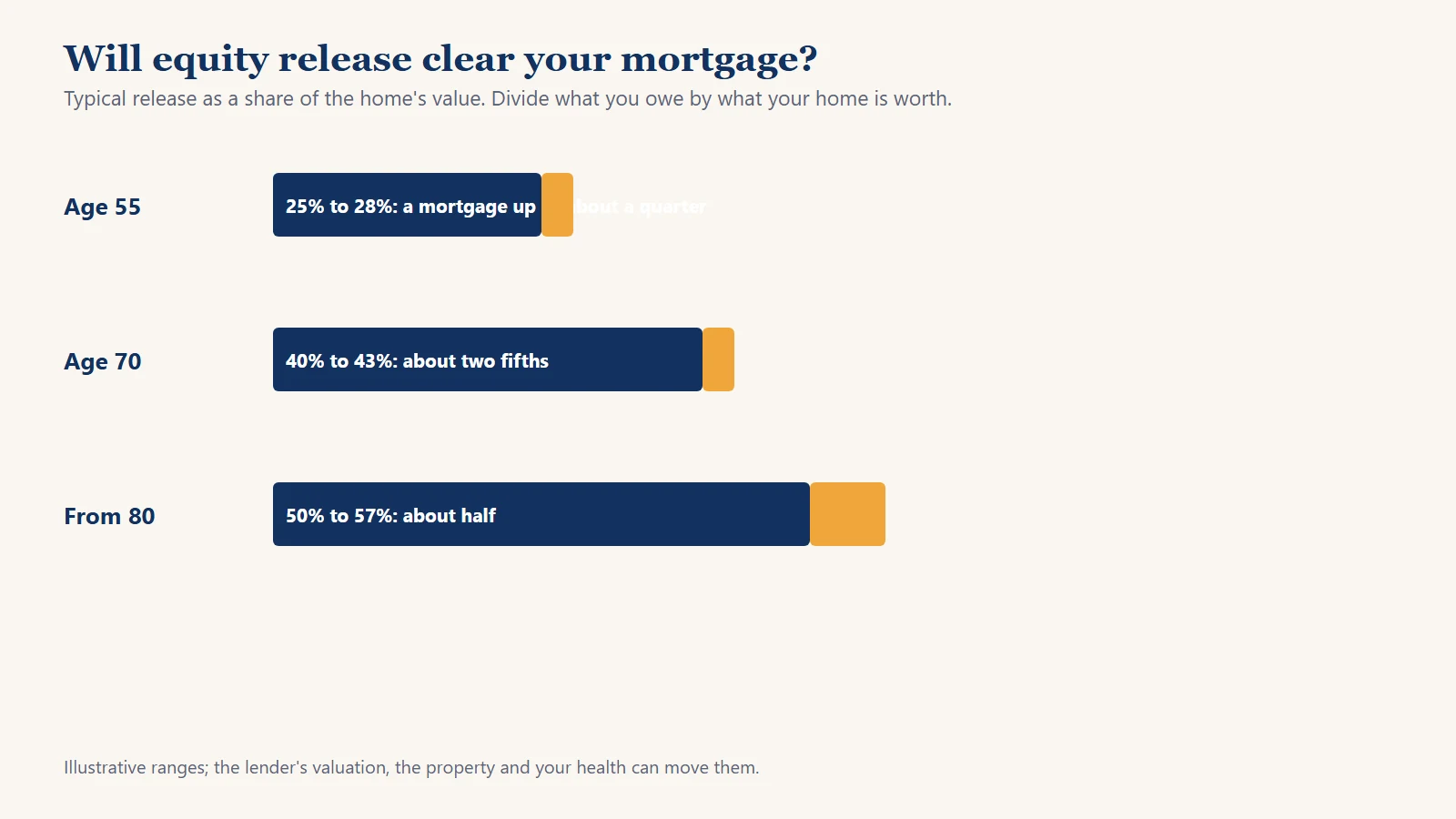
*Illustrative ranges from my equity release calculator. The lender's valuation, the property and your health can move them; leave room for fees and anything you want left over.*
The quickest way to see where you stand is to divide what you owe by what the home is worth. If that share is below the typical release for your age, the mortgage can usually be cleared with something left. If it's close to or above it, read the next section. My equity release calculator gives an indicative figure in three questions, without asking for your contact details.
What if your mortgage is bigger than you can release?
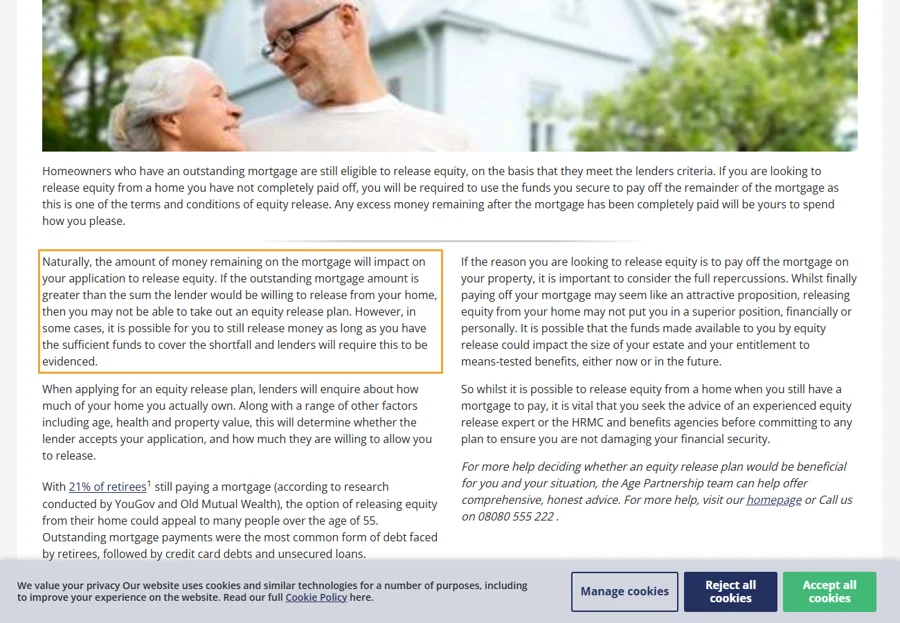
Then a lifetime mortgage on its own won't work yet, and Age Partnership says the same: if what you owe is more than the lender would release, you may not be able to take out a plan. There are four usual routes:
| Route | How it closes the gap | Worth knowing |
|---|---|---|
| Pay part off first | Savings, a pension lump sum or family help reduce the mortgage so the release can clear the rest | Age Partnership notes lenders will want the shortfall money evidenced |
| Wait | The share a lender will release rises with age | Interest-only borrowers need the lender's agreement if the term ends first |
| A retirement interest-only mortgage | Replaces the old loan if your pension covers the interest | An income test, including for the survivor of a couple |
| Remortgage or downsize | A new repayment mortgage, or a cheaper home that clears the loan | A remortgage needs income for the whole term |
I'd rather tell you at the first conversation that the numbers don't work yet than run an application that can't complete.
How is the existing mortgage paid off, step by step?
On the day the plan completes, from the money released, so you never have two mortgages at once. Here is how it runs from first call to completion.
Step 1: The first conversation and the figures
I ask your age, roughly what the home is worth and what's left on the mortgage, and I check what you want the money for. Key describes the same starting point. If the release clearly won't clear the mortgage, this is where I'll say so.
Step 2: Check the exit charge on your current mortgage
Before you go any further, find out whether your current lender charges you for paying off early. Legal & General says you'll have to pay off your existing mortgage and any early repayment charges with the money you release, and Key also suggests checking it before you start. If you're in a fixed rate with a year to run, waiting until it ends can save the charge.
Step 3: Advice, the recommendation and the application
I compare lenders across the market, explain the recommendation in writing, and complete the application with you. Family are welcome at this stage, in the room or on the phone.
Step 4: The valuation
The lender arranges a valuation of the home and confirms how much it will release, based on the value, your age and the plan, as Key sets out. This is the point at which an estimate becomes a figure, and it can come in lower than hoped.
Step 5: Independent legal advice and the redemption figure
You must have independent legal advice before any equity release plan goes ahead, under the Equity Release Council's standards. Your solicitor asks your current lender for a redemption figure, the exact amount to clear the mortgage on the completion date, so there's nothing for you to arrange yourself. I can recommend a solicitor who does equity release work day in, day out, or you can use your own.
Step 6: Completion
The new lender sends the money to your solicitor, who pays off your current mortgage, and any charge on it, first. Whatever is left comes to you, as a lump sum or, on a drawdown plan, partly now and partly in a reserve for later, as Key describes. From that day there's no mortgage payment to make.
What happens to your monthly payments after equity release?
They stop, unless you choose to keep paying something. That's the main reason people with a mortgage in retirement look at equity release: the money that went on the mortgage each month stays in your pocket. The price is that the interest on the lifetime mortgage is added to the loan and compounds instead. £60,000 at 6.25% a year with nothing paid is about £111,900 after 10 years and £208,700 after 20.
You can soften that. On many of the plans I arrange you can pay some or all of the monthly interest, from £50 a month or at 25%, 50%, 75% or 100% of it, and Equity Release Council plans let you make repayments without a charge within the lender's limits. Key notes that if you plan to make repayments, some lenders may check you can afford them. And however large the debt grows, the Equity Release Council's no negative equity guarantee means your estate will never owe more than the home is worth after reasonable sale costs.
Is using equity release to clear a mortgage a good idea?
Sometimes it's the right answer and sometimes it isn't. Age Partnership warns that clearing a mortgage this way may not leave you better off, financially or personally, and I'd agree with the warning even though it's my own work. It suits you when the mortgage payments are a real strain, the term is ending with nothing to repay it, and staying in the home matters more than what you leave behind. It suits you less when your income could carry a remortgage or a retirement interest-only mortgage, both of which cost less over time because the interest doesn't compound.
| Keep paying the mortgage, or remortgage | Clear it with equity release | |
|---|---|---|
| Monthly payments | Continue | Stop, unless you choose to pay |
| Income test | Yes | No |
| What you owe over time | Falls on a repayment mortgage | Grows unless you pay the interest |
| What your family inherits | More, once the mortgage is repaid | Less, by the loan plus rolled-up interest |
| If payments become a problem | Arrears, and the home can be at risk | Nothing to miss on a standard plan |
The full side-by-side, including the retirement interest-only option in between, is on my page comparing equity release vs remortgage.
What if your interest-only mortgage is ending?
You're far from alone. The UK still has 601,000 interest-only and part-and-part mortgages outstanding, and maturities peak in 2031 and 2032, at around 91,000 and 95,000 a year, as my retirement mortgage debt statistics show. Talk to your lender before the end date, because a plan agreed early leaves more options open than one made afterwards. The usual routes are a lifetime mortgage that clears it, a retirement interest-only mortgage if your pension covers the interest, or selling and moving somewhere smaller.
Will clearing your mortgage with equity release affect your benefits?
It can. The money isn't taxed, and Legal & General says equity release won't affect your State Pension, but it can affect means-tested benefits. Age UK lists Pension Credit, Universal Credit, Income Support, income-related Employment and Support Allowance, Jobseeker's Allowance and Council Tax Support, and adds that council-funded care at home may start to be charged for. Money spent clearing the mortgage on the day isn't sitting in your account; what's left over and paid to you is what can count. That's one reason I look at your benefits before suggesting how much to take.
Does anyone else living with you need to agree?
Often, yes. Age UK says anyone who lives with you, such as a grown-up son or daughter, may need to sign a waiver confirming they have no right to stay in the home if you die or move into permanent care, and anyone who moves in later will have to sign one too. They should get their own independent legal advice before signing. Raise it with the family early; I'm happy to be part of that conversation.
FAQ
Can you get equity release at 50 if you still have a mortgage?
What would stop me from getting equity release?
What is the cheapest way to get equity out of your house?
Is there a better way than equity release?
Can I use equity release to pay off other debts as well?
Final thoughts from me
If you have a mortgage and you're looking at equity release:
- The existing mortgage, and any exit charge on it, is cleared from the money released on the day it completes.
- Whether the release is enough depends on your age, your home's value and what you owe.
- If it falls short, paying some off first, waiting a few years or a retirement interest-only mortgage can close the gap.
- Your mortgage payments stop, but the lifetime mortgage interest compounds unless you pay some of it.
- If your income can carry the payments, a remortgage usually costs less.
- Anyone living with you may need to sign a waiver, so bring the family in early.
Book your free initial consultation today.
Pick up the phone and speak to Jeremy directly. If equity release is not the right choice, I will say so.
07768 972861 Or try the quick calculator