
Home › Lifetime mortgages › Drawdown lifetime mortgages
Drawdown lifetime mortgages: how does the reserve work?
If you're looking for a drawdown lifetime mortgage, you're in the right place. I'll explain how the reserve works, what it saves against a lump sum, the minimums, how you ask for more later and the places where drawdown can catch you out.

- On the FCA register, reference JLF01060 check the register
- Pellucid Ltd, FCA number 981845 check
- Equity Release Council member my profile
- SOLLA Later Life Lending Advice Standard
Quick answer: how does a drawdown lifetime mortgage work?
The lender agrees a total amount. You take a first sum and leave the rest in a reserve to draw later, in smaller amounts. Interest is charged only on what you've taken, from the day you take it, and nothing is due monthly. The reserve isn't guaranteed.
Why speak to Jeremy about drawdown?
Because the split between what you take on day one and what you leave in reserve depends on things a calculator can't see: your benefits, your plans, and what's coming up in the next few years. I look at means-tested benefits before I suggest an amount, and I compare drawdown plans across the whole market. My fee covers the life of the plan, so if you want a second opinion before a later drawdown, ring me and there's nothing to pay. I've specialised in later-life lending since 2009, hold CeMAP, CERT CII (ER) and the SOLLA Later Life Lending Advice Standard, and I'm an Equity Release Council member. It's me from the first call to completion, at your home or on the phone. Trusted Equity Release is a trading name of Pellucid Ltd, authorised and regulated by the Financial Conduct Authority, FRN 981845.
“Jeremy was very professional throughout the process, kept us uptaded at all times, nothing was too much trouble.”
What is a drawdown lifetime mortgage?
It's a lifetime mortgage where you don't take all the money at once. The lender agrees a total, you take an initial amount, and the rest sits in a cash reserve (lenders also call it a cash facility or drawdown facility) for you to call on later. Like any lifetime mortgage, it's a loan secured on your home, you keep ownership, nothing has to be paid monthly, and the loan plus interest is repaid when the last borrower dies or moves into long-term care.
To qualify you need to be 55 or over and own a UK home worth at least the lender's minimum; Saga quotes £70,000. Any mortgage you still have is paid off from the first amount.
How does the drawdown reserve work, step by step?
In five parts, from the day the plan is set up:
| Stage | What happens |
|---|---|
| 1. The lender sizes the plan | It works out a total from the age of the youngest borrower and the value of the home, and in some cases your health |
| 2. You take a first amount | This clears any existing mortgage and gives you the cash you need now |
| 3. The rest goes into reserve | LV= says its reserve is typically between 10% and 25% of the home's value |
| 4. You draw more when you need it | Each request has a minimum, and some lenders limit how often you can draw |
| 5. Interest runs only on what's drawn | The reserve costs nothing until you take it, then compounds like the rest |
Because loan-to-value limits rise with age, LV= says older homeowners are more likely to be offered a bigger cash facility. If your health or lifestyle counts with a lender, an enhanced lifetime mortgage can be set up as drawdown too.
How much do you have to take at the start, and how much each time after?
It depends on the lender, and the minimums matter if you're planning small top-ups. Here's what three lenders and providers publish:
| Lender | First amount | Later drawdowns |
|---|---|---|
| LV= (Lifetime Mortgage Drawdown+) | At least £10,000 | At least £1,500, no more than once a calendar month |
| Legal & General | Not stated on its customer page | At least £1,000 |
| SunLife's guide | Not stated | Minimum amounts apply, and you may be limited in how many times a year you can draw |
*Published terms as captured on 7 October and 2 November 2026; lenders change them.*
If you were hoping to draw £300 a month as an income, drawdown on these terms won't do it. A larger sum every few months fits the minimums better, and that's the kind of pattern I'd plan with you before choosing a lender.
Do you pay interest on the money left in reserve?
No. Interest is charged only on what you've drawn, from the day the lender sends it. Legal & General's own advice to its customers is to release only the amount you need at the time, because compound interest is applied from that day. It's the advice I'd give, too.
How much interest does drawdown save compared with a lump sum?
About £12,300 over ten years on £60,000, in the simplest example, and more if you spread the money further. These are my own figures at 6.25% a year compounded monthly, the basis of my equity release calculator:
| £60,000 borrowed | Option A: lump sum | Option B: two halves | Option C: three thirds |
|---|---|---|---|
| Taken on day one | £60,000 | £30,000 | £20,000 |
| Taken at the start of year 4 | Nothing | Nothing | £20,000 |
| Taken at the start of year 5 | Nothing | £30,000 | Nothing |
| Taken at the start of year 8 | Nothing | Nothing | £20,000 |
| Owed after 10 years | about £111,900 | about £99,600 | about £92,400 |
| Interest added | about £51,900 | about £39,600 | about £32,400 |
| Less than Option A | about £12,300 | about £19,600 |
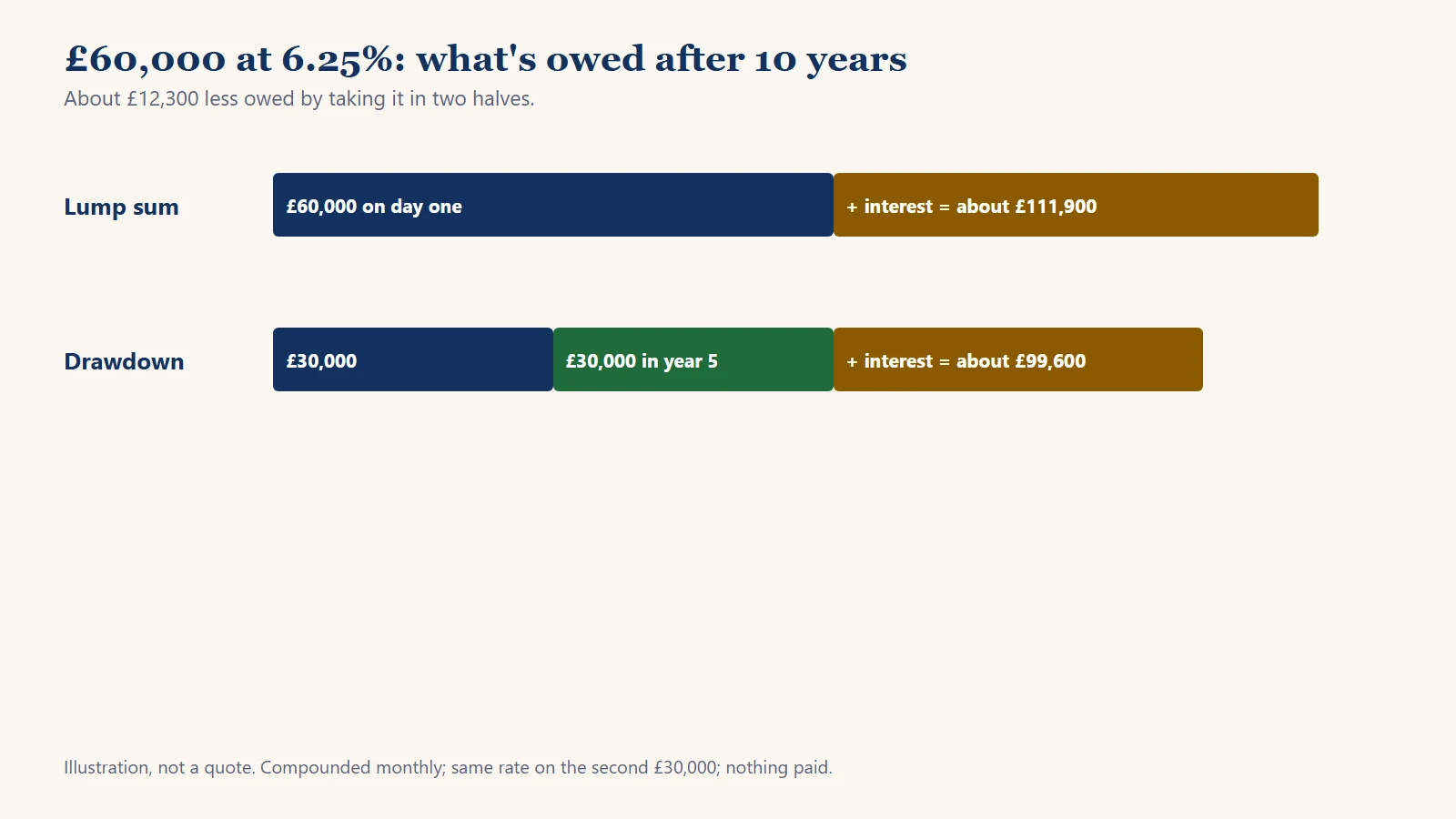
*Illustrative only, not a quote. Assumes nothing is paid, the reserve is still there when each amount is drawn, and every amount is charged the same 6.25%.*
In real life the later amounts are charged whatever rate the lender offers on the day, which could be higher or lower. The saving comes from the money sitting in reserve for years without costing anything.
Is the drawdown reserve guaranteed?
No, and this is the part of drawdown I spend longest on. Legal & General and LV= both say access to the reserve isn't guaranteed. Legal & General says that when you ask for a drawdown it reviews your circumstances and can refuse the request or withdraw the facility if things have changed significantly, and gives examples:
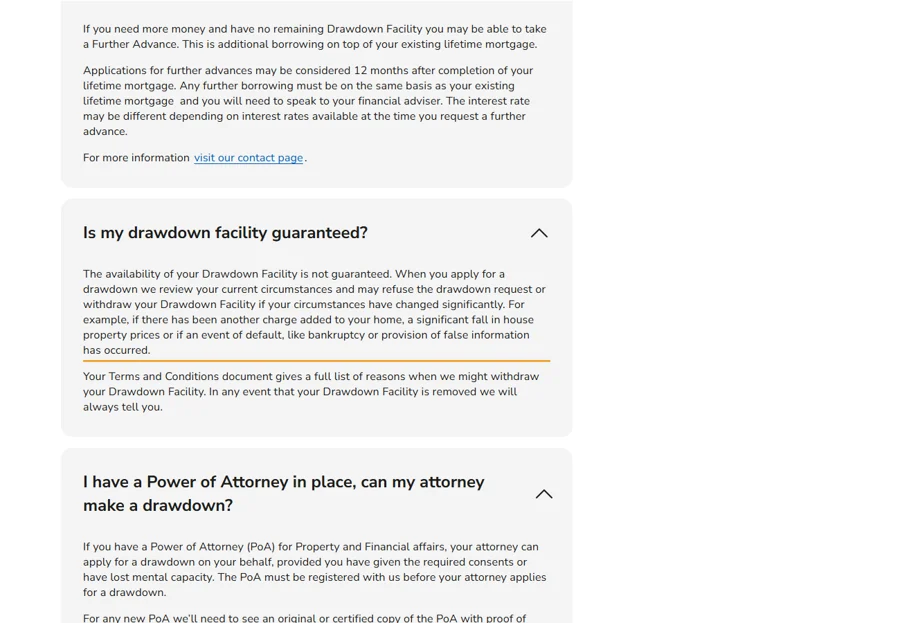
- another charge has been added to your home
- house prices have fallen significantly
- there's been an event of default, such as bankruptcy or giving false information
It says it will always tell you if the facility is removed. The practical rule I follow: money you're certain to need goes in the first amount, not the reserve. The reserve is for money you might need.
What interest rate do you pay on later drawdowns?
The rate on the day you draw, not the rate you started with. Legal & General says each drawdown is charged at the rates available on the day you apply, which may be higher or lower than your first loan, and confirms the rate in the offer. Saga describes the same thing: a rate is set when you take the first amount, then each later amount is priced separately at the lender's rate at the time.
One plan can end up holding several amounts at several rates. LV= says the rate on each amount is set when it's taken and secured for life, so a later rise in rates doesn't touch what you've already drawn. Where rates sit at the moment is on my page about equity release interest rates.
How do you ask for more money from your drawdown reserve?
Legal & General sets out its process in five steps, and other lenders work along similar lines, though the forms and timings differ.
Step 1: Check how much is left in your reserve
Your annual statement shows what's left in the facility, Legal & General says, and the lender can give you a current figure if you contact it. Check this before you plan around the money, especially if it's been a few years.
Step 2: Apply to the lender
Legal & General's online application takes about ten minutes. On a joint plan you apply together. Remember the minimum: £1,000 with Legal & General, £1,500 with LV=. If I arranged your plan and you'd like me to look at the amount or the timing first, ring me before you apply; there's no charge.
Step 3: The lender reviews it and sends an offer
The lender checks your circumstances (this is where a reserve can be refused or withdrawn) and sends an Offer of Loan with the interest rate for this drawdown. Legal & General says it may contact you if it needs more detail on what the money is for.
Step 4: Check and sign the offer
Legal & General sends the offer by email for electronic signature. On a joint plan, one of you signs and returns it before the other gets their email, and each of you needs a different electronic signature, even if you share an email address. Read the rate on the offer before you sign.
Step 5: The money arrives, and interest starts
The lender transfers the money to your bank account and confirms it, and the drawdown appears on your next annual statement. Interest on that amount starts from the day it's sent.
What happens when the reserve runs out?
You can ask for a further advance, but it's a new application, not a right. LV= says it considers more borrowing only once the existing reserve is used up and a new valuation has been done, as a one-off advance rather than a bigger facility. Legal & General says further advances may be considered 12 months after the plan completes, on the same basis as the original, at the rate available at the time, and that you'll need to speak to your adviser. A further advance isn't guaranteed and may be time limited, LV= adds.
Drawdown or lump sum: which suits you?
The question is whether you need all the money now.
| Drawdown | Lump sum | |
|---|---|---|
| Suits | Some money now and more later; regular top-ups; keeping savings low for benefits | One large cost now, such as clearing a mortgage or buying a property |
| Interest | Only on what you've drawn | On the whole amount from day one |
| Rate | Set for each drawdown on the day | One rate for the lot |
| Certainty | Reserve not guaranteed | The money's yours on completion |
| Minimums | A minimum first amount and per drawdown | None after completion |
| Benefits | Cash stays out of your savings until drawn | Cash in the bank can affect means-tested benefits |
SunLife adds that drawdown rates can be slightly higher than on some other lifetime mortgages, though not always, so I compare the two on the same day before recommending either.
What are the advantages of a drawdown lifetime mortgage?
- Interest only on what you take, so the debt grows more slowly than with a lump sum.
- Money there when you need it, without setting up a new plan each time while the reserve lasts.
- Less cash sitting in your bank, which can help with means-tested benefits.
- More left for your family than with the same total taken up front.
- No new set-up fees on each drawdown, SunLife says, though minimums apply.
- The same Equity Release Council protections as any lifetime mortgage, including the no negative equity guarantee.
What are the disadvantages of a drawdown lifetime mortgage?
- The reserve isn't guaranteed and can be reduced or withdrawn.
- Later drawdowns are priced on the day, and the rate may be higher than your first.
- Minimum amounts and limits on how often you can draw.
- Every drawdown reduces what's left for later needs, as LV= points out.
- Interest still compounds on everything you take, so your estate is smaller.
- Repaying the whole plan early can bring an early repayment charge; on LV='s Drawdown+ the fixed charges end after 10 years.
- More borrowing once the reserve is gone means a further advance, which isn't guaranteed.
The wider list for lifetime mortgages generally is on my page about the pros and cons of equity release.
How much does a drawdown lifetime mortgage cost?
Three costs to think about. The interest, which compounds on each amount from the day it's drawn. The set-up costs of the plan itself: Saga mentions set-up, legal and administrative fees, all of which you're told about before you go ahead. And my advice fee: the first conversation is free, there's nothing to pay unless the plan completes, it's a fixed fee rather than a percentage, it can be taken from the money released, and it covers you for the life of the plan. I'll tell you the figure on the phone.
Later drawdowns don't carry new set-up fees, SunLife says. You can also pay some or all of the interest as you go on many of the plans I arrange, from £50 a month or at 25%, 50%, 75% or 100% of it, which slows the growth or stops it.
Does drawdown help with means-tested benefits?
It can. For Pension Credit, savings above £10,000 count as £1 a week of income for every £500, GOV.UK says, so a lump sum sitting in the bank can reduce or end it. A drawdown keeps the cash out of your savings until you need it, which LV= also points to as a reason people choose it.
Once you draw money, it counts like any other money you hold. That's why I look at your benefits before suggesting a first amount, and why the size of each later drawdown matters as much as the timing.
Can someone with power of attorney make a drawdown for you?
With Legal & General, yes. If you've a registered lasting power of attorney for property and financial affairs, your attorney can apply for a drawdown on your behalf, as long as you've given the required consent or have lost mental capacity. The power of attorney has to be registered with the lender before your attorney applies. Other lenders have their own process, so it's worth checking before anyone needs it.
It's one reason I bring up lasting powers of attorney once the first conversation about equity release is done. I write them myself, and a reserve you can't reach because nobody has authority to ask for it is no use to anyone.
What happens to a drawdown lifetime mortgage when you die?
The same as with any lifetime mortgage. On a joint plan, nothing changes when the first of you dies; the plan carries on for the survivor. When the last borrower dies or moves into long-term care, the loan is repaid, usually from the sale of the home. LV= says repayment is most commonly needed within 12 months.
Only what's been drawn, plus its interest, has to be repaid. Money left in the reserve was never lent. And under the Equity Release Council's no negative equity guarantee, your estate will never owe more than the home is worth after reasonable sale costs. What your family deals with is on my page will my family end up in debt?
FAQ
What are the pitfalls of a lifetime mortgage with drawdown?
Can you pay the interest on a drawdown lifetime mortgage?
Is the money from a drawdown tax-free?
Can you move house with a drawdown lifetime mortgage?
Final thoughts from me
The points I'd want you to remember:
- You take a first amount, keep a reserve, and pay interest only on what you've drawn.
- Minimums apply: with LV=, at least £10,000 to start and £1,500 each time after.
- The reserve isn't guaranteed, and each later amount is priced on the day.
- Taking £60,000 in two halves left about £12,300 less to repay after ten years than taking it all at once.
- Money you're sure to need belongs in the first amount.
- Keeping cash out of your savings can protect Pension Credit, until you draw it.
Book your free initial consultation today.
Pick up the phone and speak to Jeremy directly. If equity release is not the right choice, I will say so.
07768 972861 Or try the quick calculator