
Home › Equity release › Interest rates
Rates checked 27 September 2026 (updates monthly)Equity Release Interest Rates
If you're looking for current equity release interest rates, you're in the right place. I check what every lender in the market is offering, most days of the week, because rates are where equity release is won or lost. This page shows you what plans cost in September 2026 and, more usefully, what decides the rate you would be offered.

- Member of the Equity Release Council
- SOLLA Later Life Lending Advice Standard
- Authorised and regulated by the FCA, FRN 981845
Quick answer: what is a typical equity release rate right now?
In September 2026 the lowest advertised lifetime mortgage rate is around 6.25% MER, fixed for life. Advertised rates run from there to just over 10.5% depending on lender, loan size and age. Your own rate is confirmed in a personalised illustration.
Why speak to Trusted Equity Release about rates?
I am independent and whole of market, so I compare every lender rather than a panel. I have advised on later-life lending since 2009, I am a member of the Equity Release Council, and I hold the SOLLA Later Life Lending Advice Standard. Trusted Equity Release is a trading name of Pellucid Ltd, authorised and regulated by the Financial Conduct Authority, FRN 981845. Every review on my reviews page is five stars, and around half were written by a client's son or daughter.
If rates are the question you want answered properly, get in touch and I will talk you through where the market sits for someone in your position. An opinion, or a second opinion, costs you nothing. Three ways, whichever suits: send me an email, request a printed brochure if you find that easier, or, if you are anything like me, just pick up the phone on the number at the top of this page.
What are lenders charging this month?
Checked across publicly advertised rates on 27 September 2026:
| Measure | Rate |
|---|---|
| Lowest advertised lifetime mortgage rate | 6.25% MER, fixed for life |
| Highest advertised rate in the market | 10.53% MER |
| Last published industry average (ERC, October 2024) | 6.89% advertised average |
The spread between the top and bottom of that table is the whole argument for shopping the market. The lowest rates go to lower loan-to-values, and the highest attach to maximum-borrowing plans. A written quotation is the only number that counts, and I set out where yours sits within the market when I produce one.
How have equity release interest rates changed over time?
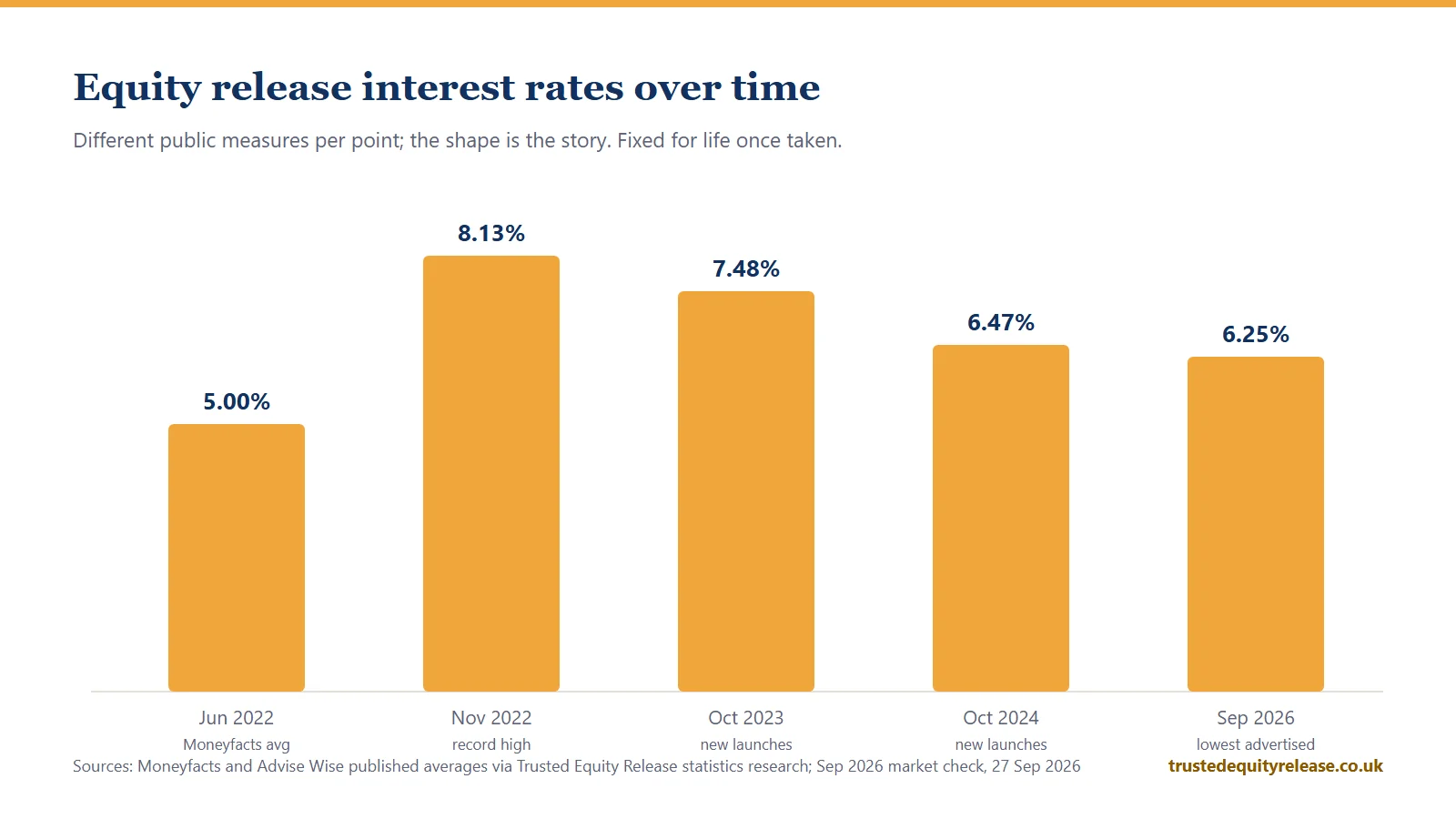
In June 2022 the average lifetime mortgage rate was 5.0% (Moneyfacts). By November 2022, after that autumn's mini-Budget, it hit a record 8.13%. New launches averaged 7.48% APR in October 2023 and 6.47% in October 2024 (Advise Wise); the ERC put that month's advertised average at 6.89%. In September 2026 the lowest advertised rate is 6.25%.
One caution: the historic points come from three different measures, so treat the shape as the story rather than any single decimal.
| When | Rate | Measure |
|---|---|---|
| June 2022 | 5.00% | Moneyfacts market average |
| November 2022 | 8.13% | Moneyfacts market average, record high |
| October 2023 | 7.48% | Advise Wise, average APR of newly launched products |
| October 2024 | 6.47% / 6.89% | Advise Wise new launches / ERC advertised average |
| September 2026 | 6.25% | Lowest advertised MER, our market check |
From October 2026 I log the market's lowest and typical advertised rates here every month, so this table becomes its own record.
What does compound interest do to what you owe?
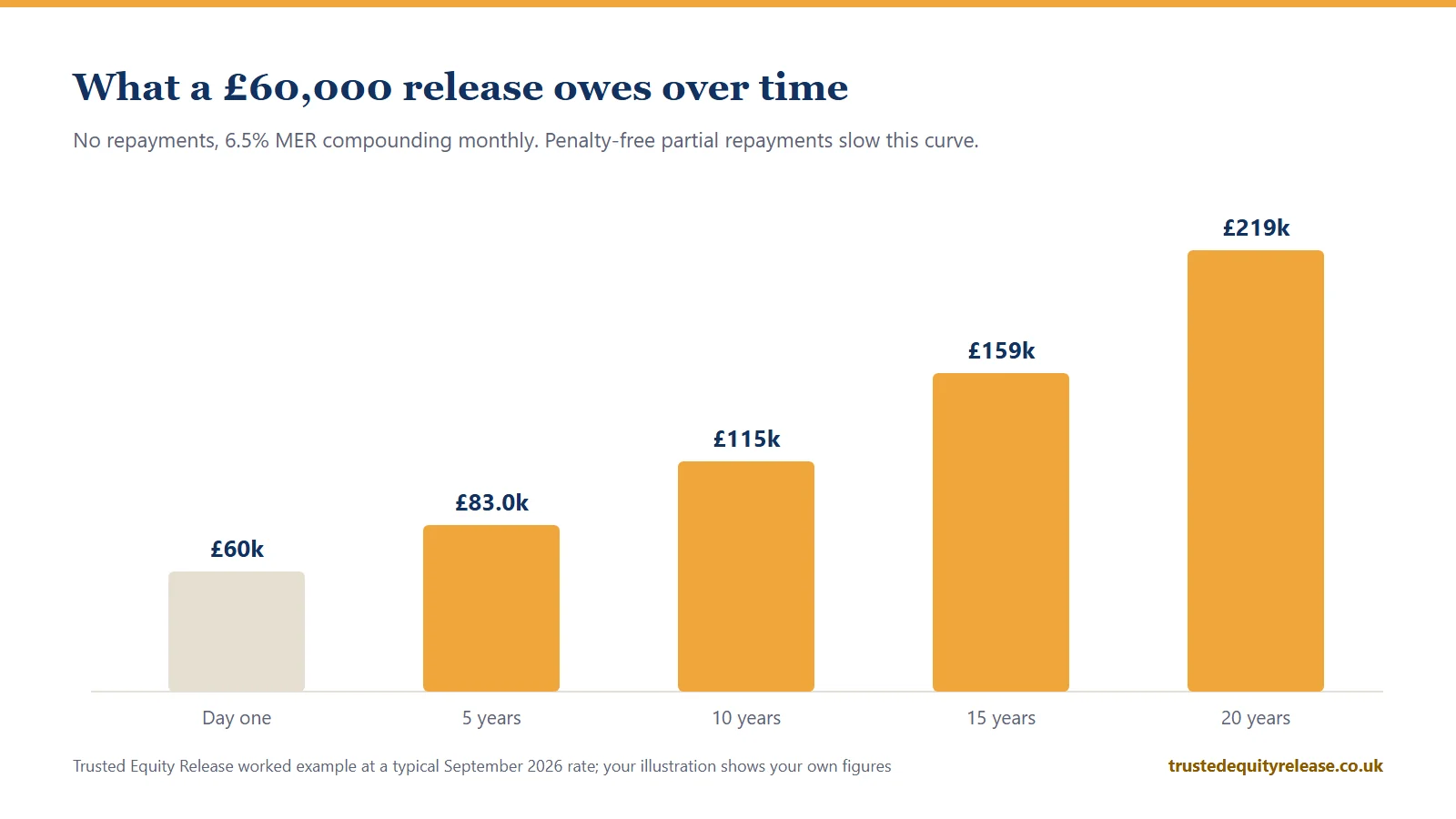
On most lifetime mortgages you make no monthly repayments, so the interest rolls up: it is added to the loan amount and then earns interest itself. At 6.5% MER, a £60,000 lump sum becomes about £83,000 after 5 years, £114,700 after 10, £158,700 after 15 and £219,400 after 20. Roughly speaking, the debt doubles about every 11 years at that rate.
That is the honest cost of the product, and it is why for every £1 released each year, households aged 55 and over in Great Britain hold £852 of net property wealth: most people, quite reasonably, leave their housing wealth alone. The full numbers are in my equity release statistics.
What softens the compounding
Two things. Since 28 March 2022, every plan meeting Equity Release Council standards lets you make penalty-free partial repayments, and even small ones slow the curve. Drawdown plans only charge interest on money you have actually taken. If you later move into long-term care, the standards waive any early repayment charge, including care with relatives since 6 May 2025.
What decides the rate you personally get?
The loan-to-value does most of the work: the smaller the share of your home's value you borrow, the lower the rate. After that, in rough order:
- Your age. Lenders will lend a higher share the older you are, and pricing follows.
- The property. Construction, condition and location all move the offer.
- Your health. Enhanced plans can offer better terms where health or lifestyle shortens the expected term. Nobody enjoys that conversation, and it can genuinely change the numbers.
- Product features. Downside protections, inheritance guarantees and repayment flexibility each carry a price.
How do you get the lowest equity release rate?
Borrow the smallest amount that solves the problem, and take the rest as drawdown. That single decision usually saves more than any lender switch, because untouched reserve costs nothing. Then compare the whole market rather than one provider's range, disclose health honestly in case enhanced terms apply, and plan to use penalty-free partial repayments if you can spare them: even small repayments slow the compounding curve.
You can see what a given rate does to your own figures on my equity release calculator.
Can you release equity at 50?
No. Lifetime mortgages start at 55. From age 50 the option is a retirement interest-only mortgage, a RIO, which is a mortgage rather than equity release: you pay the interest monthly, so the debt never grows, and the rate market is completely different. As I tell clients, very few RIOs are actually done because they are hard to place, but I do arrange them. If you are 50 to 54, my advice usually starts there.
Is there a better alternative to equity release?
Sometimes, and a proper adviser says so before recommending anything. Downsizing, a standard remortgage, a RIO, family help or simply spending savings first can each beat a lifetime mortgage on cost. If you still qualify for an ordinary remortgage, it will nearly always be cheaper than equity release. I have also had cases where the answer was a bridging loan rather than equity release, and I referred the client on. The alternatives to equity release page walks through each option.
FAQ
Are equity release interest rates fixed for life?
What happens if rates fall after I take a plan?
Do drawdowns take a new rate on each withdrawal?
Sources
- Equity Release Council: Standards and market statistics
- Moneyfacts and Advise Wise published market averages, 2022 to 2024, as compiled in our statistics research
- Bank of England: quoted household interest rates
- MoneyHelper: equity release
- FCA register: Pellucid Ltd, FRN 981845
Book your free initial consultation today.
Pick up the phone and speak to Jeremy directly. If equity release is not the right choice, I will say so.
07768 972861 Or try the quick calculator