
Home › Equity release › Equity release vs remortgage
Equity release vs remortgage: which is right for you in later life?
If you're weighing up equity release against a remortgage, you're in the right place. I'll compare the two on what each needs from you, what each costs over the years, the age limits lenders set, and the option in between that a lot of comparisons leave out.

- On the FCA register, reference JLF01060 check the register
- Pellucid Ltd, FCA number 981845 check
- Equity Release Council member my profile
- SOLLA Later Life Lending Advice Standard
Quick answer: should you remortgage or release equity?
Remortgage if your income can cover monthly repayments for a term your age allows: it usually costs least. If it covers only the interest, look at a retirement interest-only mortgage. If it covers neither, a lifetime mortgage needs no monthly payments, from 55, but the interest compounds.
Why speak to Jeremy about remortgaging or equity release?
Because I don't have a favourite. I arrange lifetime mortgages across the whole market and retirement interest-only mortgages myself. I don't arrange ordinary remortgages personally; my colleagues at Pellucid, the same firm, do. Whichever of the three fits your income, it starts with one conversation, and nobody in it has a reason to steer you towards their product. I've specialised in later-life lending since 2009, I hold CeMAP, CERT CII (ER) and the SOLLA Later Life Lending Advice Standard, and I'm a member of the Equity Release Council. It's me from the first call to completion, at your kitchen table or on the phone. Trusted Equity Release is a trading name of Pellucid Ltd, authorised and regulated by the Financial Conduct Authority, FRN 981845.
“He swiftly arranged an initial meeting with my gran and mother, while also including me via phone, as I was in another county. This demonstrated complete transparency and secured my trust in him.”
What is the difference between equity release and a remortgage?
The monthly payment, and who has to prove what. A remortgage depends on your income for its whole term, and a retirement interest-only mortgage depends on it for life. A lifetime mortgage, the usual form of equity release, doesn't depend on income at all, because nothing has to be paid until the home is sold. Side by side:
| Remortgage | Retirement interest-only mortgage | Lifetime mortgage (equity release) | |
|---|---|---|---|
| Monthly payments | Capital and interest, compulsory | Interest only, compulsory | None required; you can choose to pay some or all of the interest on a lot of plans |
| Income and credit checks | Yes, for the whole term | Yes, usually including whether the survivor of a couple could pay alone | No affordability test; your age and the home's value decide |
| From what age | Any adult, if the term ends inside the lender's age limit | 50 with some lenders, 55 with others | 55, for both of you on a joint plan |
| What happens to the debt | Falls to nothing by the end of the term | Stays the same | Grows, unless you pay the interest |
| When it's repaid | By the end of the term | When the home is sold, after death or a move into long-term care | When the home is sold, after the last borrower dies or moves into long-term care |
| If payments stop | Arrears, and the home can be repossessed | Arrears, and the home can be repossessed | Nothing to miss on a standard plan |
| Interest rate | Fixed or variable for a few years, then you remortgage again | Often fixed for a few years | Fixed, or variable with a cap, for life |
| What your family inherits | The whole home, once it's paid off | The home less the original loan | The home less the loan and the rolled-up interest |
*Sources: lender criteria (Leeds and Nottingham Building Societies for retirement interest-only mortgages) and the Equity Release Council's product standards, checked 2 November 2026.*
Saga sums up the trade in one line: remortgaging often proves the cheaper option overall, but because equity release isn't dependent on your income, you're likely to be able to release more through it.
What is home equity, and how much can each one release?
Your equity is what your home is worth less everything secured on it. A home worth £300,000 with £60,000 left on the mortgage has £240,000 of equity. Neither route lets you have all of it.
With a remortgage, the limit is usually your income, not the house. The lender works out what monthly payment you can afford for the term your age allows, and that sets the loan. LV= adds that you usually need to own a significant portion of your home outright before remortgaging to release equity.
With a lifetime mortgage, the limit is your age and the home's value. The older the youngest of you is, the bigger the share a lender will release:
| Age of the youngest borrower | Typical share of the home's value you can release |
|---|---|
| 55 | 25% to 28% |
| 70 | 40% to 43% |
| 80 and over | 50% to 57% |
*From my equity release calculator. Health and lifestyle can raise the figure. Illustrative only: the lender's valuation and criteria decide.*
On that £300,000 home, a 70-year-old could typically release around £120,000 to £129,000 before the £60,000 mortgage is cleared from it. Whether a remortgage could reach the same figure depends entirely on the pension.
How does remortgaging to release equity work?
You replace your mortgage with a new, bigger one, either with your current lender or a new one, and take the difference as cash. You can also extend the term to bring the payments down. The new lender checks your income, your outgoings and your credit record, and the payments are compulsory. LV= points out the other side of that: with a remortgage, your home could be at risk of repossession if you don't make the repayments.
What people over 55 tend to underestimate is the term. At 65, the lender's age limit might allow ten years, and squeezing a loan into ten years makes the monthly payment far bigger than over 25. LV= also notes that if property values fall, a remortgage can leave you in negative equity, owing more than the home is worth.
How does equity release work?
Equity release almost always means a lifetime mortgage: a loan secured on your home, from 55, with nothing to pay each month unless you choose to. The interest is added to the loan and compounds, and the whole amount is repaid when the last borrower dies or moves into long-term care, usually from the sale of the home. You can take it as one lump sum, or agree a total and draw it as you need it through a drawdown lifetime mortgage, so interest only runs on what you've taken.
Plans that meet the Equity Release Council's standards carry protections a remortgage doesn't: the right to live in your home for life (it must stay your main residence and you keep to the terms), the right to move to a suitable property and take the plan with you, a rate fixed or capped for life, and the no negative equity guarantee, which means your estate never owes more than the home sells for, after reasonable sale costs. The other type of equity release, home reversion, means selling part of your home; I don't arrange it.
Can you remortgage over 55, at 60 or at 70?
Yes, if the new term ends inside the lender's age limit and your income covers the payments into retirement. Aviva says it often becomes harder to remortgage from age 50 onwards, and that in retirement your pension must be able to cover the repayments. The age limits are where most of the difficulty sits:
| Lender | Mortgage must end by | Longest term at 60 | At 65 | At 70 |
|---|---|---|---|---|
| Nationwide, Santander, NatWest | 75 | 15 years | 10 years | 5 years |
| Halifax, Barclays | 80 | 20 years | 15 years | 10 years |
| HSBC | 80, but no new lending once a borrower is 70 | 20 years | 15 years | Not available |
| Leeds Building Society | 85 | 25 years | 20 years | 15 years |
| Suffolk Building Society | No maximum age (40-year maximum term) | Set by income | Set by income | Set by income |
*Age limits as each lender publishes them, checked 2 November 2026. The longest term is the gap to the age limit; the income test can shorten it. Limits change, so I check them again before any recommendation.*
Lender by lender detail, including interest-only limits and the rules for people still working, is on my page about mortgages for over 50s.
Why are so many people in their 60s turned down for a remortgage?
Two rules catch them: the term has to end inside the age limit, and the payments have to fit the pension rather than the salary. Saga notes that lenders may be more reluctant to lend to older borrowers, and the arithmetic in the table shows why it bites: a short term means a big payment.
A lot of the people who ask me this have an interest-only mortgage ending with nothing set aside to repay it. The UK still had 601,000 interest-only and part-and-part mortgages outstanding at the end of 2025 (UK Finance), and the FCA expects maturities to peak in 2031 and 2032, at around 91,000 and 95,000 a year. At the same time, 42% of new mortgage lending now runs past the borrower's 67th birthday. Both figures are in my retirement mortgage debt statistics.
Which is cheaper, a remortgage or equity release?
Usually the remortgage. Saga gives two reasons: lifetime mortgage rates are higher than standard mortgage rates because the loan can run much longer, and the unpaid interest is added to the loan, so you pay back more. The second reason matters more than the first. This table puts all three structures at the same rate, to show what the structure alone does:
| £60,000 borrowed for 15 years, all at 6.25% | Repayment remortgage | Interest paid monthly (a RIO, or a lifetime mortgage with the interest paid) | Lifetime mortgage, nothing paid |
|---|---|---|---|
| Monthly payment | about £514 | £312.50 | £0 |
| Paid out of income over 15 years | about £92,600 | £56,250 | £0 |
| Still owed after 15 years | £0 | £60,000 | about £152,800 |
| Total interest | about £32,600 | £56,250 | about £92,800 |
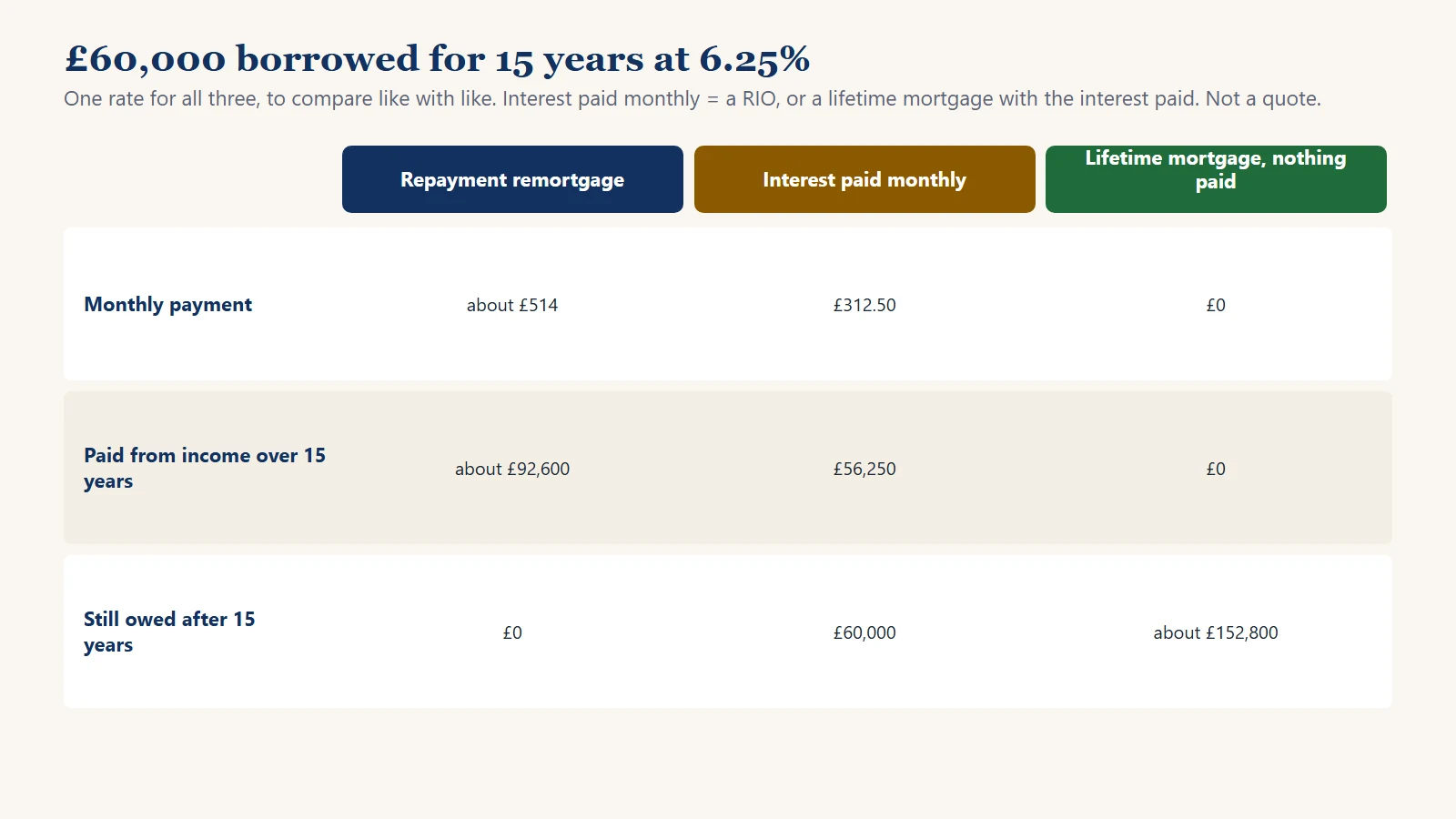
*Illustrative only. 6.25% a year, compounded monthly, is the rate in my equity release calculator; it's used for all three columns so the comparison is like for like. A remortgage rate is usually lower, which widens the gap, and a RIO rate is set by the lender. Not a quote.*
The remortgage costs least in interest and leaves nothing owing, but it asks about £514 a month of your income for 15 years. The lifetime mortgage asks nothing of your income and costs the most. Paying the interest sits in the middle, and a lot of lifetime mortgages let you pay some of it, so you can choose your own point along that line.
Set-up costs apply to both: Aviva mentions advice and legal fees on either route, and Saga lists valuation, legal and advice fees for setting up equity release. Lifetime mortgage rates as they stand are on my page about equity release interest rates.
Which one leaves more for your family?
A remortgage, if you can keep up the payments, because the debt is cleared in your lifetime and the whole home passes on. A retirement interest-only mortgage leaves the original loan to repay. A lifetime mortgage leaves the loan plus the rolled-up interest, and with nothing paid that grows faster than most people expect, because each year's interest is charged on the last year's too:
| £60,000 at 6.25%, nothing paid | What you owe | Interest added |
|---|---|---|
| After 5 years | about £81,900 | about £21,900 |
| After 10 years | about £111,900 | about £51,900 |
| After 15 years | about £152,800 | about £92,800 |
| After 20 years | about £208,700 | about £148,700 |
*Illustrative only: 6.25% a year compounded monthly, as in my equity release calculator. Your rate is fixed or capped for life and will be in your illustration.*
At that rate the debt roughly doubles in under 12 years, though the no negative equity guarantee means it can never be more than the home sells for.
Two things narrow the gap on a lifetime mortgage. Paying some of the interest each month, if your plan allows it, slows the growth or stops it. And some plans let you protect a percentage of the home's value as an inheritance, at the cost of borrowing a bit less. If leaving the home to your family matters most and your income allows it, I'd point you to the remortgage first and say so plainly.
What are the risks of each?
| Remortgage | Lifetime mortgage |
|---|---|
| Payments are compulsory; missing them puts the home at risk | Nothing to miss on a standard plan |
| The payments may outlast your income if a pension falls, for example when one of a couple dies | No income test now or later |
| If house prices fall you can owe more than the home is worth | The no negative equity guarantee caps the debt at the home's value |
| You may be refused on age, income or credit | Available from 55 if the home and its value meet the lender's criteria |
| Fixed rates end and you have to remortgage again, on whatever terms are then available | The rate is fixed or capped for life |
| The interest compounds, so your estate is smaller | |
| A lump sum in the bank can reduce means-tested benefits; Age UK lists Pension Credit and Council Tax Support among those affected | |
| Repaying the whole plan early can bring an early repayment charge |
The full list of advantages and disadvantages on the equity release side is on my page about the pros and cons of equity release.
When is a remortgage the better answer?
Whenever your income can comfortably carry it. If you're still working, or your pension covers the payments with room to spare for the term your age allows, a remortgage usually costs less and leaves your family the whole home. It also suits borrowing you plan to clear in a few years, because lifetime mortgages can carry early repayment charges for a long time. In those cases I'll hand you to my colleagues at Pellucid rather than talk you into a lifetime mortgage you don't need, and the advice rules require me to look at the cheaper routes first anyway.
When is equity release the better answer?
When there's no income to spare for monthly payments, or you'd rather not commit your pension into your eighties and nineties, and you want to stay in your home. It suits people whose remortgage application would fail on age or income, couples where one pension would fall sharply if the other partner died, and anyone who needs more than their income could borrow. The cost is real: the debt grows and the estate is smaller. I'd only recommend it once the cheaper routes have been ruled out, and I'll show you why each one was.
What about a retirement interest-only mortgage, the option in between?
It suits people whose pension covers the interest but not the capital. You pay the interest every month, so the debt never grows, and the loan is repaid when the home is sold. MoneyHelper describes it as a home loan for older borrowers whose needs aren't met by a standard mortgage. Lenders test income hard, usually including whether the survivor of a couple could keep paying alone, and they're hard to get: I arrange them, but only occasionally, because a lot of applicants fail that test. How one works is on my page about retirement interest-only mortgages, and the full head to head is on RIO vs equity release.
Can you have both, or switch from one to the other later?
Not both on the same home in the usual way. A lifetime mortgage has to be the only loan secured on the home, so any mortgage you have is paid off from the money released when the plan completes. My page on equity release with an existing mortgage explains how that works and what happens if the release falls short.
Switching later works both ways, with conditions. A lifetime mortgage can clear a remortgage you can no longer afford, if your age and the home's value allow enough. Going the other way, a remortgage can repay a lifetime mortgage, but repaying the whole plan early can bring an early repayment charge. Equity Release Council plans must let you make repayments without a charge, within the lender's limits, so you can also pay a lifetime mortgage down gradually. The detail is on my page can you pay back equity release? If the reason you'd switch is a move, a lifetime mortgage can usually move with you to a suitable home; see can I move house?
What can you use the money from each for?
Almost anything, with either route. The reasons people give me are the same six I've listed for years: paying off a mortgage or other debts, home improvements or adapting the home to stay in it, adding to retirement income, helping children or grandchildren (a "living inheritance", usually towards a home, a wedding or education), holidays and travel, and paying for care at home or private medical bills.
One caution on debts. Moving credit cards or loans onto a mortgage or lifetime mortgage swaps unsecured debt for debt secured on your home, often over a much longer period, so it can cost more in the end even at a lower rate. I'll work that sum through with you before anything is decided. LV= notes that the money you receive through equity release is tax-free, though what you do with it can have tax effects; see do you pay tax on equity release?
How do I help you choose between them?
The same way every time, and it costs nothing unless a plan completes.
Step 1: a phone call to see whether I can help
You ring me, or I ring you back, and we talk through what the money is for, roughly what the home is worth, what's owed on it and your income. That's often enough to tell which of the three routes is realistic. There's no charge and no obligation.
Step 2: a meeting at home, or on the phone if you'd rather
I come to you, anywhere within about 70 to 80 miles of March, or we carry on by phone, and family are welcome. I go through your income, spending, health and what you want to leave, because all four change the answer.
Step 3: the income test, before anything else
I check whether your income could carry a remortgage or a retirement interest-only mortgage for a term your age allows, because both usually cost less than a lifetime mortgage. If a remortgage fits, I hand you to my colleagues at Pellucid. I also check grants, benefits and downsizing, because the advice rules require it.
Step 4: a written recommendation and illustration
If a lifetime mortgage is the right answer, I compare plans across the whole market and recommend one in writing, with an illustration showing the rate, the fees, what you'll owe over time and any early repayment charges. There's no deadline to decide.
Step 5: application and valuation
I submit the application and the lender sends a surveyor to value the home. If the valuation comes in lower than expected, the amount you can release changes, and I'll go through the new figures with you before anything goes further.
Step 6: your solicitor's independent legal advice
Independent legal advice is compulsory for equity release: your solicitor explains the plan's terms and you sign to confirm you understand them. I can recommend a solicitor who does equity release day in, day out. The choice is yours, though a firm that rarely does it is the most common cause of delay I see.
Step 7: completion
The lender pays off any existing mortgage and sends the rest to your solicitor, and on to you. How long the whole process usually takes is on my page how long does equity release take?
My fee is fixed rather than a percentage, there's nothing to pay me unless a plan completes, it can be taken from the money released, and it covers the life of the plan, so if you need help with it years later there's no new charge. I'll tell you the figure on the phone.
FAQ
What is the best age to take equity release?
What is the downside of equity release?
Can you get 100% equity release on your home?
Can you take equity out of your house without remortgaging?
What if my interest-only mortgage ends and I can't repay it?
Do you need advice for equity release and for a remortgage?
Final thoughts from me
If you remember six things from this page:
- If your income can carry monthly payments for a term your age allows, a remortgage usually costs least, and the debt is cleared.
- If it covers only the interest, a retirement interest-only mortgage keeps the debt from growing.
- If it covers neither, a lifetime mortgage needs no monthly payments, from 55, but the interest compounds.
- Lender age limits run from 75 to no maximum, and at 65 or 70 they often leave a term too short to afford.
- £60,000 at 6.25% with nothing paid becomes about £152,800 after 15 years; repaid as a remortgage, the debt is gone.
- I arrange the lifetime and interest-only routes, my colleagues at Pellucid arrange remortgages, and it starts with one call.
Book your free initial consultation today.
Pick up the phone and speak to Jeremy directly. If equity release is not the right choice, I will say so.
07768 972861 Or try the quick calculator