
Home › Where I work › Cambridge
Home-visiting equity release adviser for Cambridge: who comes to you?
If you're looking for an equity release adviser in Cambridge who will come to your home, you're in the right place. I'm Jeremy Furnell, a whole-of-market later-life adviser based just outside March, and I make home visits across the city, the villages around it and the rest of Cambridgeshire.

- On the FCA register, reference JLF01060 check the register
- Pellucid Ltd, FCA number 981845 check
- Equity Release Council member my profile
- SOLLA Later Life Lending Advice Standard
Quick answer: who will visit me at home for equity release advice in Cambridge?
I will. I'm an Equity Release Council member based near March, 24.5 miles from Cambridge in a straight line, and I visit homes across the city and its villages, from Histon to Trumpington. The first conversation is free, and you pay nothing unless your plan completes.
Why speak to Jeremy about equity release in Cambridge?
Because the person you ring is the person who visits, recommends, fills in the forms with you and is still there on completion day. There's no call centre behind me and no administrator to pass you to. A grandson once contacted two Cambridgeshire firms for his gran; I replied within a couple of hours, he joined our first meeting by phone from another county, and he wrote the review below.
I've worked in financial services since 1996 and in later-life lending since 2009. I hold CeMAP and CERT CII (ER), I hold the SOLLA Later Life Lending Advice Standard, and I belong to the Equity Release Council, which since April 2026 has asked its advisers to pass an exam every year to stay in. I compare plans from the lenders I work with rather than one company's range.
Trusted Equity Release is a trading name of Pellucid Ltd, authorised and regulated by the Financial Conduct Authority, FRN 981845.
“I reached out to two firms in Cambridgeshire for assistance in securing funding for my gran's dream home. Jeremy responded within a couple of hours, displaying exceptional professionalism and an immediate understanding of our predicament.”
Do I need a Cambridge-based adviser, or will you come to me?
You need an adviser who will sit down with you properly, and that doesn't have to mean an office in the city. I'm a Fenman, based 24.5 miles away near March, and I come to you, whether that's a house off Mill Road, a bungalow in Cherry Hinton or a cottage in Grantchester. I'd rather do the proper meeting at your kitchen table, with the illustration on paper in front of us, than email a PDF and hope it gets read.
| How we talk | When it works best |
|---|---|
| Home visit | The proper meeting: the fact-find, the recommendation and the paperwork, with family welcome in the room |
| Phone call | The first conversation, quick questions, and family who live too far away to sit in |
| Video | Only if you'd prefer it. I'll do it, but I'm not a natural on camera and I won't pretend otherwise |
A lot of people start with a phone call and we arrange the visit from there. My listed hours run to 7.30pm on Mondays, Tuesdays, Thursdays and Fridays, to 5pm on Wednesdays, and 9am to 12.30pm on Saturdays, so the visit can fit round family who work. One thing I can't offer is an office on a Cambridge high street to walk into. If that matters to you, a city firm will suit you better, and I'd sooner tell you now.
How does equity release work?
Equity release lets you take tax-free money from your home without moving out. It works the same in Cambridge as it does anywhere else in the country: the rules, the lenders and the protections don't change at the city boundary. What changes is the value of the house, and in Cambridge that's usually high.
There are two types of equity release: lifetime mortgages and home reversion plans, with the latter far less common. With home reversion you sell part or all of the house to a provider for less than it's worth, in return for the right to live there. I advise only on lifetime mortgages, and I'm happy to explain the difference; there's a side-by-side on my page about the types of equity release.
You can take the money in one of two ways. A lump sum gives you everything on day one. A drawdown plan gives you a smaller first payment and a reserve to dip into later, and you're only charged interest on what you've actually drawn. Any mortgage still on the house is paid off first, out of the release.
What does a lifetime mortgage on a Cambridge home involve?
It's a loan secured on your home, available from 55, where you keep owning the house and living in it, and nothing has to be paid each month unless you choose to. The loan and rolled-up interest are repaid by your estate when you move into long-term care or die, usually from the sale of the house. For a couple, that means when the second of you dies or goes into care, so nobody is asked to leave when a partner passes away.
Your name stays on the deeds. The lender holds a charge over the house, the same as any mortgage, and whatever is left after the loan is repaid goes to your estate. The interest rate is fixed, or capped, for the life of the plan. The bigger choice is how much of the interest, if any, you pay as you go. On my calculator's example of £60,000 at 6.25% a year, this is the difference it makes:
| What you pay each month (illustration) | Owed after 10 years | Owed after 20 years |
|---|---|---|
| Nothing: the interest rolls up | about £111,900 | about £208,700 |
| All the interest, about £312.50 a month | £60,000 | £60,000 |
A lot of plans let you pay part of the interest instead, or make penalty-free partial repayments within the lender's yearly limit, which lands you somewhere between the two rows. Some let you protect a slice of the home's value as a guaranteed inheritance, which lowers what you can borrow. And you can move house and take the plan with you, if the new home meets the lender's criteria. I go through how lifetime mortgages work, and what I check before recommending one, on a page of its own.
Is equity release safe?
Yes, in the ways that protect your home, and it's more tightly controlled than a lot of people expect. Equity release can only be arranged with advice, and the Financial Conduct Authority's rules list what an adviser must weigh before recommending it, including your benefits, your tax, your health, cheaper alternatives and what you want to leave your family.
On top of that, every lifetime mortgage from an Equity Release Council member has to meet the Council's product standards:
| Protection | What it means for you |
|---|---|
| Fixed or capped interest rate | The rate is fixed, or capped, for the life of the loan, so it can't climb without limit |
| Home for life | You can live there for the rest of your life, or until you move into long-term care |
| Right to move | You can move house and take the plan with you, if the new home meets the lender's criteria |
| No negative equity guarantee | Your estate never owes more than the home sells for |
| Penalty-free partial repayments | You can pay some back without a charge, within the lender's limits |
| Independent legal advice | A solicitor explains the plan to you before anything completes |
You can check me on the FCA register under Pellucid Ltd, FRN 981845. More on how safe lifetime mortgages are, and on the risk that matters most, just below.
What is the downside to equity release?
The debt grows. If you pay nothing, interest is charged on the interest, and the loan roughly doubles in about eleven years at 6.25%. That's what shrinks the inheritance, and it's the downside I put in front of every family in figures:
| £60,000 borrowed at 6.25% a year, nothing paid (illustration) | Owed |
|---|---|
| At the start | £60,000 |
| After 5 years | about £81,900 |
| After 10 years | about £111,900 |
| After 15 years | about £152,800 |
| After 20 years | about £208,700 |
The other downsides are smaller but real. A lump sum held as savings can reduce means-tested help such as Pension Credit, help with health costs and Council Tax Reduction. Repaying the whole plan early can bring an early repayment charge, often for the first years of the plan. If a son, daughter or friend later moves in to look after you, they'll be asked to sign an occupancy waiver giving up any right to stay in the house, and they should take legal advice first. And it's a commitment designed to last the rest of your life, so it isn't something to take out on a whim. You can see what lenders are charging this month before we talk.
Is there a better alternative to equity release?
Sometimes, and with Cambridge prices the alternative can be a strong one. The first thing I tell people is that equity release is Marmite: you'll either love it or hate it. If it isn't right for you, I'll say why, whether that's what you hope to leave the children or a cheaper route that does the same job.
| Option | When it can beat equity release |
|---|---|
| Downsizing | You'd be happy to move. In Cambridge the average detached house sold for £979,000 in July 2026 and the average flat for £299,000, so a move can free far more than a lifetime mortgage would, with no interest, though stamp duty, fees and removals come off |
| Retirement interest-only mortgage | Your income comfortably covers the monthly interest; available from 50, though they're hard to get and I arrange them only occasionally |
| Remortgaging | You're still earning or have a strong pension and want a lower rate with monthly payments |
| Help from family | Someone can lend or gift what you need |
| A benefits check | You may be entitled to help you aren't claiming; Age UK's benefits calculator is a good start |
| Renting out a room | The government's Rent a Room scheme lets you earn up to £7,500 a year tax-free, though it can affect means-tested benefits |
| Grants for repairs or adaptations | The council, a charity or a home improvement agency may help with the work you'd otherwise borrow for |
I've set out the alternatives I weigh first, and how equity release compares with a remortgage. A retirement interest-only mortgage has its own page.
What do people in Cambridge use equity release for?
The same things people use it for everywhere, and the reason matters, because it changes what I check before recommending anything.
| What the money is for | What I look at first |
|---|---|
| Paying off an interest-only mortgage that has reached its end | Whether the release covers the whole balance, and whether a retirement interest-only mortgage would cost less |
| Clearing loans or credit cards | Whether the debt is better cleared another way, and what's left afterwards |
| Home improvements, or adapting the house to stay in it | Whether a drawdown reserve would mean borrowing less on day one |
| Topping up retirement income | How a lump sum would affect any means-tested benefits you get |
| Helping children or grandchildren with a deposit, a wedding or university | The tax position of gifts, and what's left in the estate afterwards |
| Holidays and travel | Taking only what you need, when you need it |
| Care at home or private medical bills | The care costs involved and how long the money has to last |
Two of my Google reviews show it in real life: my reply to one mentions the Nordic cruises a client had planned, and the review below the "why speak to Jeremy" section came from a family whose widowed grandmother was buying her new home while probate was held up. If you're thinking of a second home or a buy-to-let, second homes and buy-to-let covers it. Gifting released money can have tax consequences either way, so I go through whether you pay tax on equity release before anyone hands money over.
How does the equity release process work, step by step?
There are eight steps from your first call to the money arriving. The advice stage has no clock on it, and it shouldn't have: it runs at your pace. From the application going in to the money landing, four to eight weeks is normal for a lifetime mortgage, and the legal stage usually sets the speed.
| Step | Who does the work | Typical time |
|---|---|---|
| 1. First phone call | You and me | One call |
| 2. Home visit and fact-find | You and me, family welcome | Arranged at your convenience |
| 3. Recommendation and illustration | Me | Days, at your pace |
| 4. Application | Me, with you | Same week you decide |
| 5. Valuation | The lender's surveyor | 1 to 2 weeks to happen |
| 6. Offer | The lender | Days after the valuation |
| 7. Independent legal advice | Your solicitor | 2 to 4 weeks |
| 8. Completion | Lender and solicitor | Same or next working day |
Step 1: a free phone call to see whether I can help
You ring me, or I ring you back quickly. On that first call I'm only finding out whether I can help: your ages, roughly what the house is worth, what's left on any mortgage and what the money is for. If equity release clearly isn't right, I'll say so on the call, and it has cost you nothing.
Step 2: a visit to your home in Cambridge and a full fact-find
I come to you and we go through everything properly: income, benefits, health, debts, your plans for the house and what you'd like to leave the family. Bring the family into the room, or put them on speakerphone. It helps to have your ID, a recent council tax bill and the details of any mortgage or secured loan to hand, because missing paperwork is a common cause of delay later on.
Step 3: my recommendation, on paper
I search the whole market, then come back with a written recommendation and the lender's Key Facts Illustration, which shows the rate, the fees and how the debt grows year by year. I'd rather hand it to you than email it. If the right answer is a cheaper alternative, or "not yet", that's what the recommendation says.
Step 4: the application, which I fill in with you
Once you've decided, I send the application to the lender, usually the same week. The forms are long, and I'll sit with you and complete them together; the review on this page mentions me doing it for a grandmother. Tell me about any health conditions at this stage, because some lenders improve their terms for them, and disclosing late can mean starting again.
Step 5: the lender's valuation
The lender sends a surveyor to value the house, normally within one to two weeks. The maximum you can borrow is worked out on the surveyor's figure, not on an estimate or an online valuation. If it comes in lower than expected, the offer is reworked, and I'll go through what that means before anything else happens.
Step 6: the formal offer
The offer usually follows the valuation within days. Offers have a validity period, so this is where I start chasing everyone to keep the case moving.
Step 7: independent legal advice from a solicitor
You must have your own solicitor, who explains the plan and its effect on your estate before you sign. I can recommend one who does equity release day in, day out, and the choice stays entirely yours. In my experience a general high street firm that rarely handles equity release is the commonest reason a case slows down. Expect two to four weeks here.
Step 8: completion, and the money reaching you
On completion day the lender sends the money to your solicitor, who pays off any existing mortgage first and transfers the rest to you, normally the same day or the next working day. After that I'm still your adviser for the life of the plan.
Can I pull out once the application has started?
Yes. Right up to completion you can pause or walk away without owing the lender anything; early repayment charges only exist once a plan has completed. The family in the review on this page is the example. The grandmother was buying her new home with the release because probate was stuck; she had a wobble and we stopped, then we restarted, and then probate came through and she no longer needed the loan, so I cancelled the application. There was no cancellation fee. She'd also chosen her own solicitor, a family friend rather than an equity release specialist, and I'll admit that made the legal stage harder work than it needed to be.
What is the typical cost of an equity release in the UK?
There's no single price, because the costs come from several places and the biggest one by far is the interest. Here is everything you might pay, and who to:
| Cost | Paid to | When | Worth knowing |
|---|---|---|---|
| Advice | The adviser, as a fee, or by the lender as commission | On completion | Ask which, in writing, before you go ahead |
| Legal fee | Your solicitor | On completion | Compulsory, whoever you use |
| Valuation | The lender's surveyor | Before the offer | Some lenders charge it, some don't |
| Arrangement or completion fee | The lender | On completion | Charged by some lenders, not all |
| Interest | The lender | Added to the loan each month | The largest cost over time, unless you pay it as you go |
| Early repayment charge | The lender | Only if you repay early | Check how long it lasts and when it doesn't apply |
Here is how I'm paid. The first conversation is free, and you pay me nothing unless your plan completes. My fee is fixed, not a percentage of what you borrow, so a large Cambridge house doesn't mean a larger fee. It can be taken from the money released, and it covers you for the life of the plan, so if you need me in fifteen years you ring the same number. I'll tell you the figure on the phone, and the full cost, solicitor included, before you commit.
Is a "no broker fee" equity release adviser cheaper?
Not necessarily. The first result for this search leads with "no broker fees", and that's a fair way to work, but it isn't free: the adviser is paid a procuration fee by the lender instead. Every adviser gets paid. What you need to know is who pays, how much, and what you get for it.
Four questions are worth asking any adviser, me included. Are you paid by fee, commission or both, and how much? Do you search the whole market, or a panel? Will the same person handle my case from start to finish? And will you still be there if I want to move house or repay in ten years' time? My answers: a fixed fee, whole of market, me throughout, and yes.
What are homes in Cambridge worth, and what could that mean at my age?
More than anywhere else in the county. Land Registry figures for July 2026 put the average Cambridge home at £475,151, with prices level on a year earlier:
| Property type, Cambridge | Average price, July 2026 |
|---|---|
| Detached | £979,000 |
| Semi-detached | £603,000 |
| Terraced | £494,000 |
| Flat | £299,000 |
The rest of the county looks very different. Fenland, where I live, has the highest share of its housing value held by over-65s and the lowest prices; Cambridge is the reverse.
| District | Over-65s' share of housing value, 2021 | Over-65 households owning outright | Average price, July 2026 |
|---|---|---|---|
| Fenland | 41.9% | 11,050 | £225,613 |
| Huntingdonshire | 36.5% | 17,804 | £308,374 |
| East Cambridgeshire | 36.5% | 8,438 | £346,413 |
| South Cambridgeshire | 35.1% | 14,983 | £439,573 |
| Cambridge | 33.2% | 7,059 | £475,151 |
| Peterborough | 31.5% | 13,448 | £234,690 |
The England and Wales figure is 36.2%. These are my own figures from the 2021 Census and Land Registry prices, and the method is on my page about older homeowners' housing wealth.
What you can release depends on the age of the youngest owner. To show what the typical lender maximums mean in pounds, here they are applied to the Cambridge and South Cambridgeshire averages. This is an illustration only, not an offer and not a figure for your home:
| Youngest owner's age | Typical maximum | On £475,151 (Cambridge average) | On £439,573 (South Cambridgeshire average) |
|---|---|---|---|
| 55 | 25% to 28% | about £119,000 to £133,000 | about £110,000 to £123,000 |
| 60 | 30% to 32% | about £143,000 to £152,000 | about £132,000 to £141,000 |
| 65 | 35% to 38% | about £166,000 to £181,000 | about £154,000 to £167,000 |
| 70 | 40% to 43% | about £190,000 to £204,000 | about £176,000 to £189,000 |
| 75 | 45% to 49% | about £214,000 to £233,000 | about £198,000 to £215,000 |
| 80 | 50% to 56% | about £238,000 to £266,000 | about £220,000 to £246,000 |
Those are ceilings, and people usually take far less: FCA data for 2022 to 2025 puts the median lifetime mortgage at around 15% of the home's value, at a median age of about 71. A high value raises the stakes for whoever inherits, which is one more reason I'd rather the family hears the plan from me. Your own figure depends on your home, your health and the lender, and my calculator gives an indicative one in three questions, with no name or phone number needed.
Who can get equity release in Cambridge?
If you're 55 or over and own your home, you usually can, but the lender looks at the person and the property:
| Rule | What lenders look for |
|---|---|
| Age | The youngest owner is 55 or over |
| Your home | It's your main residence and you own it |
| Value | Usually worth at least £70,000 |
| Amount | A minimum loan, typically £10,000 |
| Construction | Standard construction in a saleable location gets the full figures; flats above shops, ex-local-authority blocks and non-standard builds may get less or be declined, and leasehold retirement housing may not be accepted |
| Existing mortgage or secured loan | It must be paid off from the release or other money |
| Health | Not a barrier, and it can improve the terms with some lenders |
The full checklist is on am I eligible for equity release.
How will equity release affect my family's inheritance and my benefits?
It reduces what you leave, and it can affect means-tested benefits if you take a large lump sum and hold it as savings. Both are reasons I weigh drawdown, and both are reasons I want your family involved.
The people who complain about equity release are rarely the people who took it out. It's the children, years later, when the inheritance is smaller than they'd hoped. So I try to get them involved early: at the meeting, on the phone, or copied in on my emails. Some plans also let you protect part of the home's value as a guaranteed inheritance, though that lowers what you can borrow. More on whether your family ends up in debt.
FAQ
Do I still own my home if I take out equity release?
Can I release equity if I still have a mortgage?
Can I get equity release if I'm under 55?
Can I rent out my Cambridge home after taking equity release?
Can my son or daughter sit in on the meeting?
How long does equity release take?
Which Cambridge villages and Cambridgeshire towns do I cover, and how far are they from March?
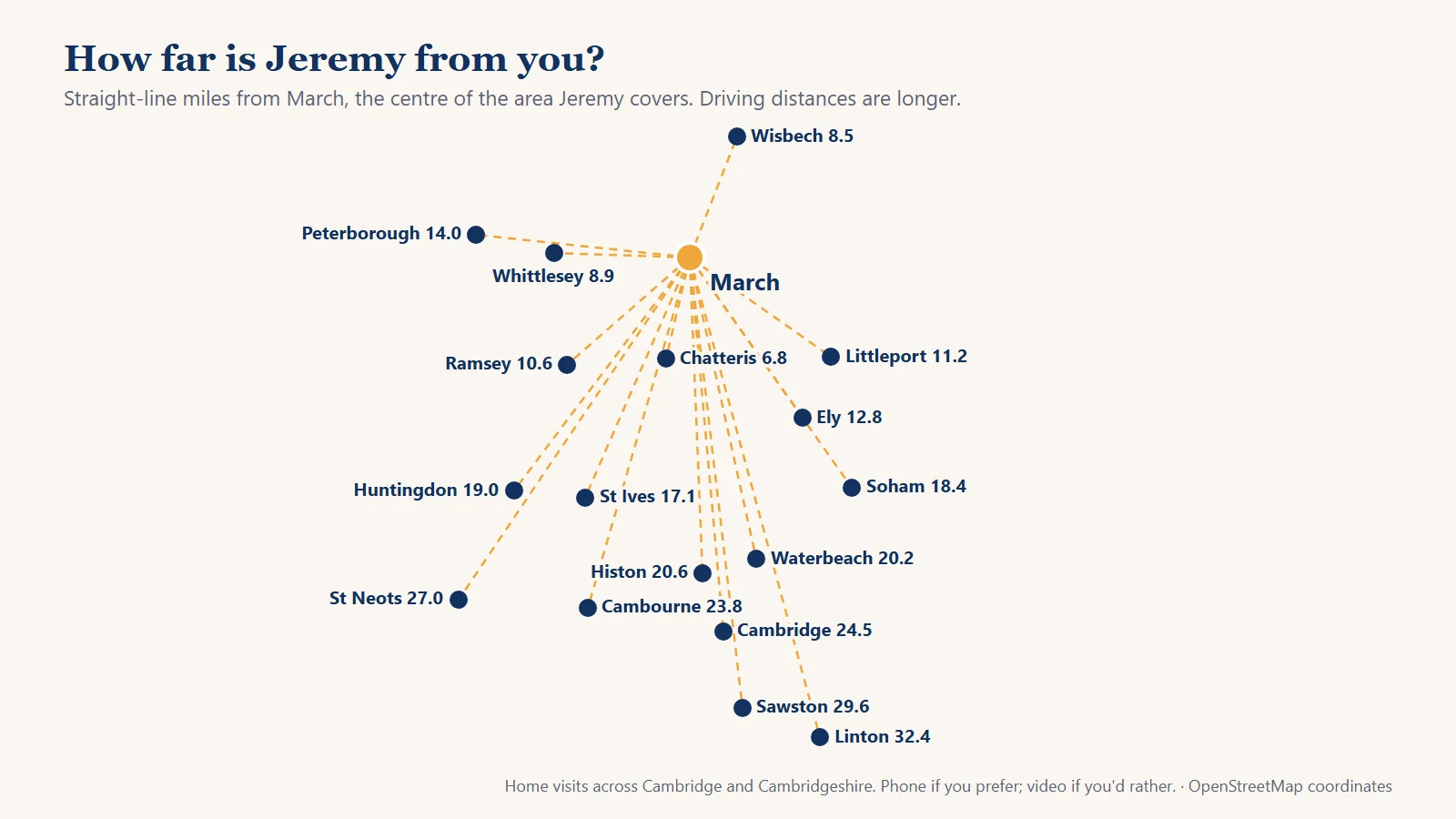
All of them. Cambridge is 24.5 miles from March as the crow flies, and the villages around the city sit between 20 and 33 miles away. The north of the county is my doorstep: Chatteris is under 7 miles, Wisbech and Whittlesey under 9.
| From March to | District | As the crow flies |
|---|---|---|
| Chatteris | Fenland | 6.8 miles |
| Wisbech | Fenland | 8.5 miles |
| Whittlesey | Fenland | 8.9 miles |
| Ramsey | Huntingdonshire | 10.6 miles |
| Littleport | East Cambridgeshire | 11.2 miles |
| Ely | East Cambridgeshire | 12.8 miles |
| Peterborough | Peterborough | 14.0 miles |
| St Ives | Huntingdonshire | 17.1 miles |
| Soham | East Cambridgeshire | 18.4 miles |
| Huntingdon | Huntingdonshire | 19.0 miles |
| Godmanchester | Huntingdonshire | 19.4 miles |
| Waterbeach | South Cambridgeshire | 20.2 miles |
| Histon | South Cambridgeshire | 20.6 miles |
| Cambourne | South Cambridgeshire | 23.8 miles |
| Cambridge | Cambridge | 24.5 miles |
| Cherry Hinton | Cambridge | 25.4 miles |
| Grantchester | South Cambridgeshire | 25.7 miles |
| Fulbourn | South Cambridgeshire | 26.0 miles |
| Trumpington | Cambridge | 26.0 miles |
| St Neots | Huntingdonshire | 27.0 miles |
| Sawston | South Cambridgeshire | 29.6 miles |
| Linton | South Cambridgeshire | 32.4 miles |
Around the city I also visit Chesterton, Coton, Girton, Hauxton, Madingley, Milton, Stow cum Quy and Teversham; the table just gives you fixed points. Everywhere in Cambridgeshire is well inside the 70 to 80 miles I cover. I have pages for Ely, March, Wisbech, Huntingdon and Peterborough.
Final thoughts from me
Before you decide anything about releasing equity in Cambridge, here's what I'd want you to keep:
- I come to your home anywhere in Cambridge and its villages, and the first conversation is free.
- What you can release depends on the youngest owner's age and your own home, and people usually take far less than the maximum.
- With Cambridge prices, downsizing can raise more than a lifetime mortgage and costs no interest.
- Unpaid interest compounds, so the debt grows and leaves less for your family.
- You can stop at any point before completion without owing the lender anything.
- My fee is fixed and only due if the plan completes, and I'll tell you the figure on the phone.
How much could you release from your home?
Three quick questions and an indicative figure straight away. No name, phone number or email needed to see it.
What clients and their families say
"Many companies take advantage of the elderly, but this was clearly not the case with Jeremy. He thoroughly explained all options and even assisted my gran with completing complex application forms. Within a week of the initial visit, my gran secured funding from a reputable lender."
"Had the pleasure of dealing with Jeremy on behalf of my mum for equity release on her home. If you want someone you can genuinely trust then don't go anywhere else! Jeremy is probably the most honest and genuine advisor that you will come across."
"Jeremy was very professional throughout the process, kept us uptaded at all times, nothing was too much trouble."
Book your free initial consultation today.
Pick up the phone and speak to Jeremy directly. If equity release is not the right choice, I will say so.
07768 972861 Or try the quick calculator