
Home › Equity release › RIO vs equity release
Retirement interest-only mortgage vs equity release: which suits you?
If you're trying to choose between a retirement interest-only mortgage and equity release, you're in the right place. I arrange both, so this is the comparison I'd talk you through at your kitchen table: what each one is, how they differ, what each costs over time and what happens when one of you dies or needs care.

- On the FCA register, reference JLF01060 check the register
- Pellucid Ltd, FCA number 981845 check
- Equity Release Council member my profile
- SOLLA Later Life Lending Advice Standard
Quick answer: should you choose a RIO or equity release?
Choose a RIO if your pension can comfortably pay the interest every month for life, including for whichever of you is left: the debt stays flat. Choose equity release if it can't, or you'd rather not commit: nothing is due monthly, but the interest compounds and reduces what you leave.
Why speak to Jeremy about a RIO or equity release?
Because I arrange both, so I've no reason to push you towards either. I'll be straight about the RIO side, too: they're hard to get, and I only arrange them occasionally, because the income test turns a lot of people down. When one won't work I'll tell you at the first meeting rather than run an application that was never going to pass. I've specialised in later-life lending since 2009, hold CeMAP, CERT CII (ER) and the SOLLA Later Life Lending Advice Standard, and I'm an Equity Release Council member. It's me from the first call to completion, at your home or on the phone. Trusted Equity Release is a trading name of Pellucid Ltd, authorised and regulated by the Financial Conduct Authority, FRN 981845.
“Would not hesitate to recommend this Company. Professional, honest and always available to help at any point of the procedure.”
What is a retirement interest-only mortgage?
A retirement interest-only mortgage, or RIO, is a mortgage for older borrowers where you pay only the interest each month, and the amount you borrowed is repaid when the home is sold: usually after you die, move into long-term care or sell up. Because the interest is paid as you go, what you owe never grows.
MoneyHelper describes it as a home loan for older borrowers whose needs aren't met by a standard mortgage, and says lenders set their own rules: a minimum age, typically over 50 or 55, the home must be your main home, and you need a minimum amount of equity. RIOs start from 50 with some lenders. It is a mortgage, not equity release, and it's regulated as one.
What is equity release?
Equity release almost always means a lifetime mortgage: a loan secured on your home, from age 55, with nothing to pay monthly unless you choose to. The interest is added to the loan and compounds, and the whole lot is repaid when the last borrower dies or moves into long-term care, usually from the sale of the home. Lifetime mortgages make up more than 99% of the equity release market; the other type, home reversion, is one I don't arrange. More on how it all works is on my equity release page.
How are a RIO and a lifetime mortgage similar?
More than people expect. Both:
- let you borrow against your home in retirement and keep living in it
- are usually repaid from the sale of the home when you die or move into long-term care, and on a joint loan, only once both of you have
- can be open-ended, with no fixed date when the loan has to be repaid
- can be used to buy a home, not only to borrow against the one you've got
- let you pay interest: on a RIO it's compulsory, on a lifetime mortgage it's optional on many plans
- are secured on your home, so they reduce what you leave
- are regulated by the Financial Conduct Authority
The big difference is the one in the first line of the quick answer: who has to prove they can pay, and what happens to the debt.
What are the differences between a RIO and equity release?
| Retirement interest-only mortgage | Lifetime mortgage (equity release) | |
|---|---|---|
| Monthly payments | Interest, every month, compulsory | None required; you can choose to pay some or all of the interest |
| Affordability test | Yes, on your retirement income | No affordability check, but eligibility rules apply |
| Minimum age | From 50 with some lenders; 55 at Leeds and Nottingham Building Societies | 55 |
| Maximum age to apply | Lender's limit, for example 80 at Leeds Building Society | Lender's limit, for example 84 on LV='s drawdown plan |
| How much you can borrow | Up to 55% of the home's value at Leeds, 60% at Nottingham, if the income supports it | Typically 25% to 28% of the home's value at 55, 40% to 43% at 70, 50% to 57% from 80 |
| What you owe over time | Stays the same | Grows unless you pay the interest |
| Interest rate | Often fixed for 2, 3 or 5 years, like an ordinary mortgage | Fixed, or capped, for life |
| Early repayment charges | During any fixed or discounted period | Often for 10 to 15 years |
| If payments stop | Arrears, and the home can be repossessed | Nothing to miss on a standard plan |
| Couples | Tested on whether the survivor's income alone can pay | No income test |
| No negative equity guarantee | Not an Equity Release Council product; check the mortgage terms | Yes, on Equity Release Council plans |
| Advice | Set by the lender's own process; I advise on both | Advice is compulsory before you can take one |
| What your family inherits | The home less the original loan | The home less the loan and the rolled-up interest |
*Lender criteria as published by Leeds and Nottingham Building Societies, captured 7 October 2026. Release percentages from my equity release calculator. Criteria change.*
Two figures from the FCA's sales data put the table in context. In 2025, around 27,000 lifetime mortgages were sold against about 3,000 RIOs, and the typical RIO borrowed a bigger share of the home: a median loan-to-value of about 27%, against about 15% on lifetime mortgages. Both are in my equity release statistics.
How much more does equity release cost than a RIO over time?
A lot, if you pay nothing on the lifetime mortgage. Take £60,000. With a RIO you pay the interest every month out of your pension and still owe £60,000 when the home is sold. With a lifetime mortgage at 6.25% a year and nothing paid, the interest is charged on interest:
| £60,000 borrowed | RIO: what you owe | Lifetime mortgage: what you owe | Difference your estate repays |
|---|---|---|---|
| After 5 years | £60,000 | about £81,900 | about £21,900 |
| After 10 years | £60,000 | about £111,900 | about £51,900 |
| After 15 years | £60,000 | about £152,800 | about £92,800 |
| After 20 years | £60,000 | about £208,700 | about £148,700 |
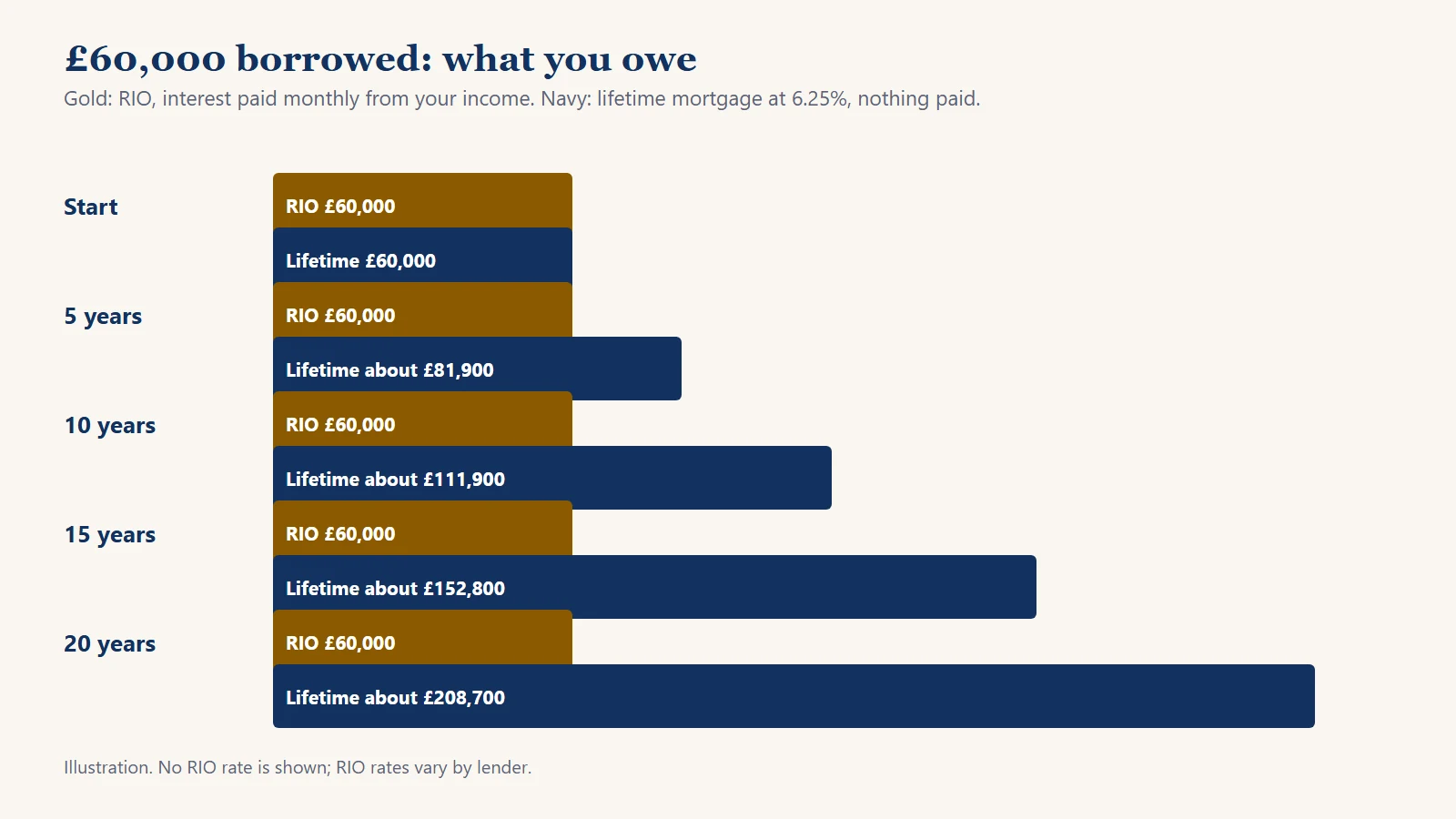
*Illustrative only: lifetime mortgage at 6.25% a year compounded monthly with nothing paid, as in my equity release calculator. The RIO line ignores the interest you pay each month, which comes out of your income instead.*
That last note matters. The RIO isn't free money: you've paid the interest month by month for those 20 years. The difference is who pays it and when. The Vernon Building Society puts the compounding plainly: at 6% fixed for life, a lifetime mortgage debt doubles roughly every 12 years.
I haven't put a RIO rate here. Tembo says RIO rates are generally lower than equity release rates, and that fits what you'd expect from a loan where the interest is paid as you go, but the honest figure for your case is a written quotation. Lifetime mortgage rates as they stand are on my page about equity release interest rates.
How do lenders decide whether you can afford a RIO?
They test whether your retirement income can carry the interest for life, for you and for whichever of you is left. Nottingham Building Society publishes its rules, and they're typical of what I see:
| What the lender checks | Nottingham Building Society's rule |
|---|---|
| Couples | Joint borrowers must show they can keep paying if the highest earner dies |
| Income counted | Guaranteed income that transfers to the survivor; current income at application; income from properties you own outright |
| Work income | If you're still working, it projects your income into retirement; employment and self-employed income aren't included in that projection |
| Debts | Personal unsecured debts are taken into account |
| Loan size | Up to 60% of the home's value |
| Repayment | The sale of the home is the only repayment plan assessed |
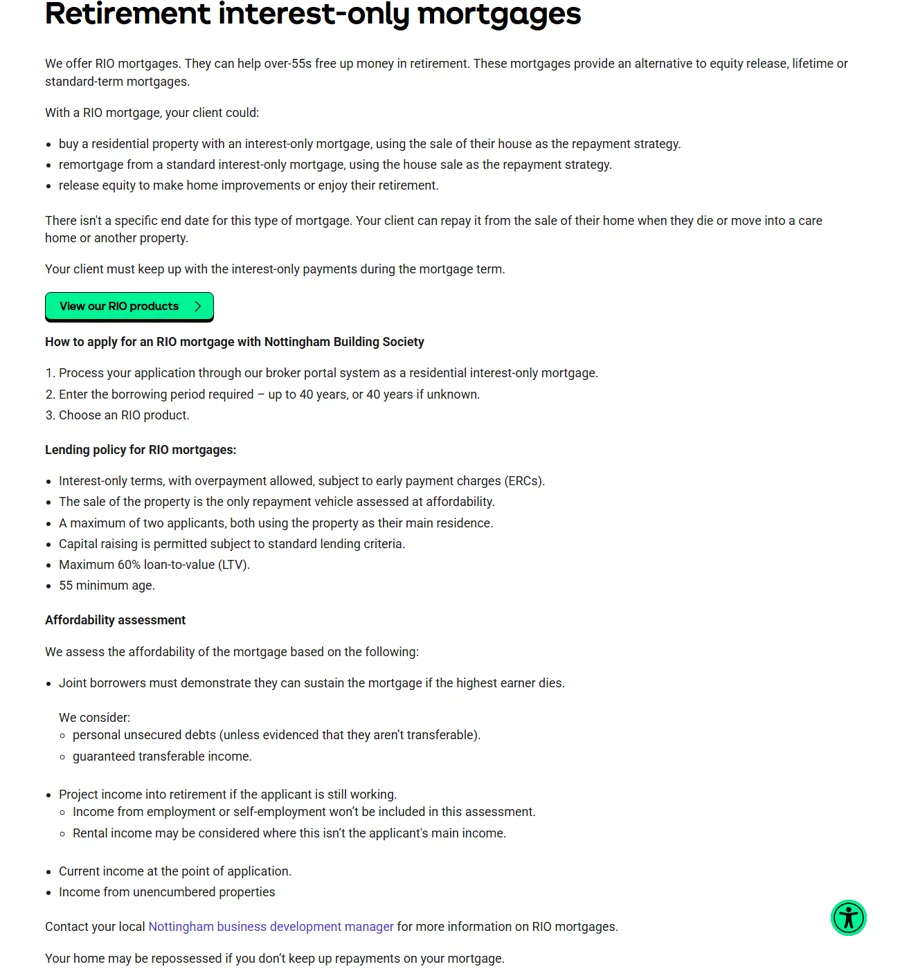
*Nottingham Building Society, published criteria captured 7 October 2026.*
The survivor test is where RIOs fall down most. A couple living comfortably on two pensions can find that one pension alone, after a death, wouldn't cover the interest, and the application fails even though they'd manage today. That's the honest reason I describe RIOs as hard to get.
What happens to a RIO if one of you dies?
Nothing changes for the survivor on a joint RIO: the loan carries on, and the survivor keeps paying the interest. Leeds Building Society says the repayment event is triggered by the surviving or last borrower living in the property. That's why the lender tested the survivor's income at the start.
Does equity release need an income test?
No. A lifetime mortgage has no affordability check, because there's nothing you have to pay. Saga puts it the same way: no affordability checks, but there are eligibility criteria, such as being 55 or over and owning a UK home worth at least £70,000 for its plan. What decides how much you can borrow is your age, the value of the home and sometimes your health. If you choose to pay some interest, you can stop if money gets tight, and the interest simply rolls up from then on.
Is a RIO the same as a term interest-only mortgage?
Near enough. I'd call them the same product wrapped up slightly differently. A term interest-only mortgage has a set end date and the lender checks how you'll repay the capital when it ends. A RIO usually has no end date and is repaid when the home is sold. Some lenders sell a RIO with a term anyway: the Vernon says one can run for as little as three years or for the rest of your life.
What happens to each one when you die or move into care?
| RIO | Lifetime mortgage | |
|---|---|---|
| Single borrower dies | Loan repaid, usually from the sale of the home | Loan plus rolled-up interest repaid, usually from the sale |
| One of a couple dies | Carries on for the survivor, who keeps paying the interest | Carries on for the survivor, nothing to pay |
| Move into long-term care | Repaid when the last borrower moves out permanently | Repaid when the last borrower moves out permanently; the lender waives any early repayment charge under Equity Release Council standards |
| If the sale doesn't cover the debt | Depends on the mortgage terms | The no negative equity guarantee: the estate never owes more than the home is worth after reasonable sale costs |
| What's owed | The original loan | The loan plus compounded interest, unless you paid it |
Either way, your family will need to deal with the lender once the home is to be sold. What that involves is on my page will my family end up in debt?
Should you choose a RIO or a lifetime mortgage?
It comes down to income, how much you want to leave and how you feel about a monthly commitment into your eighties and nineties.
Consider a RIO if:
- your guaranteed pension income covers the interest comfortably now
- the survivor's income alone would still cover it if one of you died
- leaving as much of the home as possible to your family matters more than keeping your income free
- your interest-only mortgage is ending and you want to keep the same arrangement into retirement
- you may want to repay or move within a few years, and a short fixed rate suits you better than a lifetime product
Consider a lifetime mortgage if:
- there's no income to spare for monthly payments, or you'd rather not commit to them
- one of your pensions would fall sharply if the other partner died
- you'd like the option of paying interest when you can and stopping when you can't
- you want the money in stages, through a drawdown lifetime mortgage
- you want the certainty that nothing you miss can put the home at risk
A lot of people sit between the two. If remortgaging onto an ordinary repayment mortgage is also on the table, my comparison of equity release vs remortgage covers that side.
Can you pay off a RIO mortgage early?
Yes. You can repay a RIO from savings, a sale or a downsize, or clear it with a lifetime mortgage if your age and the home's value allow enough to be released. Whether there's a charge depends on the deal. Nottingham Building Society allows overpayments on its RIOs, subject to early repayment charges; the Vernon offers RIOs fixed for 2, 3 or 5 years, and points out that this gives you flexibility to repay once the fixed period ends. Read the charges section of the offer before you sign, because that's where the answer is.
What happens if you can't keep up the payments on a RIO?
It's treated like any mortgage in arrears: the borrower has to pay the interest every month for the life of the mortgage, as Leeds Building Society puts it, and Nottingham Building Society warns that your home may be repossessed if you don't keep up the payments. Talk to the lender as early as you can: lenders would rather agree a plan than repossess. The realistic ways out are usually a lifetime mortgage that clears the RIO, if you're 55 or over and the home's value allows, or selling and moving somewhere smaller. It's the main risk a RIO carries that a standard lifetime mortgage doesn't.
Can you switch from a RIO to equity release, or the other way?
Both ways, with conditions. A lifetime mortgage can repay a RIO, because any existing mortgage has to be cleared from the money released. My page on equity release with an existing mortgage explains how that works.
Going the other way means repaying the lifetime mortgage with a RIO, which can bring an early repayment charge in the early years. Equity Release Council plans let you make repayments without a charge within the lender's limits, so a lifetime mortgage can also be paid down gradually, which gets you closer to a RIO's flat debt without changing products. The detail is on my page can you pay back equity release?
Do you need advice for a RIO and for equity release?
For equity release, yes: you can't take out a plan without financial advice, and the Equity Release Council also requires independent legal advice from a solicitor. For a RIO, the lender sets its own process; Leeds and Nottingham, for example, publish their RIO criteria for brokers. The point I'd make is simpler. Ask whether the person advising you can arrange both, because someone who can only arrange one has a reason to like it. I can arrange both.
FAQ
Can a retired person get an interest-only mortgage?
Is a retirement interest-only mortgage a good idea?
Is there a better way than equity release?
What are the disadvantages of a lifetime mortgage?
Can you get a RIO in your 80s?
Can you use a RIO or a lifetime mortgage to buy a home?
Final thoughts from me
The short version:
- A RIO needs pension income to pay the interest every month; a lifetime mortgage needs none.
- RIOs start at 50 with some lenders, lifetime mortgages at 55.
- With a RIO, £60,000 stays £60,000; with nothing paid at 6.25%, a lifetime mortgage reaches about £111,900 in ten years.
- For couples, a RIO lender tests whether the survivor's income alone could pay, and that's where a lot of applications fail.
- Missing RIO payments puts the home at risk; a standard lifetime mortgage has nothing to miss.
- A lifetime mortgage can clear a RIO later if your age and the home's value allow.
Book your free initial consultation today.
Pick up the phone and speak to Jeremy directly. If equity release is not the right choice, I will say so.
07768 972861 Or try the quick calculator