
Home › Lifetime mortgages › Enhanced lifetime mortgages
Enhanced lifetime mortgages: does your health get you more?
If you're looking for an enhanced lifetime mortgage, you're in the right place. I'll go through who qualifies, what the lenders ask, how much difference it can make at your age and what it costs your family, with the same figures I'd put on the table if I were sitting in your kitchen.

- On the FCA register, reference JLF01060 check the register
- Pellucid Ltd, FCA number 981845 check
- Equity Release Council member my profile
- SOLLA Later Life Lending Advice Standard
Quick answer: does your health get you more from a lifetime mortgage?
Often, yes. If smoking, diabetes, blood pressure, a heart condition, cancer or another condition shortens life expectancy, some lenders release more or charge a lower rate. You answer a questionnaire, not a medical. The gain is biggest in your fifties and sixties and can disappear by 80.
Why speak to Jeremy about enhanced lifetime mortgages?
Because the health questions only work for you if they're asked properly, and I ask them myself. Your health and life expectancy are on the FCA's list of things an adviser has to weigh before recommending equity release, so I'd ask anyway. With your permission I go through every condition and every tablet, then put the same answers to each lender I compare, because they score them differently. I've specialised in later-life lending since 2009, hold CeMAP, CERT CII (ER) and the SOLLA Later Life Lending Advice Standard, and I'm an Equity Release Council member. It's me from the first call to completion, at your home or on the phone. Trusted Equity Release is a trading name of Pellucid Ltd, authorised and regulated by the Financial Conduct Authority, FRN 981845.
“if you want someone you can genuinely trust then don't go anywhere else! Jeremy is probably the most honest and genuine advisor that you will come across.”
What is an enhanced lifetime mortgage?
It's a lifetime mortgage where the lender uses your health and lifestyle to set how much you can borrow and the interest rate. You'll also see them called impaired, ill-health or medically enhanced plans. Everything else works as on a standard plan: the loan is secured on your home, you keep ownership, nothing has to be paid monthly, and the loan plus interest is repaid when the last borrower dies or moves into long-term care.
The logic runs the opposite way to insurance. A life insurer charges more when your health is poor because it expects to pay out sooner. A lifetime mortgage lender expects to be repaid sooner, so it can afford to lend more against the same house, or charge less for the same loan.
Who qualifies for an enhanced lifetime mortgage?
Anyone who meets the normal lifetime mortgage rules and has at least one health or lifestyle factor a lender counts, for either borrower. In practice:
| Requirement | What it means |
|---|---|
| Age | The youngest borrower is 55 or over |
| Home | Your main home, worth at least the lender's minimum (Bower Home Finance quotes £70,000) |
| Existing mortgage | Any mortgage left is repaid from the money released |
| Health or lifestyle | At least one factor on the lender's questionnaire |
| Evidence | Answers the lender can check with your GP if it asks |
If nothing on the questionnaire applies to you, you aren't shut out. A standard lifetime mortgage is the same product without the health underwriting, and my page on who is eligible for equity release covers the general rules.
Which health conditions and lifestyle factors do lenders ask about?
Each lender has its own questionnaire, but they cover the same ground. Between them, Equity Release Supermarket, MoneyRelease and Willow Private Finance list all of these:
| Area | What you're asked |
|---|---|
| Smoking | Whether you smoke |
| Weight | Height and weight, to work out your BMI; high or low can count |
| Blood pressure | Whether it's high |
| Diabetes | Whether you have it |
| Heart | Angina, a heart attack or heart surgery |
| Stroke | A stroke or mini stroke |
| Cancer | Now or in the past |
| Lungs | Chronic respiratory illness |
| Neurological | Multiple sclerosis or Parkinson's disease |
| Mobility | Whether you need mobility aids |
| Other serious illness | An organ transplant or organ failure; HIV |
| Medication | Any illness needing daily medication, or prescriptions generally |
| Alcohol | How much you drink |
| Work history | Whether you retired early because of ill health |
Equity Release Supermarket says its list is by no means exhaustive, and that more severe factors can mean more cash.
Do well-controlled conditions still count?
Often they do. MoneyRelease says people with relatively minor or well-controlled conditions can often qualify. That's why I'd rather hear about the tablets you take every morning than have you decide they don't matter: a condition you've stopped thinking about can still be one a lender counts.
How is the enhancement worked out?
In two stages. First the lender works out a standard offer from the age of the youngest borrower and the value of the home, as for any lifetime mortgage. Then, if the questionnaire shows something that counts, it runs a second calculation. How much that adds depends on how many conditions you have and how serious they are, and each lender has its own criteria, Equity Release Supermarket says.
That last point matters more than it sounds. MoneyRelease gives two examples. After a heart attack, some lenders only count it if you were admitted to hospital, and others don't mind. Some ask whether you've been diagnosed with a condition in the last five years; others ask whether you've ever been diagnosed. The same answers can earn an enhancement from one lender and nothing from the next. I put them to each lender rather than picking one first.
How much more can you release with an enhanced lifetime mortgage?
Your age decides it as much as your health. Younger applicants see the biggest enhancements, and by about 80 the standard limits are already so high that health can add nothing. MoneyRelease published this illustration of maximum releases as a share of the home's value:
| Youngest borrower's age | Standard plan | Medically enhanced | Difference |
|---|---|---|---|
| 55 | 23.9% | 36.5% | 12.6 points more |
| 60 | 29.5% | 38.7% | 9.2 points more |
| 70 | 39.5% | 41.3% | 1.8 points more |
| 80 | 52.5% | 52.5% | None |
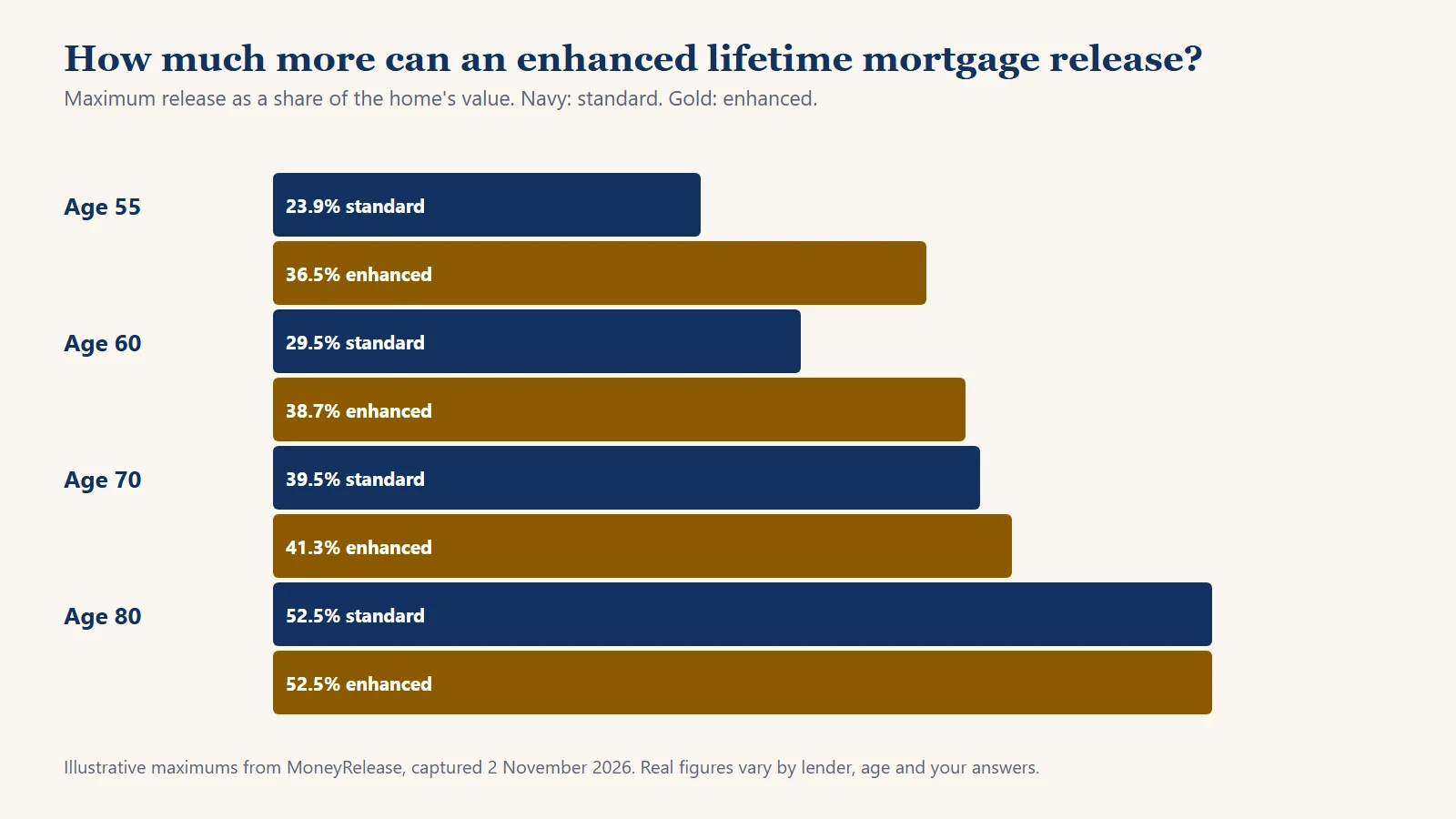
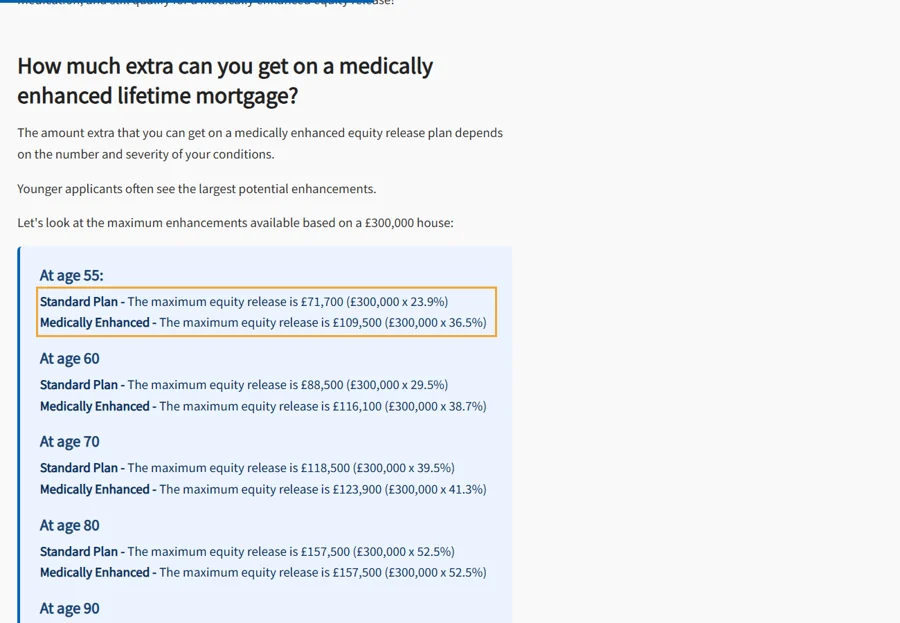
*Illustrative maximums from MoneyRelease's own example, captured 2 November 2026. Real figures vary by lender, by age and by your answers.*
Read those as the ceiling for someone whose conditions count heavily, not as what you'd get. My own equity release calculator uses standard terms and puts typical releases at 25% to 28% of the home's value at 55, 40% to 43% at 70 and 50% to 57% from 80. I won't put an enhancement figure on your case until a lender has seen your questionnaire, because before then any number I gave you would be a guess dressed up as a quote.
Can you take a lower interest rate instead of more money?
Yes, with some lenders. If the standard maximum already covers what you need, the health answers can go towards the rate instead. Equity Release Supermarket notes that Aviva's Lifestyle Flexi plan offers a lower rate when you don't need the maximum.
A lower rate is worth more than it looks because unpaid interest compounds. At 6.25% a year with nothing paid, £60,000 grows to about £111,900 in ten years, and any cut in the rate slows that every month for the life of the loan. I ask for both versions, the bigger sum and the lower rate, and show you them side by side. For where rates sit at the moment, see my page on equity release interest rates.
Is an enhanced lifetime mortgage always the better deal?
No, and better to hear it now than after you've got your hopes up. Equity Release Supermarket points out that enhanced rates tend to be higher than standard ones. MoneyRelease adds that not every lender offers enhanced plans, so a standard plan from another lender is sometimes cheaper. The biggest offer and the cheapest money can be two different plans.
I compare both every time. If you need the extra, the enhanced plan may be the only way to reach it. If you don't, a standard plan at a lower rate can leave your family more.
What are the advantages of an enhanced lifetime mortgage?
- More money than a standard plan would lend at your age, or a lower interest rate for the same amount.
- No medical examination: a questionnaire, checked with your GP if the lender asks.
- The extra can be what makes a plan work at all, such as clearing a mortgage a standard release wouldn't cover.
- Enhanced terms exist on drawdown plans too; Equity Release Supermarket says More2Life's comes with a bigger cash reserve.
- The Equity Release Council protections, including the no negative equity guarantee, are the same as on any other plan.
What are the disadvantages of an enhanced lifetime mortgage?
- Borrow the maximum and there may be little or nothing left to inherit.
- The rate can be higher than a standard plan's.
- Waiting for a GP's report can add a couple of weeks.
- A bigger lump sum can affect means-tested benefits.
- Repaying the whole plan early can bring an early repayment charge.
- You share medical details with the lender, and it may check them with your doctor.
The wider list of lifetime mortgage downsides, which apply here too, is on my page about the pros and cons of equity release.
How does an enhanced lifetime mortgage compare with a standard one?
| Standard lifetime mortgage | Enhanced lifetime mortgage | |
|---|---|---|
| Who it's for | Homeowners from 55 | Homeowners from 55 with a health or lifestyle factor a lender counts |
| Health questions | Not used to set the terms | A questionnaire for each borrower |
| Extra checks | Valuation and the usual application checks | The same, plus a possible GP report and, for smokers, a possible nicotine test |
| Maximum release | Set by age and home value | Can be higher, most of all at younger ages |
| Interest rate | The lender's standard rate | Can be lower, but can also be higher |
| Time to complete | The usual timescale | Can be a couple of weeks longer |
| Safeguards | Equity Release Council standards | The same |
| When it's repaid | Death or a permanent move into care | The same |
Do you need a medical for an enhanced lifetime mortgage?
No, but expect your answers to be checked. After you apply, Equity Release Supermarket says, the lender will usually write to your doctor for a medical report, and some lenders randomly ask a smoker for a nicotine test. Without evidence, Willow Private Finance says, standard terms apply.
You can speed it up. MoneyRelease suggests sending copies of your prescriptions, and hospital letters if you're comfortable sharing them, so the lender can check your answers without waiting on your GP. It's optional, and I'd never ask you to send anything you'd rather keep to yourself.
Why does telling the lender everything matter?
Because the lender can only count what it's told and what it can check. A condition left off the form earns nothing. I go through the questionnaire with you line by line, including the things that feel minor, the operation from years ago and the inhaler in the kitchen drawer.
How long does an enhanced lifetime mortgage take?
A little longer than a standard one, usually. The GP's report is the hold-up, and MoneyRelease suggests allowing an extra couple of weeks before the money arrives. The lender requests the report, not you, and I can chase it, but I can't make a busy surgery answer faster. If the money has a deadline, a house purchase for instance, tell me at the first meeting so I can plan around it. The general timeline is on my page about how long equity release takes.
How are joint applications assessed when only one of you is unwell?
Both of you fill in a questionnaire. The age and answers of the younger borrower usually carry the most weight, MoneyRelease says, because the loan is repaid when the last of you dies or moves into long-term care, and the younger one will typically live longer.
That doesn't rule couples out. MoneyRelease also says a couple can still qualify for an enhanced plan when the younger partner is fit and takes no medication. Give me both sets of answers, even if you think only one of you counts.
Which lenders offer enhanced lifetime mortgages?
Equity Release Supermarket names Aviva, More2Life and Just (listed as Just Retirement) as the lenders specialising in enhanced plans, and says all three can lend more than on their standard terms. It notes differences between them, too:
| Lender | What Equity Release Supermarket says is different |
|---|---|
| Aviva | Lifestyle Flexi offers a lower rate if you don't need the maximum |
| More2Life | An enhanced drawdown plan with a bigger cash reserve for later |
| Just | A more detailed lifestyle questionnaire that takes in conditions other plans don't |
Products change, so I check each lender's current terms at the time rather than working from a list. I'm not tied to any lender, and how I judge them is on my page about the best equity release companies.
Who is an enhanced lifetime mortgage best suited to?
It earns its place in three situations:
- The standard maximum falls short of what you need, for example to clear an existing mortgage, which has to be repaid from the release. My page on equity release with an existing mortgage explains how that works.
- You want the lowest rate available, and your health or lifestyle gives a lender a reason to offer one.
- You're in your fifties or sixties, where MoneyRelease's figures show the largest enhancements.
It earns less from about 80, when standard plans already lend typically 50% to 57% of the home's value, and when you need nowhere near the maximum. Neither is a reason to skip the questions, because a lower rate can still be on offer.
What can you use the money from an enhanced lifetime mortgage for?
The same things as any lifetime mortgage. The reasons people bring to me are paying off a mortgage or other debts, home improvements or adapting the house so they can stay in it, topping up retirement income, helping children or grandchildren with a living inheritance, holidays and travel, and paying for care at home or private medical bills. Where health is the reason you qualify, adapting the home can be part of the reason you need the money.
How does an enhanced lifetime mortgage affect care funding and benefits?
Money from a lifetime mortgage can pay for care at home. If you later move permanently into long-term care, the plan ends for you and the loan is repaid from the home; on a joint plan it carries on while the other borrower still lives there. Under the Equity Release Council's standards, the lender waives any early repayment charge when a borrower moves permanently into care, once it has a medical practitioner's certificate. How care fees, your home and a lifetime mortgage fit together is on my page about equity release and care home fees.
Benefits are the other half. A lump sum can affect means-tested benefits, and an enhanced plan can mean a bigger lump sum. Taking the money in stages through a drawdown lifetime mortgage can help, because money you haven't drawn isn't sitting in your account. I check your benefits before suggesting an amount.
What safeguards come with an enhanced lifetime mortgage?
The same as any lifetime mortgage that meets the Equity Release Council's standards. Enhanced terms change the money, not the protections.
| Safeguard | What the Equity Release Council standard says |
|---|---|
| Interest rate | Fixed, or variable with a fixed cap, for the life of the loan |
| Home for life | You can live in the home for the rest of your life, or until you move permanently into care, provided it stays your main home and you keep to the terms |
| Moving home | You can move and take the plan with you, subject to the lender's criteria at the time |
| No negative equity guarantee | You or your estate will never owe more than the home is worth, after reasonable sale costs |
| Repayments | You can make repayments without charges, subject to the lender's criteria |
| Long-term care | Any early repayment charge is waived on a permanent move into care |
| Legal advice | You must have independent legal advice before the plan goes ahead |
On top of that, the advice is regulated by the FCA. The solicitor can be your own, or one I recommend who does equity release work day in, day out; the choice is yours.
Can you repay an enhanced lifetime mortgage early?
Yes, in part or in full, on the same terms as a standard plan. Plans that meet the Council's standards let you make repayments without a charge, within the lender's limits. On many of the plans I arrange you can also pay some or all of the monthly interest, from £50 a month or at 25%, 50%, 75% or 100% of it, so the debt grows more slowly or not at all. Repaying the whole plan early, other than on death or a move into care, can bring an early repayment charge, and that charge is set out in writing before you sign. The detail is on my page can you pay back equity release?
Does an enhanced lifetime mortgage leave less for your family?
It can, simply because you can borrow more. Unless you pay the interest it compounds, and the bigger the loan, the faster the debt grows in pounds. Here's £60,000 against £80,000 at 6.25% a year with nothing paid:
| Borrowed | After 5 years | After 10 years | After 15 years | After 20 years |
|---|---|---|---|---|
| £60,000 | about £81,900 | about £111,900 | about £152,800 | about £208,700 |
| £80,000 | about £109,300 | about £149,200 | about £203,800 | about £278,300 |
*Illustrative only: 6.25% a year compounded monthly, no payments made, worked out as in my equity release calculator. Your rate depends on the lender and your answers.*
Three things soften it. A lower rate, if you take the enhancement that way, slows the growth. Many plans let you protect part of the home's value as a guaranteed inheritance, at the cost of borrowing less. And the no negative equity guarantee means your family can never be left owing more than the home sells for. More on that in will my family end up in debt?
FAQ
Can I get a lifetime mortgage at 60?
Can you get an enhanced drawdown lifetime mortgage?
Will the lender want another GP report if I borrow more later?
Is an enhanced lifetime mortgage worth it at 80?
How much money can I give my daughter to buy a house?
Final thoughts from me
If you only remember a handful of things from this page:
- An enhanced lifetime mortgage can mean more money or a lower rate, depending on the lender and your answers.
- Smoking, weight, blood pressure, diabetes, heart trouble, stroke, cancer, lung conditions and mobility all feature on the questionnaires.
- The enhancement is biggest at younger ages and can be nothing by 80.
- There's no medical, but the lender may ask your GP, so answer fully.
- Enhanced rates can be higher than standard ones, so I compare both.
- The interest still compounds, and borrowing more means the debt grows faster.
Book your free initial consultation today.
Pick up the phone and speak to Jeremy directly. If equity release is not the right choice, I will say so.
07768 972861 Or try the quick calculator