
Refused equity release: why do lenders say no, and what can you do next?
If you're worried about being refused equity release, or a lender has already said no, you're in the right place. I'll go through the reasons lenders actually give, at which point in the process each one tends to come up, which of them can be fixed, and what I'd do next if you've been turned down.
Quick answer: can you be refused equity release?
Yes. Lenders refuse applicants under 55, homes that are hard to resell, debts the release can't clear, and undisclosed problems such as bankruptcy. Each lender sets its own rules, so a refusal from one often isn't a refusal from all. Most reasons can be checked before you apply.
Why ask me before you apply?
Because the cheapest refusal is the one that never happens. Lenders draw their lines in different places on construction, location, condition and how much they'll lend at your age, and I compare them across the whole market before an application goes anywhere. If your home or your circumstances won't suit any lender, I'd rather tell you on the first call than after a valuation. I've specialised in later-life lending since 2009, I hold CeMAP, CERT CII (ER) and the SOLLA Later Life Lending Advice Standard, and I'm a member of the Equity Release Council. Trusted Equity Release is a trading name of Pellucid Ltd, authorised and regulated by the Financial Conduct Authority, FRN 981845.
“Many companies take advantage of the elderly, but this was clearly not the case with Jeremy.”
When in the process can equity release be refused?
At four points, and the later it happens, the more it costs you in time and sometimes in fees:
| Stage | What's being checked | The refusals that come up here |
|---|---|---|
| Before you apply | The basic criteria, with your adviser | Age, property type, value, debt on the home, plans to move into care |
| Application | The lender's checks on you | Undischarged bankruptcy; credit problems or plans for the money that weren't mentioned |
| Valuation | The surveyor's report on the home | Construction, location, condition, flood risk, a value lower than expected |
| Offer and legal work | Offer conditions and the solicitors' checks | Repairs or other conditions not met; title problems; the solicitor not being satisfied you understand the plan |
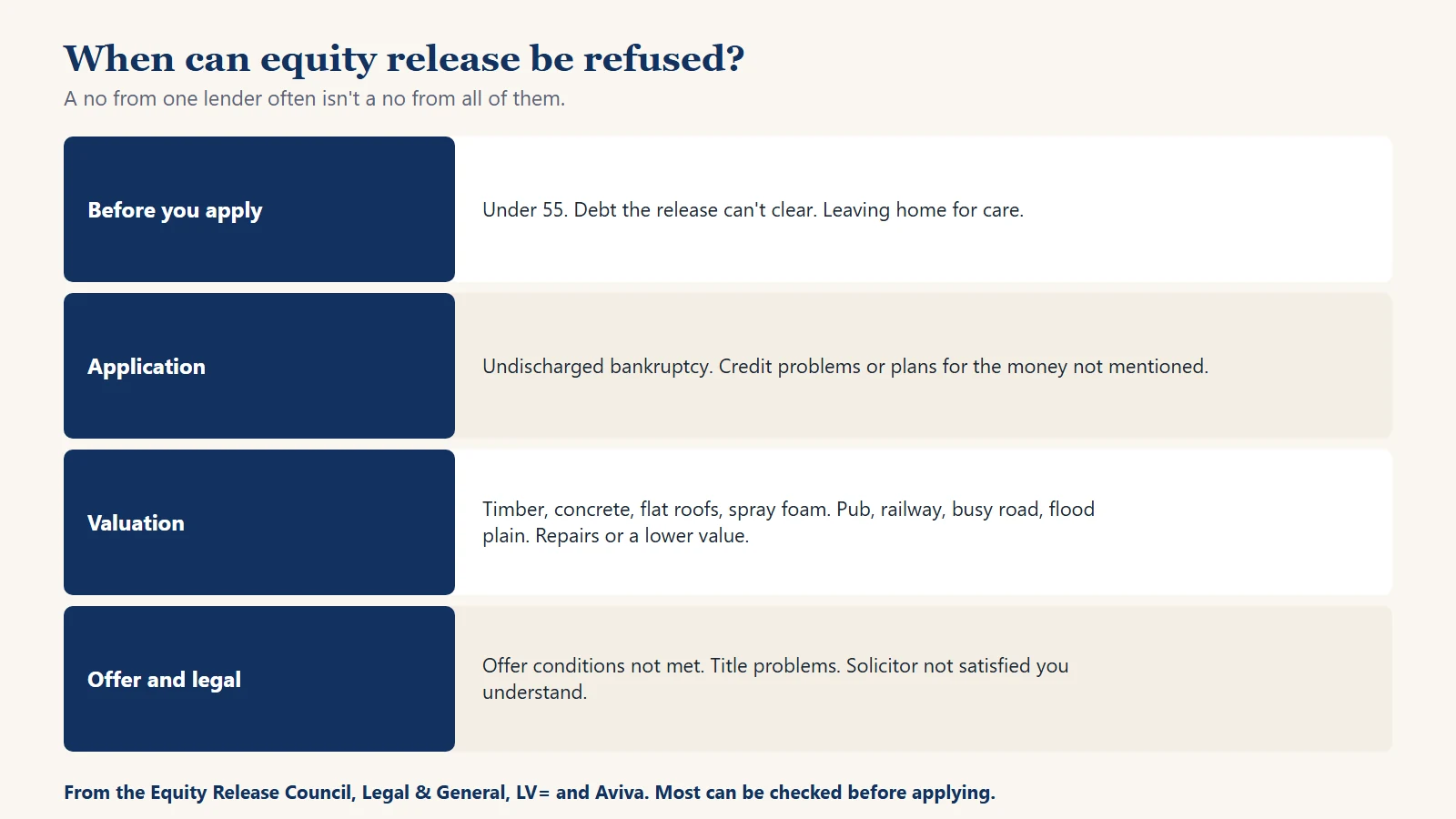
The reasons in the first row are the ones good advice should catch before anything is submitted. The ones in the valuation row are the hardest to predict, because they depend on what the surveyor sees on the day.
What are the most common reasons for being refused equity release?
Here are the reasons lenders and the Equity Release Council publish, and what can be done about each:
| Reason for refusal | What the lenders say | What can be done |
|---|---|---|
| A borrower under 55 | Both applicants must be 55 (Aviva, LV=) | Wait, or look at the routes from 50 |
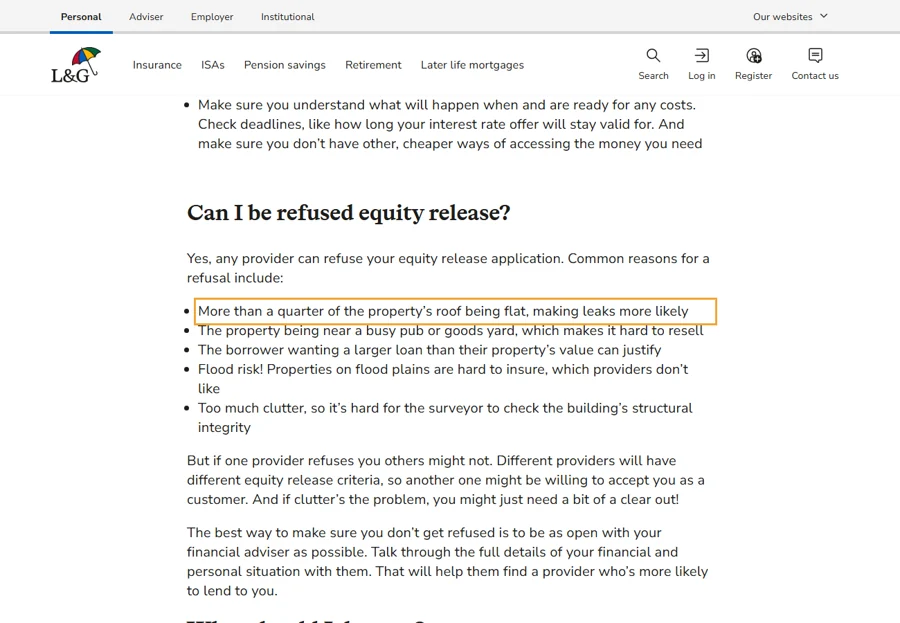
| Construction | Some providers won't accept timber frames, concrete or flat roofs (Equity Release Council); Legal & General names more than a quarter of the roof being flat | Find the lender whose rules fit |
| Spray foam insulation | "Very frequently a problem to providers" (Equity Release Council) | Ask me before anything else; this one needs specialist evidence |
| Location | Next to a pub, railway station or busy road, or on a flood plain (LV=); near a busy pub or goods yard (Legal & General) | Another lender may accept it |
| Condition | Urgent repairs may be needed before an offer (Aviva); too much clutter for the surveyor to check the structure (Legal & General) | Repairs first, and clear access for the surveyor |
| Value too low | Usually £70,000 minimum (LV=); £75,000 with Aviva | A lender with a lower threshold, if one fits |
| Loan too big for the home | Legal & General: wanting more than the property's value can justify | Borrow less, or wait until you're older |
| Debt the release can't clear | Any mortgage must be repaid from the release (LV=, Aviva) | Pay some off first, or wait |
| Undischarged bankruptcy | Applicants in undischarged bankruptcy cannot apply (LV=) | Wait until you're discharged |
| Information left out | Credit issues or plans for the money not mentioned (Legal & General) | Tell your adviser everything at the start |
| Moving into long-term care | Equity release may not be permissible if you're leaving the home (Equity Release Council) | A different way of funding care |
*From each lender's or the Council's own pages, checked 2 November 2026. Every lender's criteria differ, and they change.*
My page on equity release criteria covers the rules themselves in detail: ages, property values, lease lengths, who else can live in the house and how much you have to borrow. This page is about what happens when one of them catches you out.
Can you be refused equity release because of your age?
Yes, for a standard lifetime mortgage, if either of you is under 55. On a joint plan both applicants must meet the minimum, because the plan runs until the last of you dies or moves into long-term care. That isn't really a refusal so much as "not yet". Between 50 and 54 there are other routes, and my page on equity release at 50 sets them out.
Being older is never the problem. The older the youngest borrower, the more a lender will usually lend.
Can your property be refused for equity release?
Yes, and it's the most common reason I see cases struggle. The lender is repaid from the sale of the home, perhaps decades from now, so it only lends on homes it's confident will sell. That shows up in four ways.
Which construction types do lenders refuse?
Standard brick or stone with a tiled or slate roof is accepted everywhere. The Equity Release Council says some providers won't accept timber frames, concrete construction or flat roofs, and Legal & General gives more than a quarter of the roof being flat as a reason it may refuse, because leaks are more likely. Spray foam insulation is the one I'd flag hardest: the Council describes it as very frequently a problem to providers. If you've had it fitted, tell me before we look at anything else.
Can where you live get you refused?
It can. LV= says lenders may be less willing if you live next to a pub, a railway station or a busy road, or on a flood plain. Legal & General adds a busy pub or a goods yard, and flood plains because the homes are hard to insure. These are all about how easily the home would sell. One lender's no on location is often another's yes, so this is rarely the end of it.
Can the condition of your home stop equity release?
It can stop it or delay it. The surveyor checks the home is habitable and in reasonable repair. Aviva says that if the valuation shows urgent repairs, you may need to do them before it makes an offer, or as a condition of the loan. Legal & General even lists too much clutter as a refusal reason, because the surveyor can't check the structure. A clear loft hatch and clear access to the walls are worth an afternoon's work before the visit.
Is your home worth enough for equity release?
Usually it has to be worth at least £70,000, according to LV=, and Aviva sets £75,000. Aviva's smallest loan is £15,000, so very small releases can be refused too, or simply not be worth arranging.
What if the valuation comes in lower than expected?
Then the offer shrinks, and if the new figure won't cover what you need or what you owe, the case can fail. The Equity Release Council says a down valuation often happens when someone has lived in the home for years without having it valued, or when the surveyor finds a problem such as damp. You can appeal, but the Council says it takes strong evidence, such as recent local sales. If the lower figure is down to repairs, a revaluation after the work is done may put it right.
Here's how a lower valuation changes the numbers for a 70-year-old, using the release bands on my equity release calculator:
| Expected value £300,000 | Surveyor's value £270,000 | |
|---|---|---|
| Typical maximum at 70 (40% to 43%) | £120,000 to £129,000 | £108,000 to £116,100 |
| With £110,000 owed on a mortgage | £10,000 to £19,000 left after clearing it | Between £2,000 short and £6,100 left |
*Illustrative only: the bands are typical maximums from my calculator, not an offer, and lenders' figures vary.*
On the lower valuation, the release may not clear the mortgage at all, and even where it does, a few thousand pounds left over is below most lenders' minimum loan. That's how a valuation alone can turn a yes into a no.
Can you be refused equity release if you owe too much?
Yes. A lifetime mortgage has to be the only loan secured on the home, so any mortgage or secured loan is repaid from the release on day one. If the most a lender will lend at your age doesn't cover what you owe, the case can't go ahead yet. Here's the same £250,000 home with £90,000 owed, at three ages:
| Youngest borrower's age | Typical maximum release (my calculator) | After clearing the £90,000 mortgage |
|---|---|---|
| 55 | £62,500 to £70,000 | £20,000 to £27,500 short: refused as it stands |
| 70 | £100,000 to £107,500 | £10,000 to £17,500 left |
| 80 and over | £125,000 to £142,500 | £35,000 to £52,500 left |
*Illustrative: bands are typical maximums at 25% to 28% (55), 40% to 43% (70) and 50% to 57% (80 and over). Real offers depend on the lender, the property and the day.*
The fixes are paying some of the debt off first, borrowing elsewhere for the gap, or waiting, because each year of age raises the maximum. How an existing mortgage is handled is on my page about equity release with an existing mortgage.
Does bad credit or a low income get you refused?
Not usually, on a standard lifetime mortgage. LV= says credit checks are carried out but good credit isn't essential, and income isn't generally assessed, because nothing has to be paid each month. The one firm line is undischarged bankruptcy: LV= says applicants in it cannot apply, so you'd need to be discharged first.
What does cause trouble is something the lender finds that nobody mentioned. Legal & General lists borrowers not mentioning credit issues, or how they plan to spend the money, among the things that hold applications up. A county court judgment you told me about at the start is a question of choosing the right lender. The same judgment turning up halfway through is a problem.
Plans with compulsory payments are different. A payment term lifetime mortgage or a retirement interest-only mortgage checks your income and credit like an ordinary mortgage, and those can be refused on affordability.
Can you be refused equity release if you're going into care?
Yes, if you're leaving the home for good. The Equity Release Council warns that if the owners are moving into long-term care and leaving their home, equity release may not be permissible, because a lifetime mortgage is for the home you live in. Using it to pay for care at home is a different matter. My page on equity release and care home fees goes through what does and doesn't work.
Can equity release be refused after you've had an offer?
It can fall through, though it's less common. An offer can carry special conditions, such as repairs, paying off a debt or extra paperwork, and LV= points out these have to be met before completion. Title problems can surface at the legal stage too: Legal & General gives the examples of a deceased owner still on the deeds and a home covered by a separation agreement.
The solicitor is a check as well. Equity Release Council rules mean at least one face-to-face meeting with a solicitor, partly to make sure you understand the contract and aren't being pressurised into signing. If the solicitor isn't satisfied, the plan doesn't go ahead, and that's exactly as it should be. If memory or capacity is a worry, tell me at the start, and we'll talk about a lasting power of attorney before anything else.
Can your adviser refuse to recommend equity release?
Yes, and sometimes that's the most useful thing an adviser does. The Equity Release Council says your adviser should check whether equity release is the most suitable option for you, taking into account other sources of money and any state benefits. My site has said for years that if equity release isn't the right choice, I'll tell you, and some first conversations end exactly there, with the reasons explained. A no from me usually comes with a better route: a remortgage, downsizing, or not borrowing at all.
What should you do if you've been refused equity release?
Step 1: find out exactly why
Ask for the reason, in writing if you can. "The property" or "lending criteria" isn't enough: you need to know whether it was the construction, the location, the valuation, the debt or something on your credit file, because each one has a different answer.
Step 2: check whether it was one lender's rule or every lender's
A lot of refusals are one lender's line, not the market's. Legal & General says plainly that if one provider refuses you, others might not, and LV= says an adviser may find a different lender who'll accept the location of your property even after a decline. If your first application went through someone tied to one lender, a whole-of-market adviser starts with more doors.
Step 3: fix what can be fixed
Some refusals have a practical answer: repairs done and a revaluation; clutter cleared for the surveyor; a down valuation appealed with recent local sales; some of the mortgage paid off; a short lease extended (my page on equity release on a leasehold property explains how); a bankruptcy discharged.
Step 4: wait, if the numbers are close
Each year of age raises the typical maximum: 25% to 28% of the home's value at 55, 40% to 43% at 70, 50% to 57% from 80. If the debt is the problem, time can solve it, though it doesn't help with a property a lender won't accept.
Step 5: check whether your health changes the terms
Your health won't get you refused. It can work the other way: some lenders offer more where health or lifestyle is likely to shorten the plan. My page on enhanced lifetime mortgages explains how. I only ask medical questions with your permission.
Step 6: look at the alternatives
If equity release can't work, or shouldn't, there are other ways to raise money from a home: downsizing, a retirement interest-only mortgage, a remortgage, or help from family. My page on alternatives to equity release goes through each one.
Step 7: complain if the process was handled badly
A refusal isn't something you can overturn by complaining, because lenders are entitled to set their own criteria. But if an application dragged on or you were let down along the way, the Equity Release Council's advice is to raise it with the firm concerned, and if you're still unhappy, the Financial Ombudsman Service handles equity release complaints.
FAQ
What would stop me from getting equity release?
How easy is it to get equity release?
Can you be refused equity release after a decision in principle?
Can you get equity release with a CCJ?
Can you apply again after being refused equity release?
Can your health get you refused for equity release?
Final thoughts from me
If you're worried about being turned down:
- Lenders refuse for clear reasons: age, the property, debt on the home, bankruptcy or information left out.
- Most of those can be checked before an application goes in.
- The property is where most cases run into trouble, especially construction, spray foam and location.
- A refusal from one lender often isn't a refusal from all of them.
- A down valuation can be appealed with strong evidence, or put right after repairs.
- Sometimes the right answer is not to go ahead, and I'll say so.
Book your free initial consultation today.
Pick up the phone and speak to Jeremy directly. If equity release is not the right choice, I will say so.
07768 972861 Or try the quick calculator