
Home › Equity release broker
Equity release broker: what does one do, and how do you choose one?
If you're looking for an equity release broker, you're in the right place. I'm Jeremy Furnell, a whole-of-market equity release adviser based just outside March in Cambridgeshire, and below I'll explain what a broker does for you, how brokers are paid, what to ask one, and when a good one should tell you not to go ahead.

- On the FCA register, reference JLF01060 check the register
- Pellucid Ltd, FCA number 981845 check
- Equity Release Council member my profile
- SOLLA Later Life Lending Advice Standard
Quick answer: what does an equity release broker do for you?
A broker checks whether equity release suits you at all, compares lifetime mortgages across lenders, recommends one in writing and runs the application, valuation and solicitors through to the money. Advice is compulsory for equity release. A whole-of-market broker isn't tied to one lender.
Why ask me to be your equity release broker?
Because you deal with one person throughout, and that person comes to you. I've worked in financial services since 1996 and specialised in later-life lending since 2009. I hold CeMAP, the Certificate in Equity Release (CERT CII (ER)) and the SOLLA Later Life Lending Advice Standard, and I'm a member of the Equity Release Council. SOLLA's directory lists me as an independent, whole-of-market adviser. I completed 40 equity release cases last year, and at least nine in ten of all my business has been face to face, because I like to look people in the eye and shake a hand. Trusted Equity Release is a trading name of Pellucid Ltd, authorised and regulated by the Financial Conduct Authority, FRN 981845.
“Had the pleasure of dealing with Jeremy on behalf of my mum for equity release on her home - if you want someone you can genuinely trust then don't go anywhere else! Jeremy is probably the most honest and genuine advisor that you will come across.”
Is an equity release broker the same as an equity release adviser?
In practice, yes. Both give regulated advice on lifetime mortgages and recommend a plan; "broker" stresses that they compare lenders and arrange the loan, "adviser" that they give the advice. You'll also see "specialist", "lifetime mortgage broker" and "later-life lending adviser" used for the same job. The words matter much less than three questions: are they qualified in equity release, which lenders can they recommend, and how are they paid? Equity release needs its own qualification on top of a mortgage one, and a mortgage broker without it has to refer you on.
What does an equity release broker actually do?
More than find a rate. Here's the work, in the order it happens on my cases:
| What the broker does | What it means for you |
|---|---|
| Fact find | Your age, home, income, health, debts, family and what the money is for, written down before any product is mentioned |
| Checks the alternatives | Downsizing, a remortgage, a retirement interest-only mortgage, grants, benefits and family help, because FCA rules require it |
| Compares the market | Lenders' rates, criteria, early repayment charges and features, against your circumstances |
| Recommends in writing | A suitability letter and an illustration showing the rate, fees, what you'll owe over time and any charges |
| Applies and chases | The application, the lender's valuation and the offer, with the broker chasing each one |
| Works with your solicitor | Independent legal advice is compulsory; the broker makes sure the solicitor has what they need |
| Stays on after completion | Further borrowing, repayments, moving home and questions from your family in later years |
The FCA's rules for equity release advice spell out the second row: before recommending a plan, an adviser has to consider other ways you could raise the money, your entitlement to benefits, your tax position and your health and life expectancy. A broker who goes straight to the product has skipped the part that protects you.
Do you have to use a broker for equity release?
You have to take advice, but it doesn't have to come from a broker. Legal & General, for example, says you can't take out equity release without financial advice. Where it comes from changes what you can be offered. If you go to a lender first, its advice is usually limited to its own plans: Aviva says an adviser you contact through it can only advise on its lifetime mortgage and can't recommend one from another provider. A whole-of-market broker can recommend any lender's plan. My page on whether you need an adviser for equity release goes through the routes in more detail.
What does "whole of market" mean, and why does it matter?
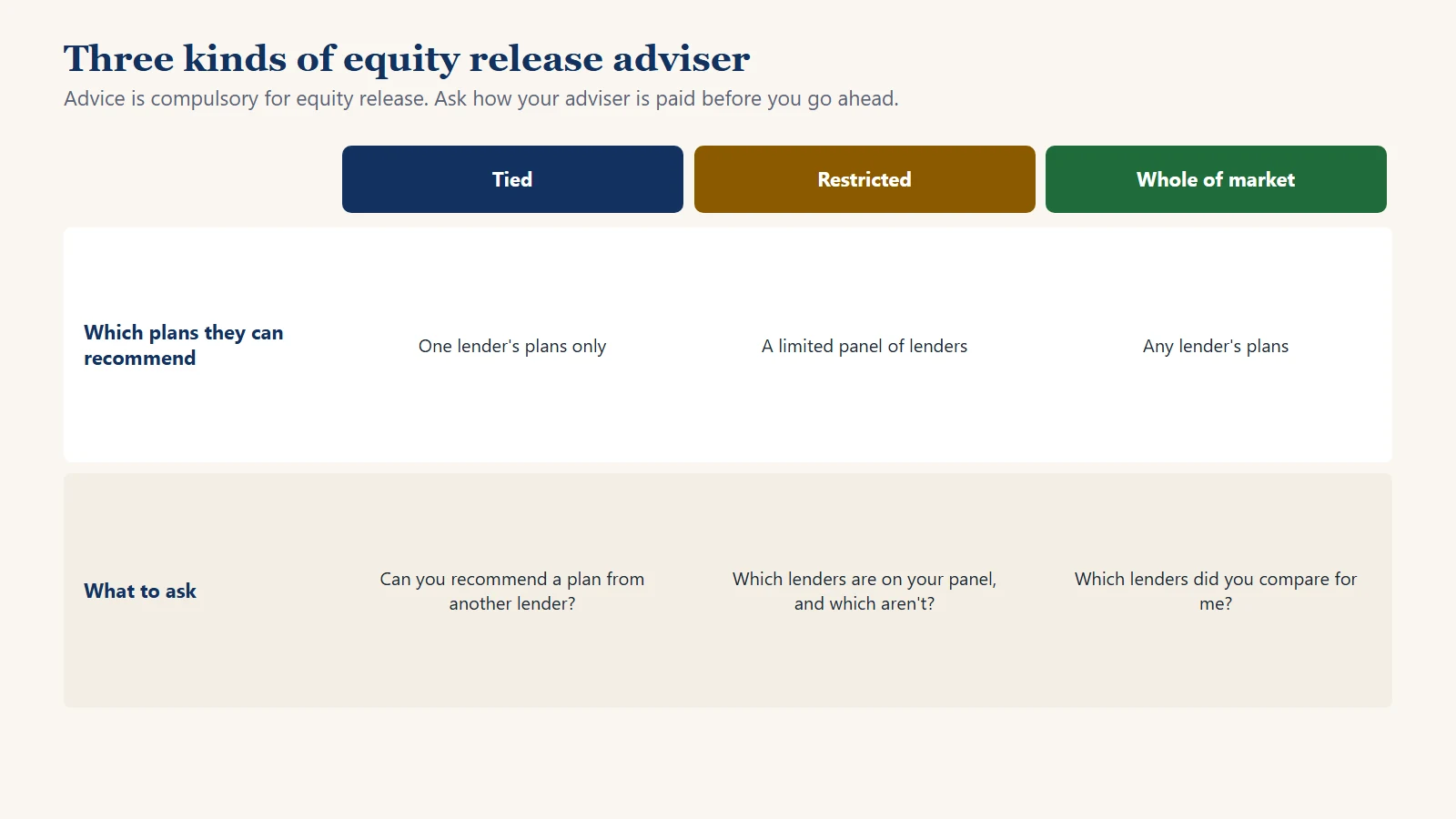
It means the broker can recommend any lender's equity release plan, not one company's or a short list. There are three kinds of adviser:
| Type of adviser | What they can recommend | What to ask |
|---|---|---|
| Tied (often the lender's own advice line) | One lender's plans only | "Can you recommend a plan from another lender?" |
| Restricted | Plans from a limited panel of lenders | "Which lenders are on your panel, and which aren't?" |
| Whole of market | Any lender's plans | "Which lenders did you compare for me?" |
It matters because lenders differ on the things that decide a case, and the headline rate is only one of them:
| Where lenders differ | Why it matters to you |
|---|---|
| Interest rate | A lower rate means less compounding over the years |
| How much they'll lend at your age | The same home can borrow noticeably different amounts with different lenders |
| Property types they accept | Flats, leasehold, non-standard construction and some locations narrow the choice |
| Health and lifestyle questions | Some lenders offer more for medical conditions; see enhanced lifetime mortgages |
| Drawdown facility | Taking money in stages means interest runs only on what you've taken |
| Early repayment charges | How long they last and how they're worked out varies a lot |
| Voluntary repayments and paying interest | Some plans are more flexible than others |
| Inheritance protection | Some let you ring-fence part of the home's value |
The lenders shown on my site include Aviva, Canada Life, Just, Legal & General, LiveMore, LV=, more2life, Pure Retirement, Royal London and Standard Life Home Finance, and being whole of market I'm not limited to them. How to judge the lenders themselves is on my page about the best equity release companies.
Why isn't the cheapest rate always the best plan?
Because a plan you can't use properly costs more in the end. A slightly lower rate with an early repayment charge that runs for 15 years can be the wrong choice for someone who might move or repay in five. A plan without drawdown can cost more than a dearer one with it, if you'd only need half the money now. I'll show you why the plan I recommend beat the cheaper ones, in writing.
How much does an equity release broker charge?
It varies, and any broker should tell you how they're paid before you go ahead. Echo Finance puts it plainly: some advisers charge a fixed fee, while others charge a percentage of the amount released. On top of that, lenders pay brokers a commission when a plan completes; Aviva, for example, says that if you go to it directly you won't pay a separate advice fee and it pays the adviser commission on completion instead. The main ways it's done:
| How the broker is paid | What to check |
|---|---|
| A fixed fee | When it's due, and whether you pay anything if the plan doesn't complete |
| A percentage of the amount released | What that comes to on your figure; the more you borrow, the more it costs |
| Commission from the lender only ("fee free") | Whether the broker is whole of market, and what the commission is |
| A fee plus commission | Both figures, in writing, before you apply |
Here's how I work. The first conversation is free. There's nothing to pay me unless your plan completes. My fee is fixed, not a percentage, so it doesn't rise with what you borrow, it can be taken from the money released, and it covers you for the life of the plan, so if you need help with it years later there's no new charge. I'll tell you the figure on the phone. You'll also have the lender's valuation and your solicitor's costs, and I'll set those out before you decide anything.
What will an equity release broker ask you?
Everything that changes the answer. These are the areas I cover at the first meeting, and why each one matters:
Your age, and your partner's
The age of the youngest borrower sets how much a lender will release: typically 25% to 28% of the home's value at 55, 40% to 43% at 70 and 50% to 57% from 80, on my equity release calculator. On a joint plan both of you need to be at least 55.
Your home
Its value, its construction, whether it's leasehold or freehold and where it is, because lenders accept different properties. A home worth less than a lender's minimum, or built in an unusual way, can rule some lenders out before rates come into it.
How much you need, and when
Borrowing more than you need means paying interest on money sitting in the bank. If you'll need more later, a drawdown plan can hold it in reserve instead.
Any mortgage or loan secured on the home
It has to be paid off from the money released, so it sets the minimum the plan has to provide.
Your health and lifestyle
Some conditions, and smoking, can mean a bigger release or a better rate with some lenders. I ask so the right lender is picked first time.
Your income, savings and benefits
Money released and kept in the bank can reduce means-tested benefits, so I check what you receive before deciding how much to take and when. Your income also tells me whether a cheaper route, such as a retirement interest-only mortgage, could work.
Your family and what you want to leave
Equity release reduces what you leave, and anyone living with you who isn't on the plan may have to sign a waiver. I'd always rather your family were in the room, or on the phone.
Whether you might move
Plans meeting Equity Release Council standards can move with you to a suitable home, but rules on where and what you can move to differ by lender.
Will a good equity release broker tell you not to go ahead?
Yes, and often. Aviva says it only suggests a lifetime mortgage for around a quarter of the people it speaks to, which tells you how often the honest answer is no. Mine has been on this site for years: if equity release isn't the right choice, I'll say so. Sometimes it's a remortgage your income could carry, which my colleagues at Pellucid arrange. Sometimes it's downsizing, or waiting a few years until you can release enough. Sometimes the need just goes away. One family I was helping no longer needed the money once probate came through, so I cancelled the application with no cancellation fee; the grandson wrote about it in his Google review. I don't arrange home reversion at all, because it doesn't fit how I want to work.
How do you check an equity release broker before you call?
Look the firm and the adviser up on the FCA register, check the adviser is a member of the Equity Release Council, ask whether they're whole of market and how they're paid, and read their reviews in full rather than the star rating. For me that's Pellucid Ltd, FRN 981845, and Jeremy Furnell, reference JLF01060, on the FCA register, and my entry in the Council's adviser directory. Each check, step by step, with what a good and a bad answer sound like, is on my page about how to find a trustworthy equity release adviser.
Should you choose a local equity release broker or a national one?
It depends how you want to be advised. Some national firms advise mostly by phone or video, from an office. A local broker can come to your home, which a lot of people in their seventies and eighties prefer, especially when family want to sit in. I cover Cambridgeshire, Norfolk, Suffolk, south Lincolnshire and Northamptonshire, within about 70 to 80 miles of March, and I'll travel further when a case needs it. Most people start with a phone call; after that it's a visit to your home, or the phone if you'd rather, and video only if you prefer it. My Equity Release Council listing promises one local point of contact throughout, with no call centres or administrators, and that's how it works. The towns I cover are on my where I work page.
In my experience the national firms prefer the bigger cases. A lot of mine are £70,000 to £80,000, and some are as small as £15,000. If you need a modest sum, that's no reason for anyone to give your case less time.
What happens after you call an equity release broker?
On my cases it goes like this. You can pause or stop at any point before completion.
Step 1: a free phone call
We talk through what the money is for, roughly what the home is worth, what's owed on it and your age. That's usually enough for me to tell you whether equity release is realistic, and if it plainly isn't, I'll say so on that call.
Step 2: a meeting at your home
I go through the fact find with you, and with family if you'd like them there, and we look at the alternatives properly. Nothing is signed at this meeting unless you want to go further.
Step 3: research and a written recommendation
I compare the market for your circumstances and send you a recommendation with an illustration from the lender: the rate, the fees, what you'll owe over time and any early repayment charges. There's no deadline to decide.
Step 4: the application
If you go ahead, I complete the application with you. I'm happy to fill in the forms with you at your kitchen table.
Step 5: the valuation and the offer
The lender sends a surveyor to value the home, then issues an offer. If the valuation comes in lower than expected, I'll go through the new figures with you before anything goes further.
Step 6: independent legal advice
Your solicitor explains the plan and its terms, which the Equity Release Council requires before you can sign. I can recommend a solicitor who does equity release day in, day out; the choice stays yours, but a firm that rarely does it is the most common cause of delay I see.
Step 7: completion, and afterwards
The money is released, any existing mortgage is cleared from it, and the rest comes to you. After that I'm still your adviser for the life of the plan. How long the whole thing usually takes is on my page how long does equity release take?
What protections come with a plan arranged through an Equity Release Council member?
Plans that meet the Council's standards must give you:
| Protection | What it means |
|---|---|
| A home for life | You can live in the home for the rest of your life, or until you move into long-term care, as long as it stays your main residence and you keep to the terms |
| The right to move | You can move to a suitable property and take the plan with you, subject to the lender's criteria |
| No negative equity guarantee | You or your estate will never owe more than the home is worth after reasonable sale costs |
| Repayments without charges | You can make repayments without a charge, within the lender's criteria |
| A rate fixed or capped for life | The rate can't rise beyond what you agreed |
| Independent legal advice | Your own solicitor explains the plan before you commit |
What the standards don't do is make equity release cheap. Interest compounds unless you pay it, the plan reduces what you leave, a lump sum can affect means-tested benefits, and repaying the whole plan early can bring an early repayment charge.
FAQ
Are there fee-free equity release brokers?
Can you release 100% of your home's value?
What is the cheapest way to get equity out of a house?
Who is the best equity release provider in the UK?
Do you arrange retirement interest-only mortgages as well?
Which equity release companies should you avoid?
Final thoughts from me
What I'd want anyone choosing a broker to know:
- Equity release needs advice before you can take it, so the real question is who gives it.
- Whole of market means the broker can recommend any lender's plan, not one company's.
- The cheapest rate isn't always the best plan; early repayment charges, drawdown and criteria matter too.
- Ask how the broker is paid before you go ahead: fixed fee, percentage or commission.
- A good broker checks the alternatives first and will tell you when not to go ahead.
- With me, the first conversation is free and it's me from the first call to completion.
Book your free initial consultation today.
Pick up the phone and speak to Jeremy directly. If equity release is not the right choice, I will say so.
07768 972861 Or try the quick calculator