
Home › Equity release › Equity release for elderly parents
Equity release advice for elderly parents: how can you help them decide?
If you're looking for equity release advice for an elderly parent, you're in the right place. Three of my six Google reviews were written by a son, daughter or grandchild rather than by the person I advised, so I know it's often you reading this, not them.

- On the FCA register, reference JLF01060 check the register
- Pellucid Ltd, FCA number 981845 check
- Equity Release Council member my profile
- SOLLA Later Life Lending Advice Standard
Quick answer: how can you help an elderly parent with equity release?
Be there. Sit in on the meetings, ask what the money is for and whether a cheaper route would do, check the cost and who else lives in the house, and make sure your parent understands the plan. The decision stays theirs, and their own solicitor must advise them first.
Why speak to Jeremy about equity release for a parent?
Because I'd rather you were in the room. My Equity Release Council profile says family members or friends are welcome at meetings, and I mean it. The people who complain about equity release are rarely the ones who took it out. It's the children, when the inheritance turns out smaller than they'd hoped. So I ask for you: at the meeting, on the phone, or copied in on my emails, with your parent's agreement.
I've specialised in later-life lending since 2009, I hold CeMAP, CERT CII (ER) and the SOLLA Later Life Lending Advice Standard, and it's me from the first call to completion. I also write wills and lasting powers of attorney myself. Trusted Equity Release is a trading name of Pellucid Ltd, authorised and regulated by the Financial Conduct Authority, FRN 981845.
“Had the pleasure of dealing with Jeremy on behalf of my mum for equity release on her home - if you want someone you can genuinely trust then don't go anywhere else! Jeremy is probably the most honest and genuine advisor that you will come across.”
Should you be involved in your parent's equity release decision?
Yes, as long as you remember whose decision it is. It's your parent's home, their money and their contract, and they sign it, not you. What you can do is make sure they've asked the right questions, heard the downsides and aren't being rushed. The law builds in two professionals to check the same things: a qualified adviser, who has to look at the alternatives and put the recommendation in writing, and their own solicitor, who explains the plan to them before anything completes.
The hardest part is often raising it. I'd suggest starting with what your parent wants the money for, not with the inheritance. If the answer is a new boiler and a holiday, the conversation about whether a lifetime mortgage is the right tool is much easier than one that starts with what you'll be left.
What should you check before a parent takes equity release?
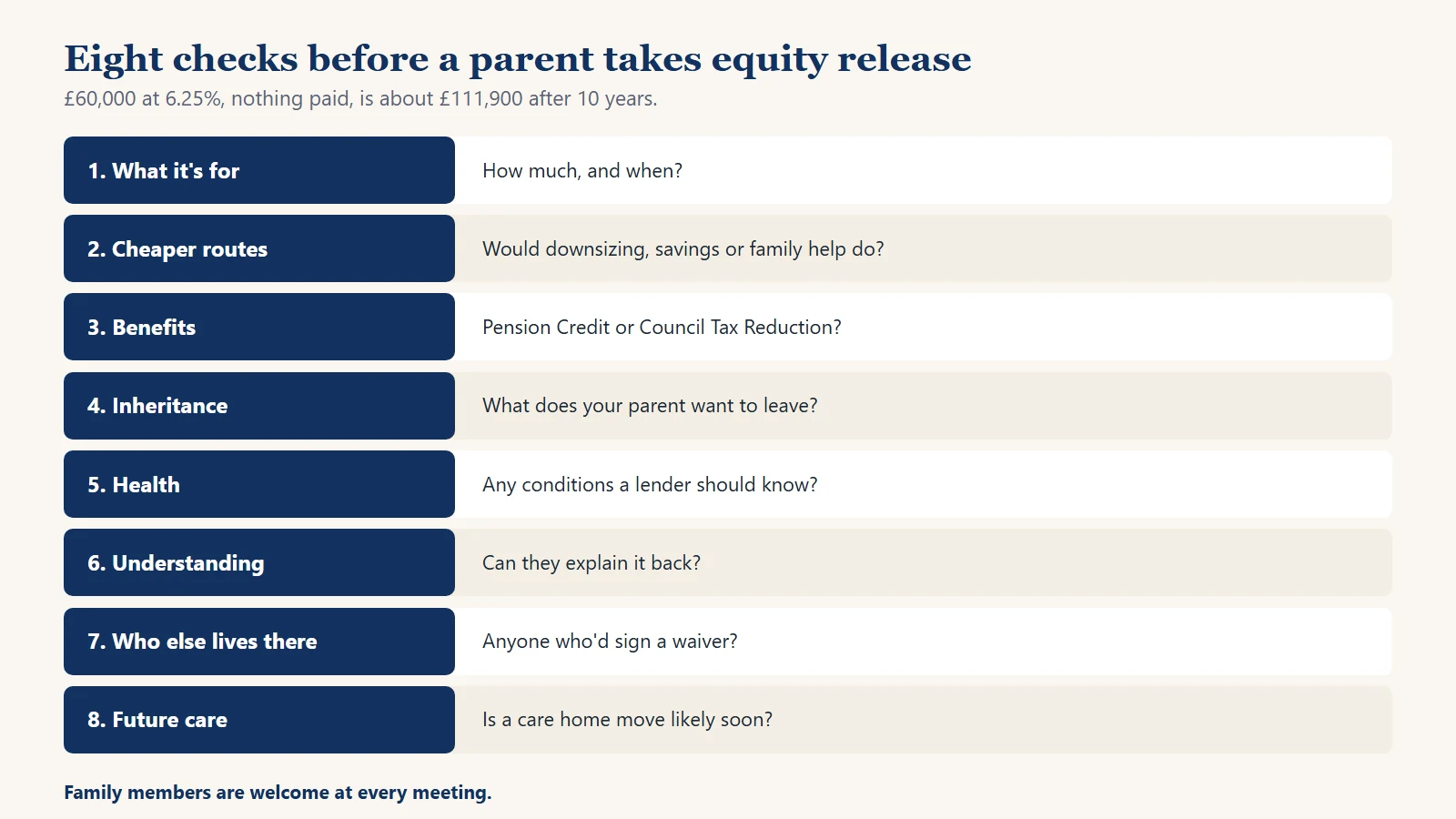
Eight things. I go through every one of them with the family before I recommend anything:
| Check | The question to ask | Why it matters |
|---|---|---|
| What the money is for | How much is actually needed, and when? | Borrowing less, or drawing it as needed, keeps the interest down |
| Cheaper routes | Would downsizing, savings or family help do the job? | Equity release is rarely the cheapest money |
| Benefits | Does your parent get Pension Credit or Council Tax Reduction? | A lump sum can reduce or stop means-tested benefits |
| Inheritance | What does your parent want to leave, and to whom? | Unpaid interest compounds, so the estate shrinks |
| Health | Any conditions a lender should know about? | Some health conditions let a lender release more |
| Understanding | Can your parent explain the plan back in their own words? | They must understand it and sign it themselves |
| Who else lives there | Is anyone else living in the house, or likely to? | Other adults usually have to sign a waiver |
| Future care | Is a move into a care home likely soon? | The plan is repaid when they move into long-term care |
Is equity release expensive for an older parent?
It costs more than most people expect, because interest is charged on interest, though an older borrower's plan usually runs for fewer years. These figures are for £60,000 at 6.25% a year, compounded monthly, from my equity release calculator:
| Years the plan runs | What's owed if nothing is paid | What's owed if the interest is paid monthly |
|---|---|---|
| 5 | about £81,900 | £60,000 |
| 10 | about £111,900 | £60,000 |
| 15 | about £152,800 | £60,000 |
| 20 | about £208,700 | £60,000 |
*Illustrative. Your parent's rate is fixed when the plan starts.*
Paying the interest on £60,000 would cost about £312.50 a month, and paying even part of it slows the growth. A drawdown plan, where your parent takes a smaller first amount and draws the rest only when needed, cuts the cost because interest only runs on what's been drawn. There are set-up costs too: advice, the solicitor, the valuation and a lender's fee. With me, nothing is payable for my advice unless the plan completes, and the fee is fixed, not a percentage.
How much could your parent release at their age?
More than a younger borrower, because the plan is expected to run for fewer years. These are the bands my calculator uses, from lender criteria published in July 2026:
| Age of the youngest homeowner | Typical maximum release |
|---|---|
| 65 | 35% to 38% of the home's value |
| 70 | 40% to 43% |
| 75 | 45% to 49% |
| 80 | 50% to 56% |
| 85 and over | 52% to 57% |
If both your parents are on the deeds, the younger one's age sets the figure. Some health conditions can raise it through an enhanced lifetime mortgage.
Can you get equity release at 80?
Yes. There's no reason to rule it out on age alone, and at 80 the typical maximum is 50% to 56% of the home's value. The same rules on property, any mortgage and who lives there still apply, and so does the cost: interest still compounds, and repaying the whole plan early can bring an early repayment charge.
Can you still inherit your parent's house?
Usually not the house itself, but very often something from it. When the last borrower dies or moves into long-term care, the house is normally sold, the lender is repaid the loan and the rolled-up interest, and what's left goes to the estate. The family can also repay the plan and keep the house, if they'd rather. What happens step by step, and how long you have, is on my page about inheriting a house with equity release.
Two things protect what you inherit. Many plans let your parent ring-fence a percentage of the home's value at the start, which reduces what they can release but guarantees that share for the estate. And paying some interest each month stops the debt growing as fast.
Can the family end up owing more than the house is worth?
No. Every plan from an Equity Release Council member carries the no negative equity guarantee: when the house is sold, neither your parent nor their estate can owe more than the sale raises, even if house prices fall. The debt doesn't pass to you. My page on will my family end up in debt? explains the guarantee in full.
Can your parent give you money from equity release?
Yes. The money is your parent's to spend, and helping family with a deposit, a wedding or school fees is one of the reasons people release it. Three rules follow the money, and I'd want all of you to know them:
| Rule | What it means |
|---|---|
| Inheritance tax on gifts | A gift is free of inheritance tax if your parent lives seven years after making it. Up to £3,000 a year can be given without being added to the estate at all (GOV.UK) |
| Care funding | If your parent gives money away and later needs care, the council may treat it as deliberate deprivation of capital and charge as if they still had it (Age UK) |
| Means-tested benefits | Money released and kept counts as savings, so it can reduce Pension Credit and Council Tax Reduction. Money given away can be treated the same way |
I never sell equity release as an inheritance tax plan. Releasing money to give it away can reduce an estate, but the interest on the loan can cost more than any tax saved. My page on whether you pay tax on equity release goes through gifting in detail.
What if someone else lives with your parent?
Then they'll usually have to sign a waiver. Any adult who isn't a borrower, whether a partner who isn't on the deeds, a lodger or a grown-up son or daughter, is normally asked to give up any right to stay in the house once the plan ends. Age UK says that applies to someone who moves in later, too, for company or to provide care, and that they should get their own legal advice before signing.
If that's you, think it through before your parent applies. When the plan ends, the house will normally be sold, and you'd need somewhere else to live, or the money to repay the loan. Age UK also warns about a single parent who later marries or moves a partner in: the plan may not transfer into joint names, so the partner could have to repay it or leave.
What happens to equity release if your parent needs care?
When the last borrower moves permanently into long-term care, the plan is repaid, normally from the sale of the house. Under the Equity Release Council's standards, the early repayment charge should be waived when that happens, including a move to live with relatives who provide care, once a doctor's certificate is provided.
That's why timing matters. Age UK's view is that if a move into a care home is likely now or soon, equity release may not be suitable, because it's designed to be repaid at exactly that point. It suits care at home better: paying for help, adaptations or a stairlift so your parent can stay put. If your parent already has care at home funded by the council, released money can change what the council charges. The detail is on my page about equity release and care home fees.
Does your parent need mental capacity to take out equity release?
Yes. A lifetime mortgage is your parent's own contract: they have to understand what they're agreeing to and sign it themselves, and their solicitor has to be satisfied of that before anything completes. A son or daughter can't sign on their behalf because they're worried, or because it would be quicker.
If you're concerned about your parent's memory, tell me on the first call. It's far better said early than discovered at the solicitor's office, when everyone's hopes are up.
What if your parent has a lasting power of attorney?
Then it matters what kind, and whether it's registered. A property and financial affairs LPA lets the attorney deal with money and property, but GOV.UK says it can only be used once it's registered with the Office of the Public Guardian, which takes 8 to 10 weeks if there are no mistakes. Age UK notes that lenders may or may not agree to deal with an attorney, so it's one of the first things I check with the lender.
An LPA can only be made while your parent still has capacity. I write wills and lasting powers of attorney myself, and if your parent can still make one, it's worth doing now, whatever happens about equity release.
What if there's no LPA and your parent can't decide?
Then nobody in the family has legal authority over the home. The route is an application to the Court of Protection for someone to become a deputy, who then reports to the Office of the Public Guardian every year. Until the court has appointed a deputy, nobody can agree a plan on your parent's behalf.
How can you sit in on the meetings?
In person, or on the phone, and you don't have to live nearby. Shaun Mizen had contacted two firms in Cambridgeshire for his gran, who had recently lost her husband and wanted to buy a new home while probate dragged on. I met his gran and his mum, and Shaun joined by phone from another county.
I sat with his gran twice. She had a wobble partway through, so we stopped, then started again when she was ready. Within a week of the first visit she had her funding. Then probate came through, she no longer needed the loan, and I cancelled the application with no cancellation fee. She'd also chosen to use her own solicitor, a friend, rather than the specialist I recommend, which made the case harder work; that was her right. Changing her mind cost her nothing.
What if you think your parent is being pressured?
Say so, to me and to their solicitor. Age UK's advice to anyone taking equity release is that if they feel rushed or pushed, or aren't getting straight answers, they should go elsewhere. The protections are there for exactly this. The adviser has to put the recommendation and the reasons in writing, and under the Equity Release Council's standards your parent gets independent legal advice from their own solicitor before the plan can complete.
Pressure can come from a salesperson, and sometimes from inside a family. If I'm not satisfied the decision is your parent's own, I won't recommend it, whoever is asking. It cuts both ways, though. When a family asks me what I'd do, I tell them there's no right and no wrong: it's down to what your parent is happy with.
Are there better options than equity release for your parent?
Often there are, and an adviser has to look at them first. The ones worth checking for an older parent:
| Option | When it fits |
|---|---|
| A full benefits check | Low income: Age UK says many older people are entitled to benefits they don't claim |
| Council or Home Improvement Agency help | The money is for adaptations, such as a stairlift or a walk-in shower |
| Downsizing | Your parent would be happy somewhere smaller and easier to run |
| Savings or investments | The sum is modest and there's money set aside |
| Help from the family | You can lend or give, and everyone's clear which it is |
| A retirement interest-only mortgage | Your parent's pension covers the monthly interest |
Each one is weighed up on my page about alternatives to equity release.
FAQ
What is the bad side of equity release?
Is equity release a con for older people?
Can the family pay off a parent's equity release early?
Do I need to be at my parent's equity release meetings?
Final thoughts from me
If you take a few things from this page into the conversation with your parent:
- You're welcome at every meeting, in person or on the phone, but the decision is theirs.
- Check what the money is for, the cheaper routes, benefits, inheritance, health and who else lives there.
- Unpaid interest compounds: £60,000 at 6.25% becomes about £111,900 in ten years.
- Gifts from released money follow the seven-year inheritance tax rule and can affect future care funding.
- If a care home move is likely soon, equity release may not be the right tool.
- A registered lasting power of attorney matters, and it can only be made while your parent has capacity.
Book your free initial consultation today.
Pick up the phone and speak to Jeremy directly. If equity release is not the right choice, I will say so.
07768 972861 Or try the quick calculator